Back
Copy
Share
Like

place
63 Building: A Seoul Icon Returns to the Spotlight
63 Building: A Seoul Icon Returns to the Spotlight
63 Building: A Seoul Icon Returns to the Spotlight
With one of the world's top three contemporary art museums as its anchor, alongside brands making their first entry into Korea and highly curated F&B concepts, the 63 Building builds an entirely different retail experience upon its 40-year heritage. From its new exterior resembling a traditional moon jar to the observation deck reopening after 16 years, the space has been completely rewritten while keeping memories intact.
With one of the world's top three contemporary art museums as its anchor, alongside brands making their first entry into Korea and highly curated F&B concepts, the 63 Building builds an entirely different retail experience upon its 40-year heritage. From its new exterior resembling a traditional moon jar to the observation deck reopening after 16 years, the space has been completely rewritten while keeping memories intact.
With one of the world's top three contemporary art museums as its anchor, alongside brands making their first entry into Korea and highly curated F&B concepts, the 63 Building builds an entirely different retail experience upon its 40-year heritage. From its new exterior resembling a traditional moon jar to the observation deck reopening after 16 years, the space has been completely rewritten while keeping memories intact.
Article Highlights
The world's third Centre Pompidou branch converges a moon jar exterior with Korean artist-centered retail.
It defines a unique, museum-grade commercial destination rather than competing with large fashion malls.
Preserving the observatory and collective memory while adding digital/AI experiences forms the project's core.
That observatory we first climbed as children on our school trips. The place where we first realized how vast Seoul was while looking down at the sunset over the Han River. An afternoon from our childhood when we stood glued to the aquarium tank, not moving for the longest time. The 63 Building has long been a place of our memories. Regardless of the generation, if you are from Seoul, you probably have at least one story woven together with this building.
That space has now, once again, stood at a starting point.
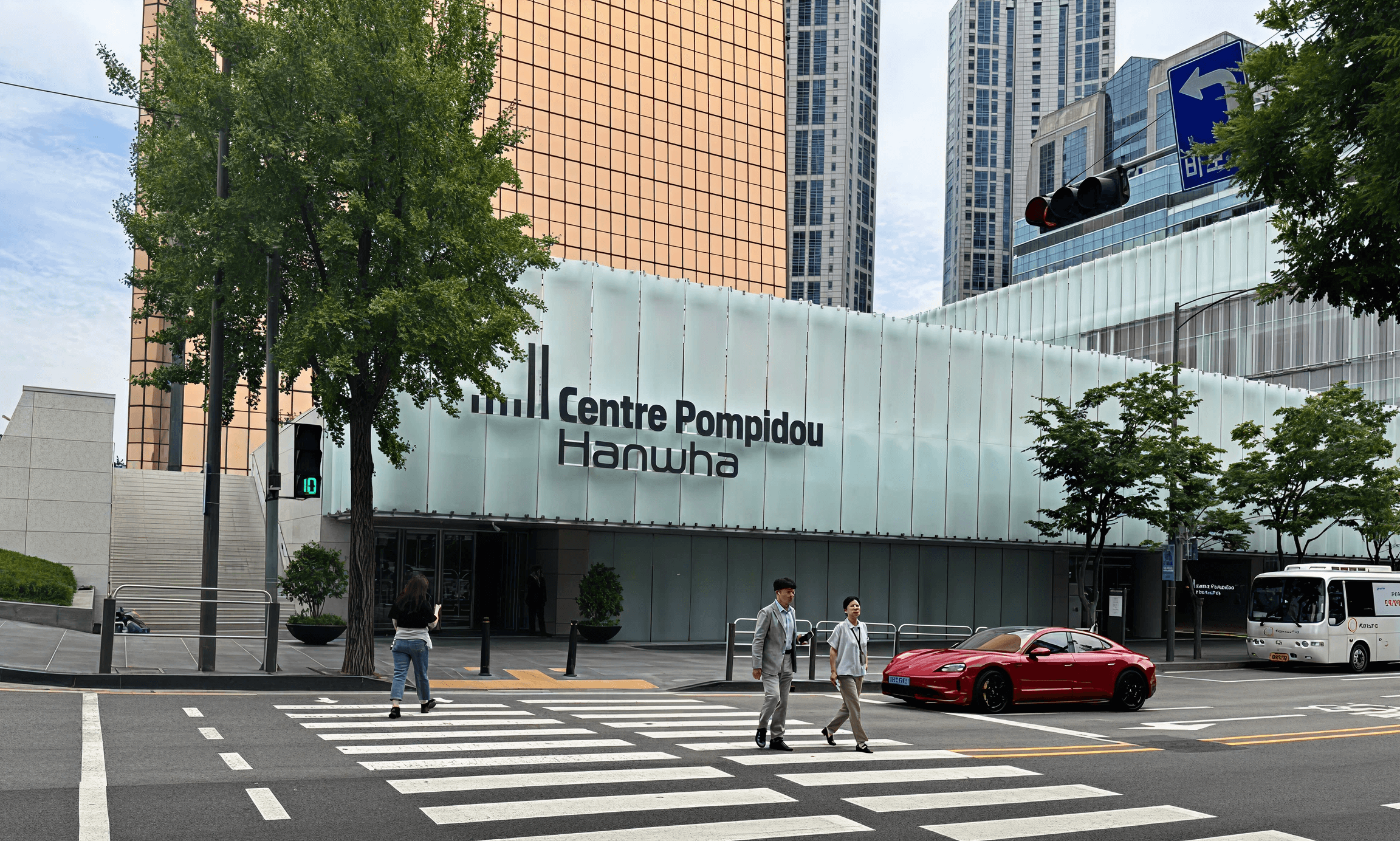
The Journey of Pompidou to Yeouido
At the time of its completion in 1985, the 63 Building was the tallest skyscraper in South Korea. Its golden glass exterior was the symbol of the Han River skyline, and the route leading from the observatory to the aquarium and the buffet was, in itself, a signature Seoul landmark package. However, the city moved quickly. New landmarks went up in Gangnam and Jamsil, and The Hyundai Seoul and IFC Mall created a new axis of gravity even within Yeouido. The 63 Building was gradually pushed back into the category of an 'old space'.
As the city changed rapidly and new spaces continued to emerge, the time approached for the 63 Building to transform once again as a landmark, and the catalyst for that transition was the partnership with the Centre Pompidou. Opening on June 4, 2026, Centre Pompidou Hanwha is the third international branch showcased globally by the Centre Pompidou in Paris, following Malaga, Spain, and Shanghai, China. One of the world's three major modern art museums, housing masters of 20th-century modern art such as Picasso, Chagall, and Braque, has taken root in Yeouido, Seoul.
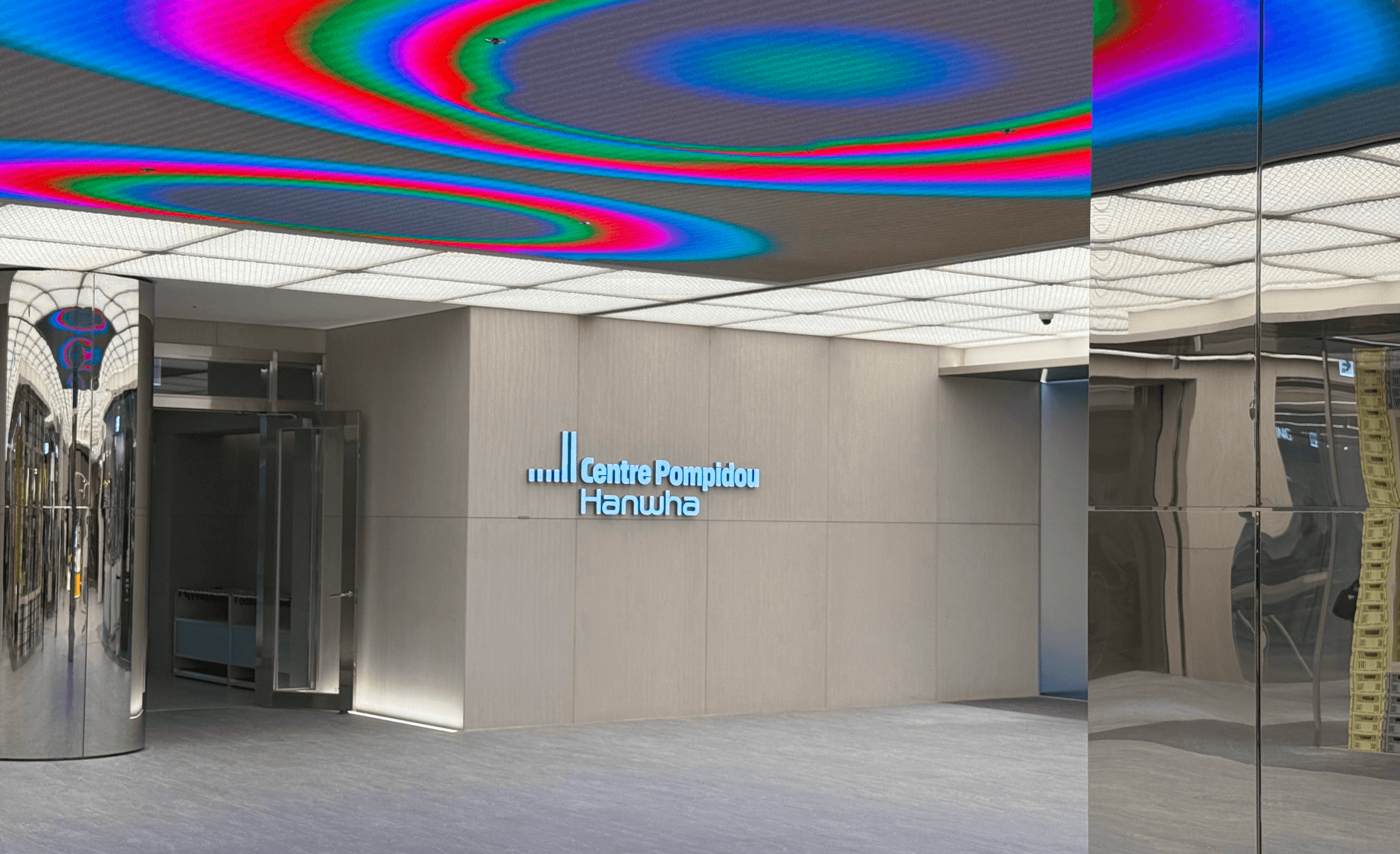
An Unprecedented Space
Architect Jean-Michel Wilmotte, who took charge of the space design, defined this building as a 'Light Box'. During the day, natural light seeps deep into the interior through the glass facade, and at night, light spills out of the building to illuminate the Han River. The exterior, composed of 80cm glass modules, absorbs and reflects the surrounding landscape, becoming an objet d'art in its own right.
Looking not just at the design but the composition of the space itself, such a combination of spaces is rare globally. Deputy General Manager Lee Choong-heon shared, "It's usually one of the two — either a gift shop inside an art museum, or an exhibition space partially located in a large shopping mall. It is hard to find a case like ours globally, where an independent art museum is combined with a commercial facility of this scale." He explains that the format in which the museum and retail coexist in equal scale is, in itself, a new typology. Consequently, this also means there are no prior precedents to reference.
This very point was what Deputy General Manager Lee Choong-heon picked as his biggest concern. "Seoul's trends move faster than any other city in the world, and trying to respond to customers who constantly demand something new must be a concern for all commercial facility operations," he answered, yet he did not look for the solution in 'the speed of novelty'. "We think we should go in the direction of being a space where people can consume the sensibility of art and culture, continuously creating our own content." Instead of chasing trends, they chose to maintain a certain high-quality standard, completing preparations to welcome visitors who will return home with new memories of 63.
A Select Shop Cluster and % Arabica Only at 63 (Culture Street)
The commercial facilities, entirely restructured alongside the museum, completely discarded the grammar of traditional office arcades. The commercial space, spanning a total gross floor area of about 11,500 square meters, did not position itself to compete directly with IFC Mall or The Hyundai Seoul from the beginning. Deputy General Manager Lee Choong-heon drew a clear line. "The biggest thought was that we had to differentiate ourselves with our own unique content."
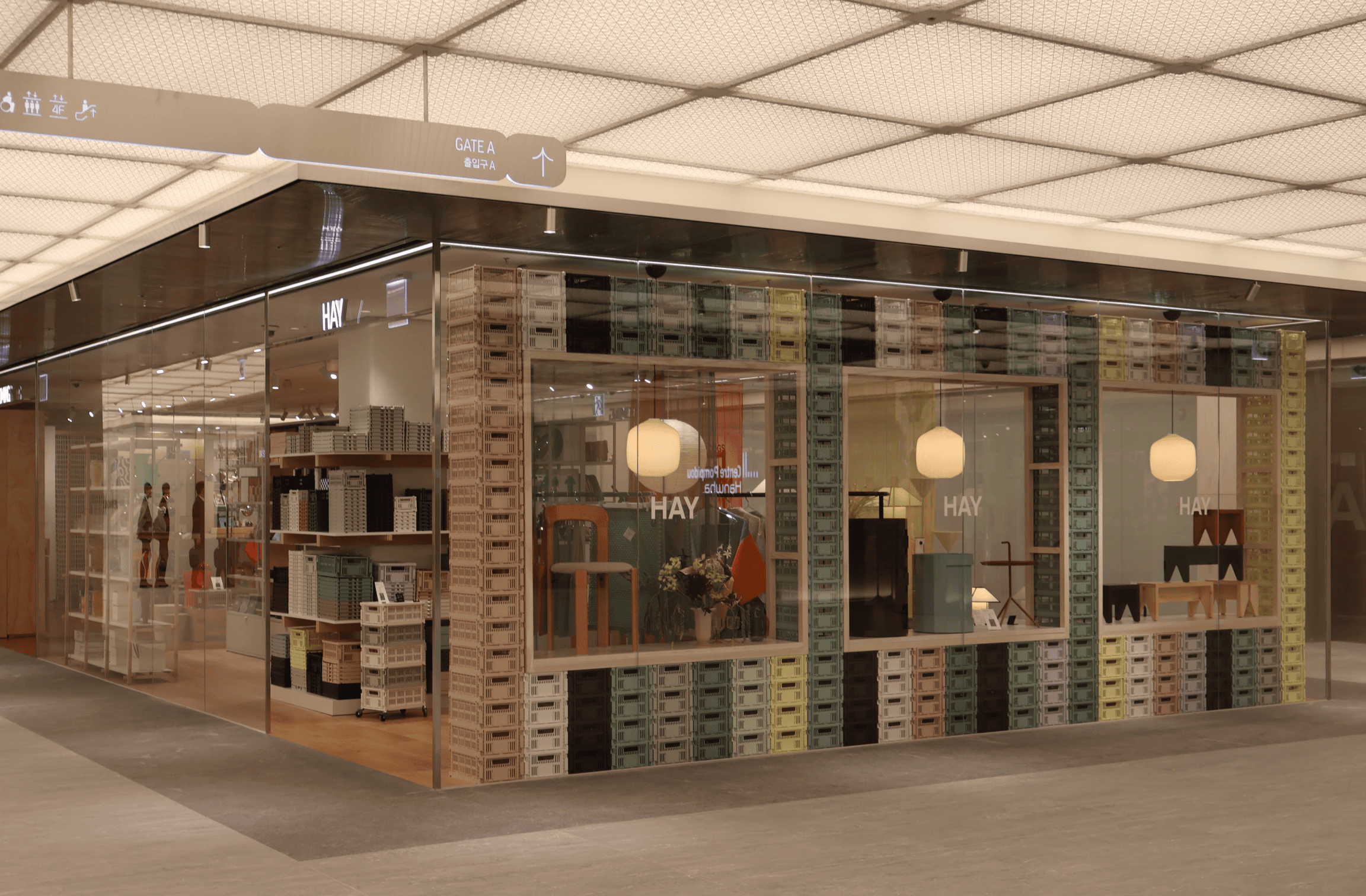
The resulting retail space resembles 'one massive select shop' where individual boutique shops are tied together under one cohesive concept. Rooming & HAY, a global design brand with a Nordic sensibility; LOPA Seoul, a subculture-based select shop; the first offline store of Hand to Home, which distributes works of rising domestic and international artists online and offline; Present Moment Hoho, a gift curation shop; and Poses, which houses postcards from 300 artists in a library format. While each brand is independent, packing them together shapes a cultural and artistic consumption ecosystem linkable to the Pompidou.
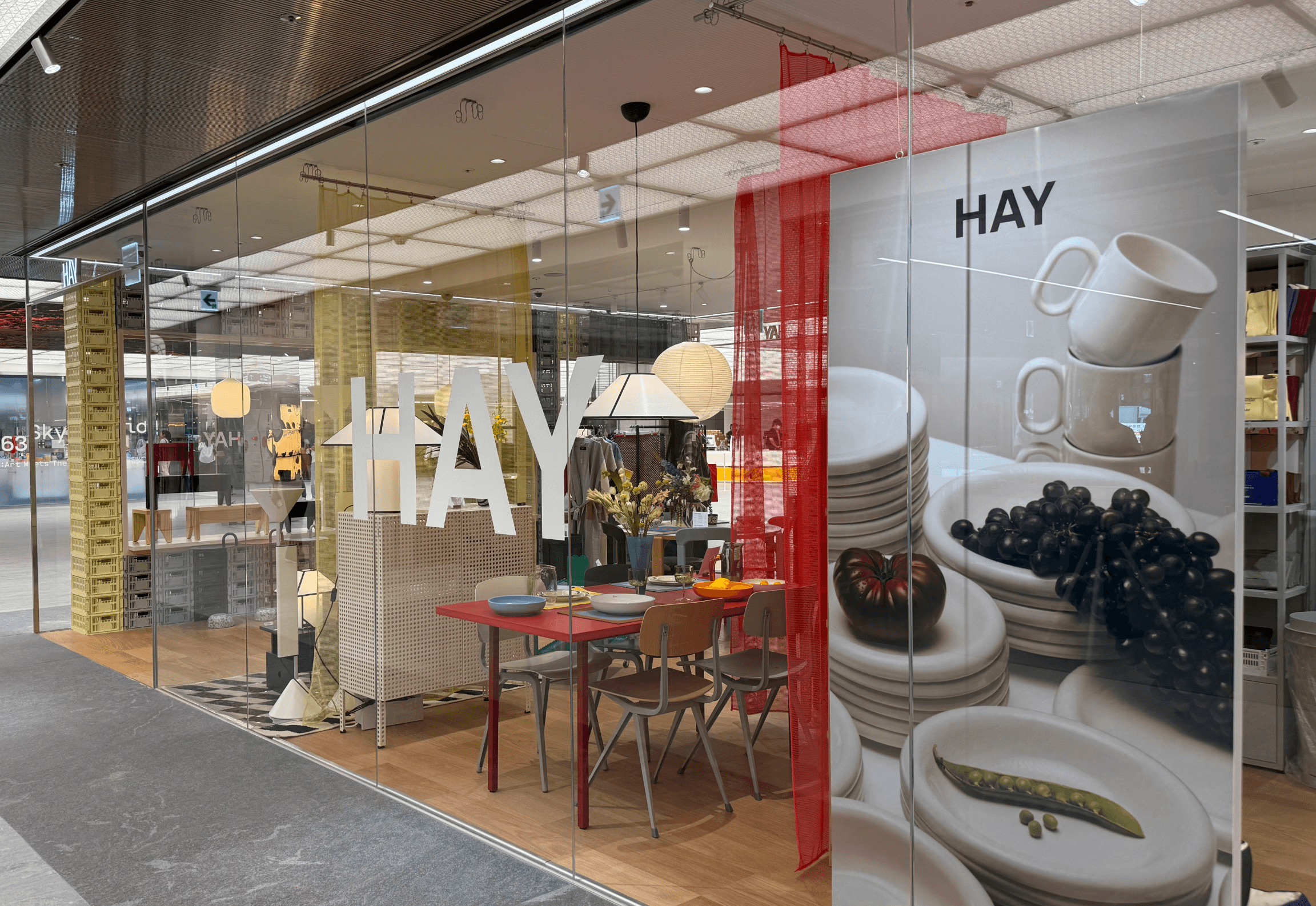
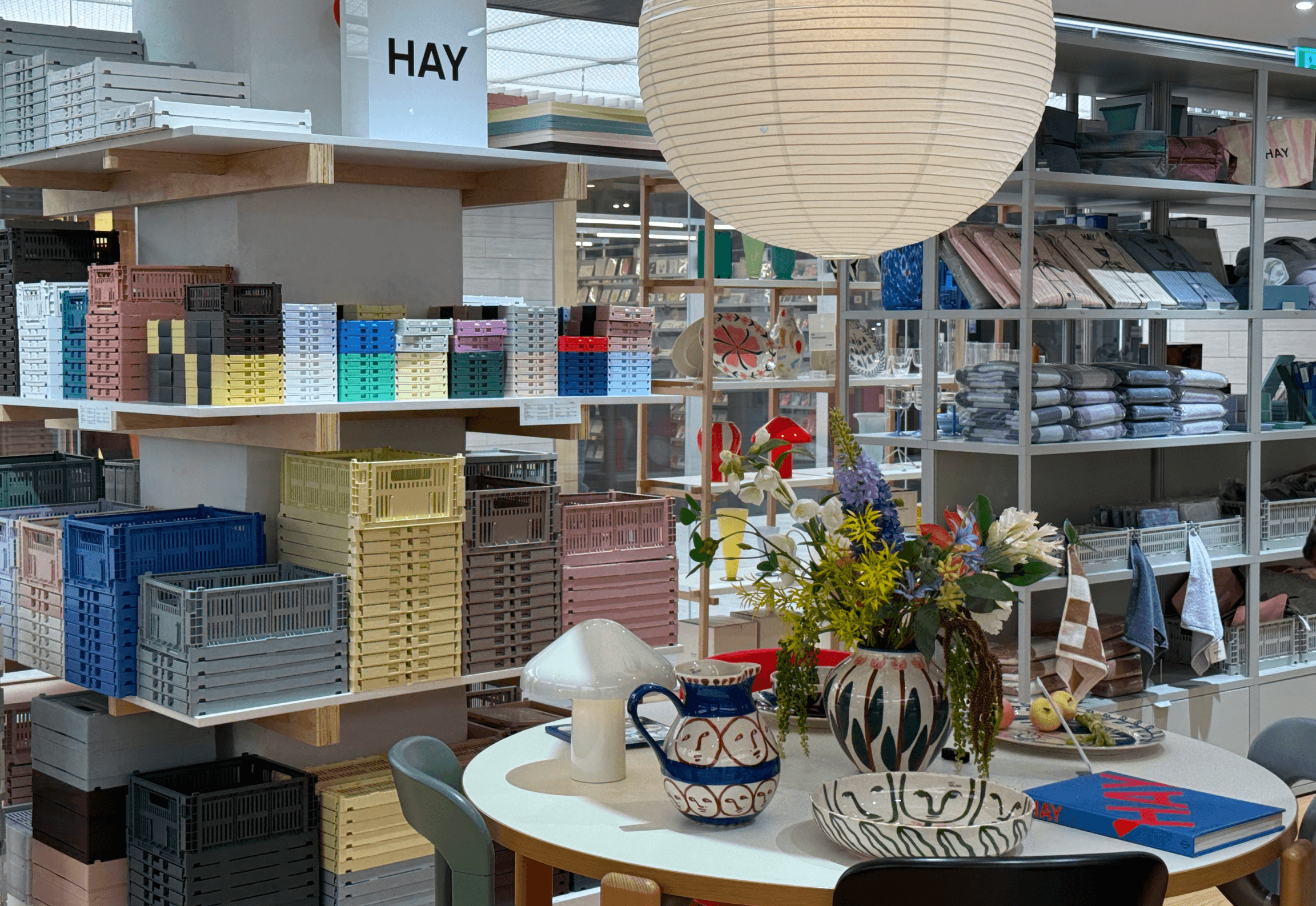
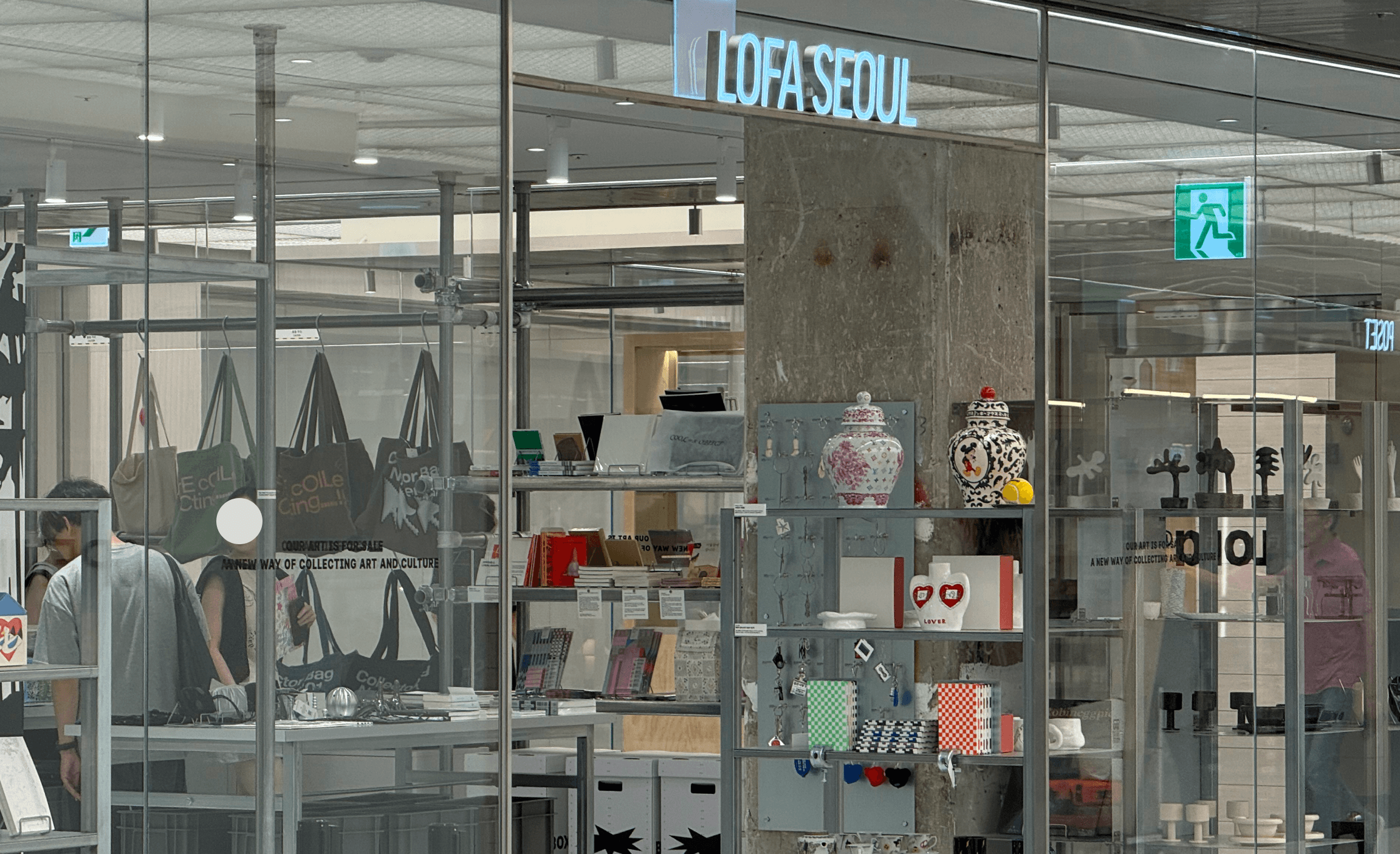
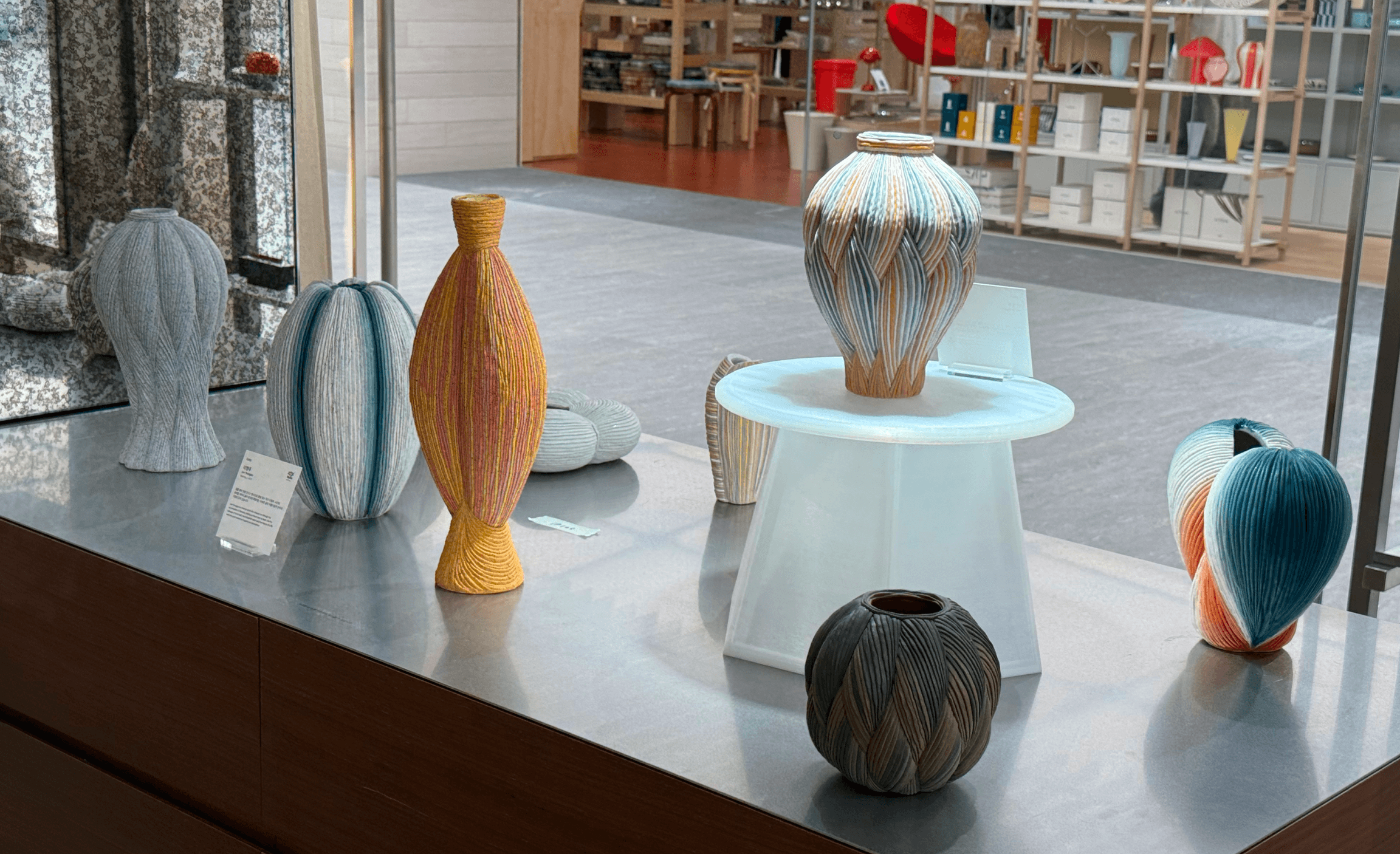
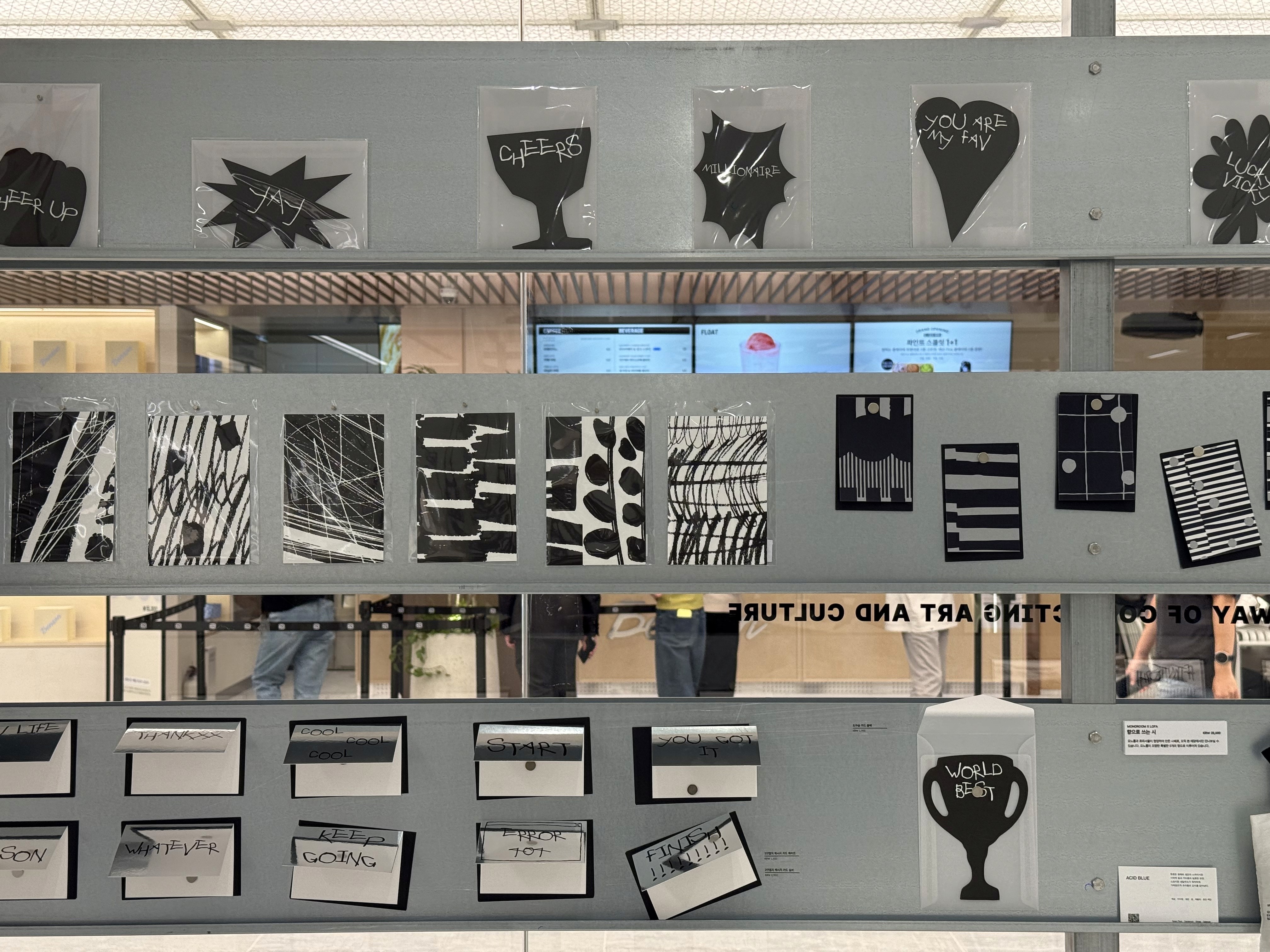
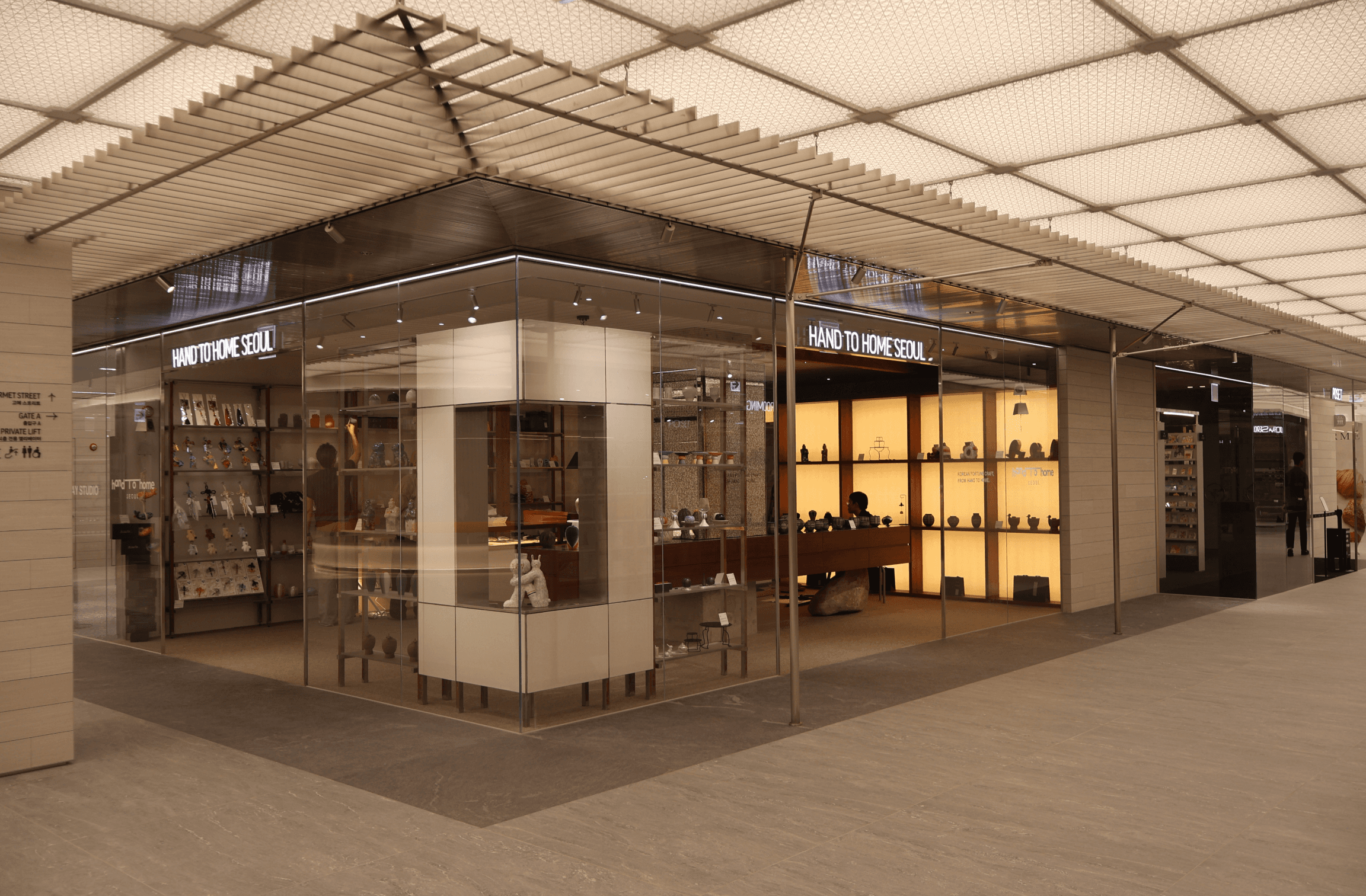
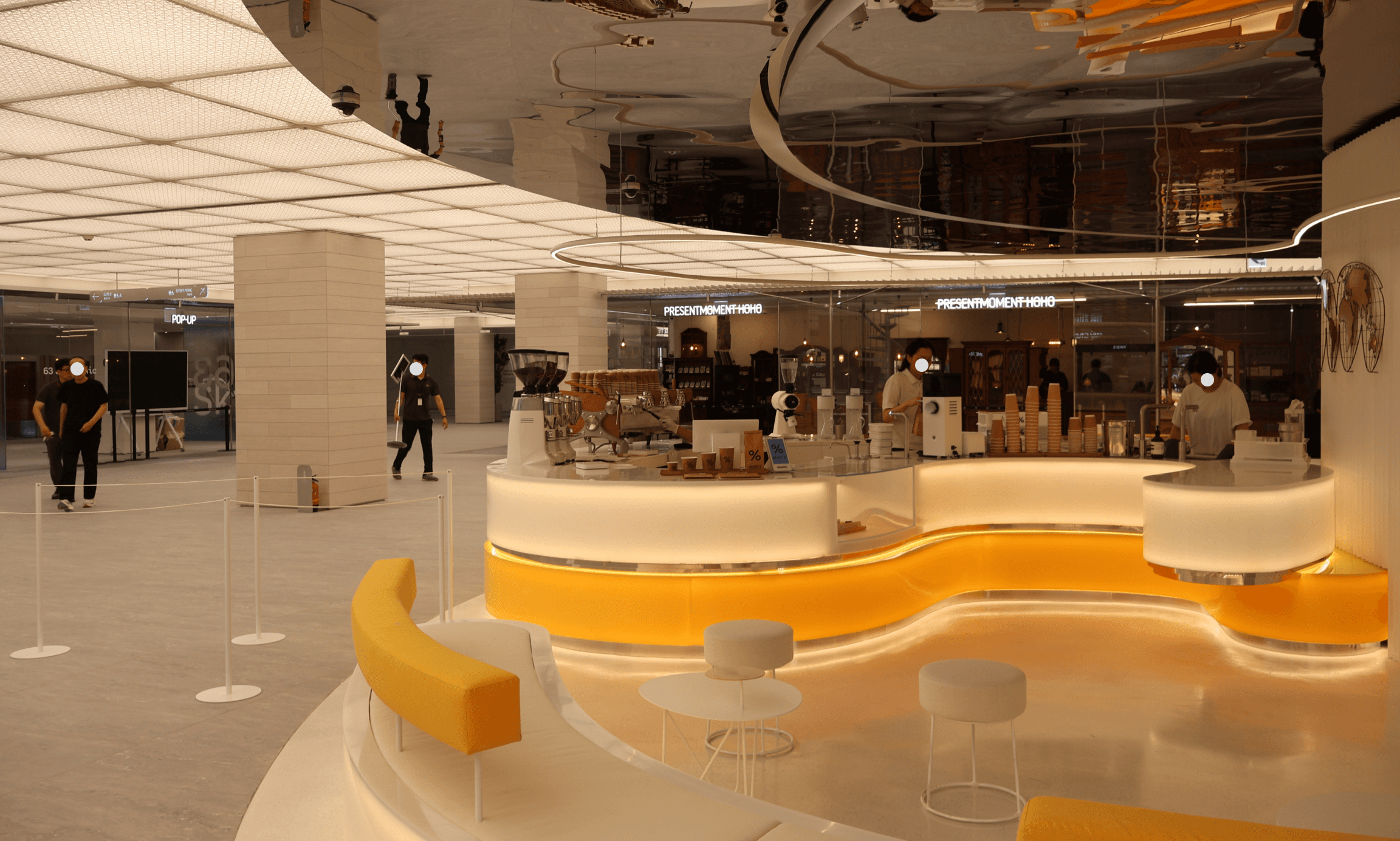
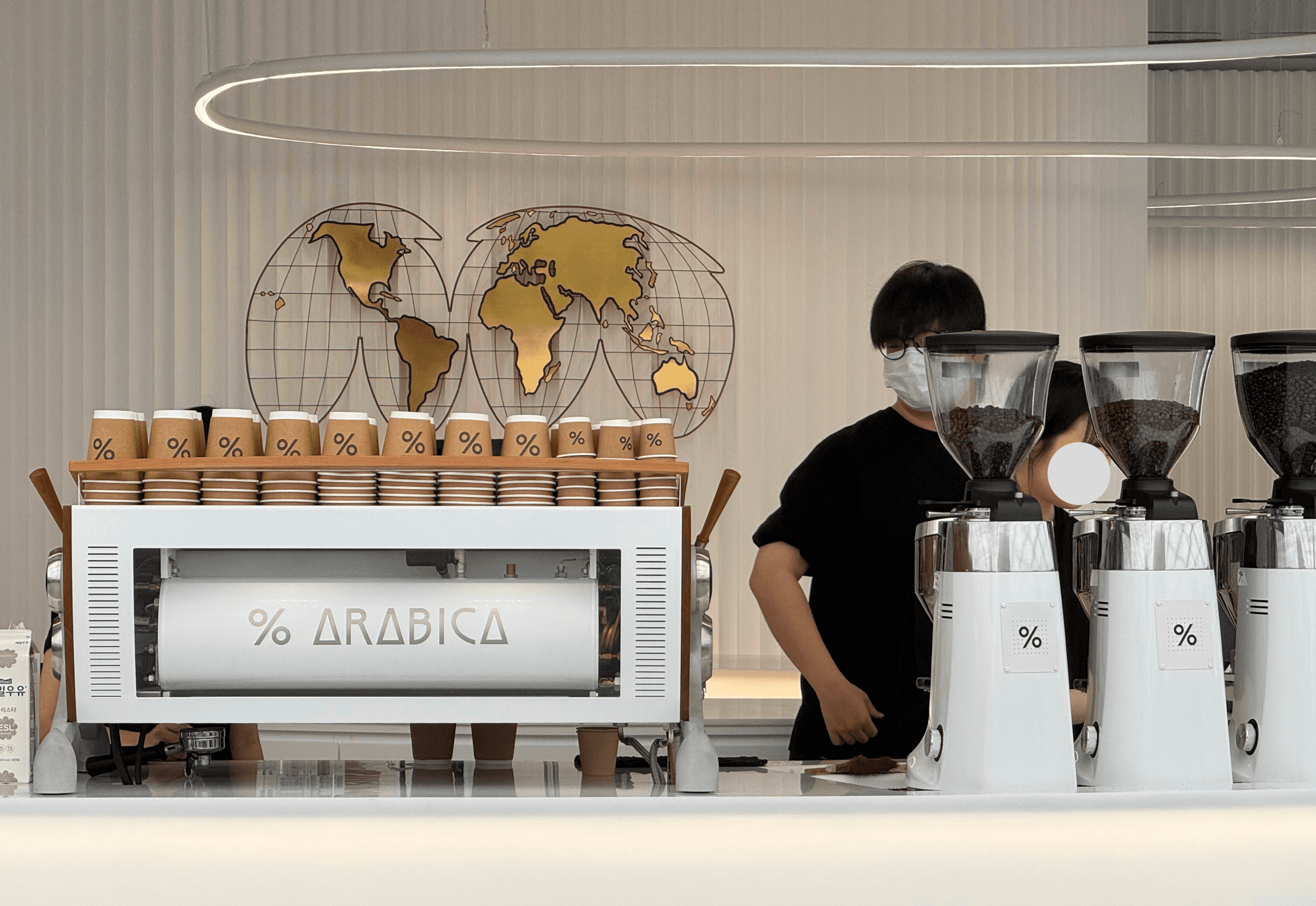
Right in the center sits % Arabica Coffee, designed in collaboration with Spanish architects Selgascano. It was the first brand Deputy General Manager Lee Choong-heon had in mind when planning this project. "The coffee market already has so many diverse and excellent brands, but I couldn't think of any brand other than % Arabica that fits so perfectly with these cultural elements." Completed in collaboration with the architects, the Arabica space functions as a commercial lounge and simultaneously serves as a prelude leading to the museum.
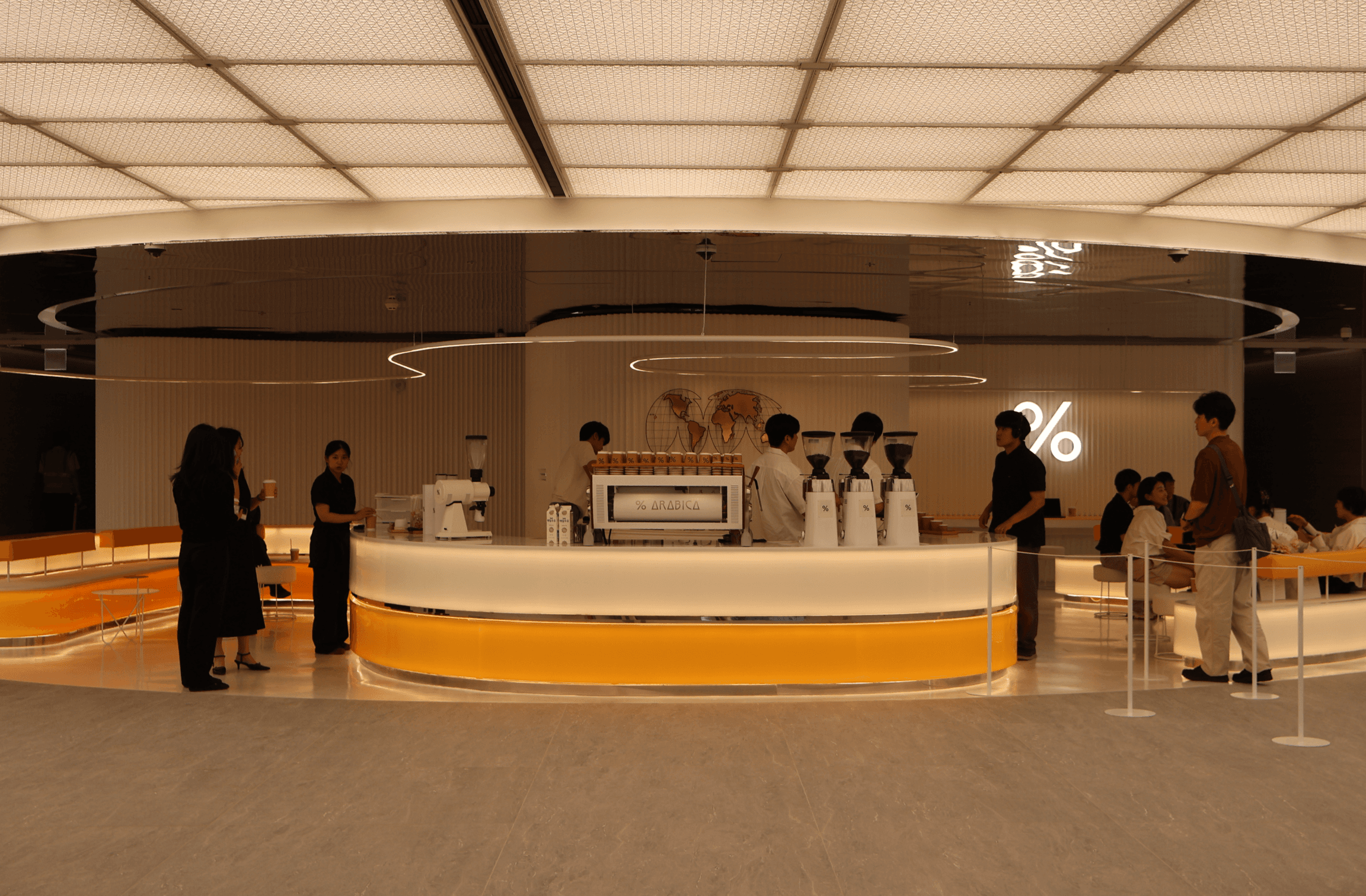
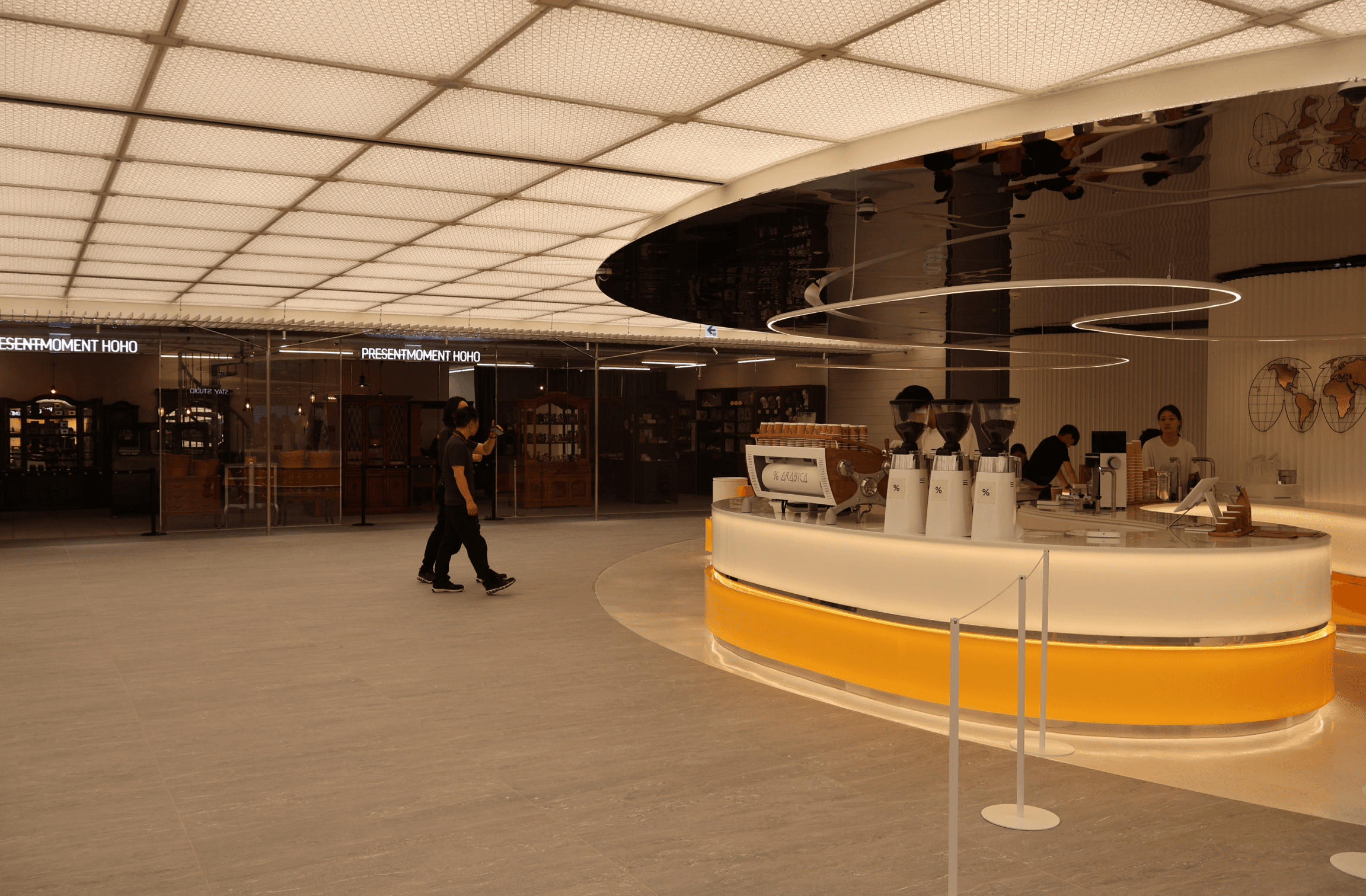
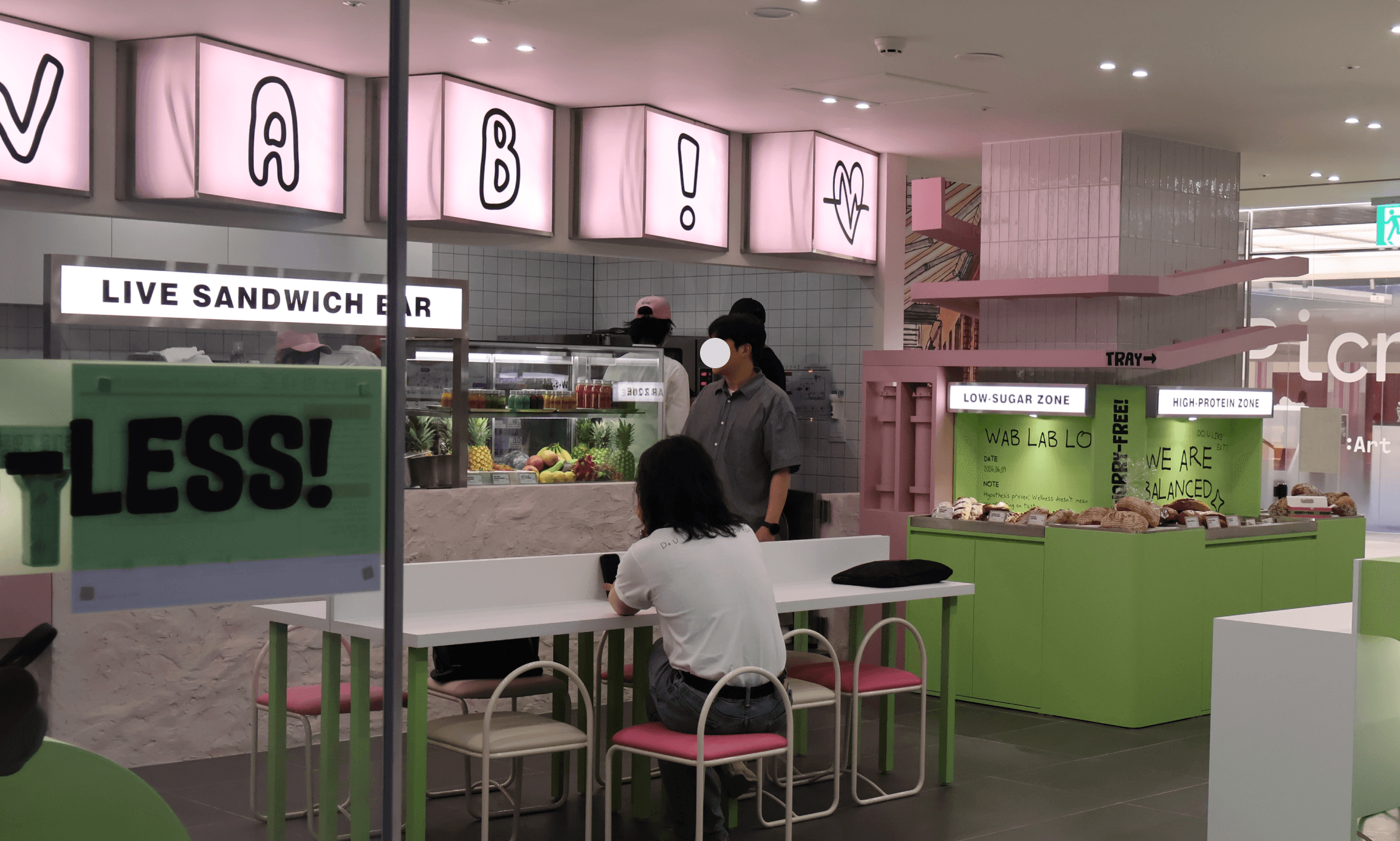
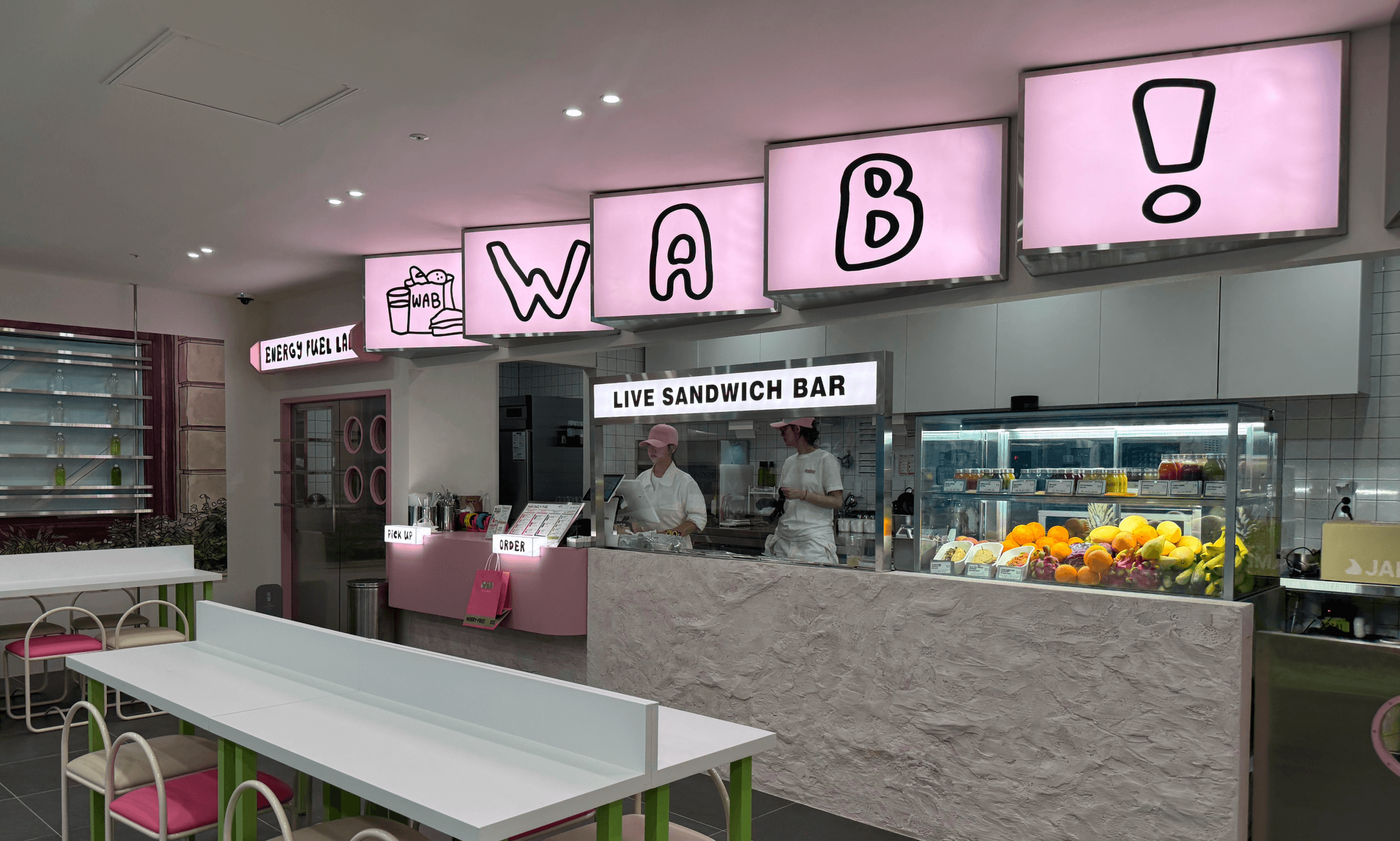
Passing Arabica on the way to the 63 Sky Picnic, you will find WAB (What a Bread), a wellness-concept second brand of Yongsan's What a Bread. The entry of a social media sensation brand, rarely seen in Yeouido, adds buzz to attract crowds, while naturally aligning with the trend of wellness rising as a central pillar of consumption. The structure where the path starting at the museum leads to coffee, wellness, and views — the flow of a unique visitor experience engineered by the 63 Building can be read here too.
A High-Sensibility Gastronomy Cluster (Welcome Street & Gourmet Street)
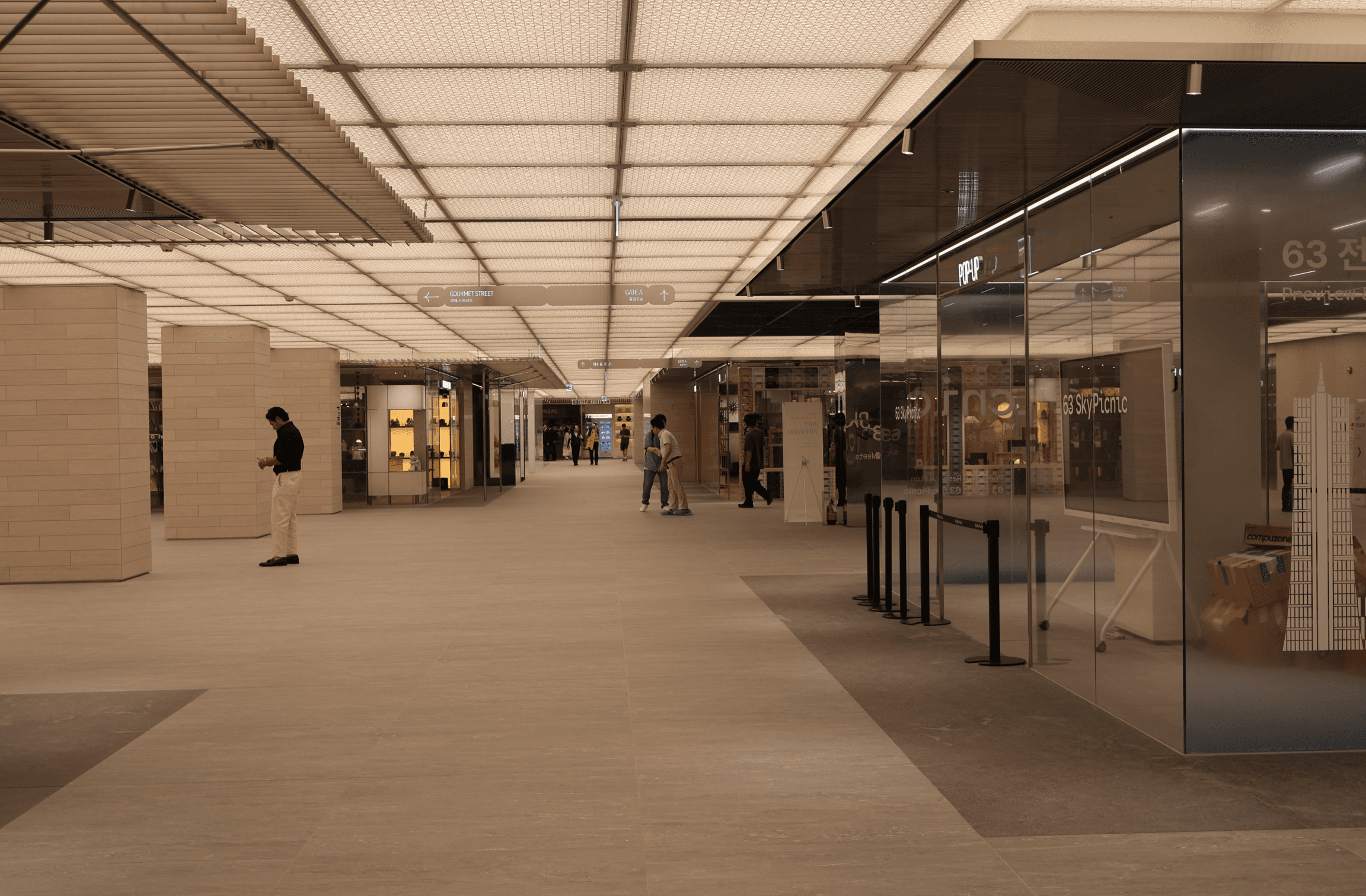
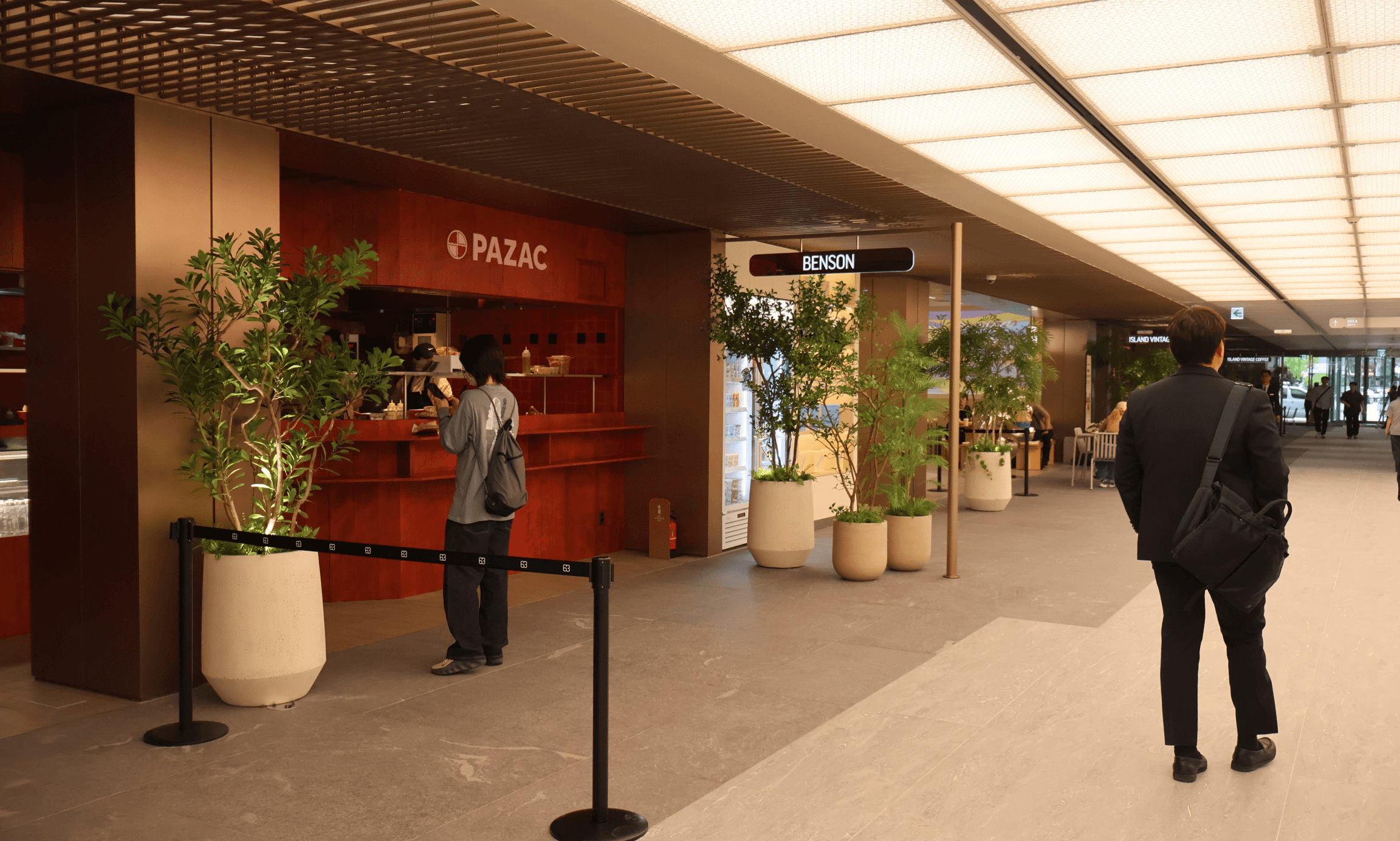
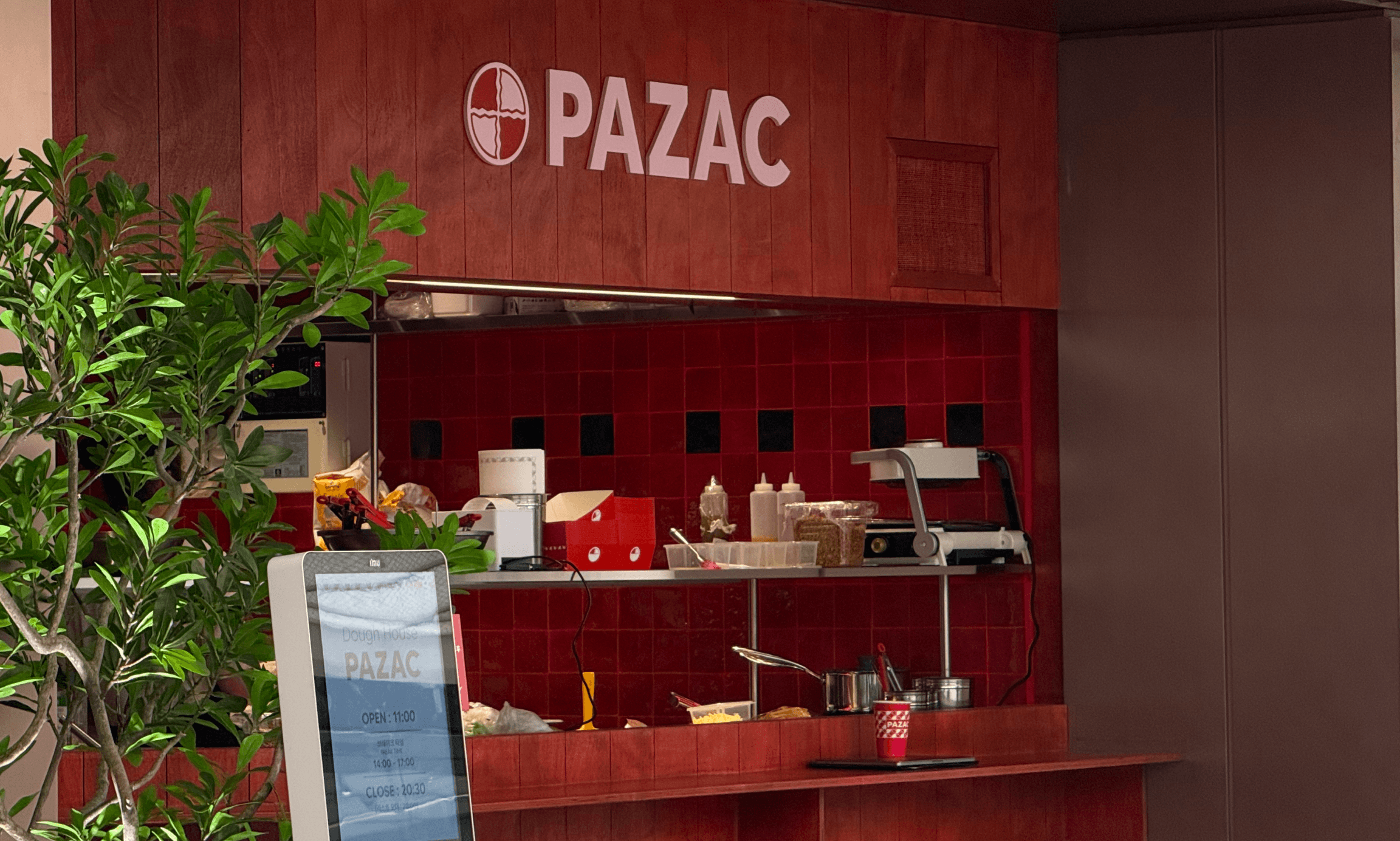
There is deliberate intent behind the F&B lineup as well. The Welcome Street zone begins the moment you enter Gate A. While it is the main corridor with the highest foot traffic, its wide width risked making it a space where people simply flow past. Hanwha chose a method of styling the public area of this corridor like a shop terrace. By arranging tables and chairs, they created seats naturally situated within the flow of traffic, and unified the ceiling and floor finishes of only that section to give the space a single identity. It is a device designed to give the impression that visitors have arrived at a shopping mall rather than an office building from the moment they step into the 63 Building. Starting with Island Vintage Coffee, its first domestic store directly entering from Hawaii, liquid nitrogen ice cream shop Benson, and Pajak, a Neapolitan-style wood-fired sandwich shop opening its third location following Cheonggyecheon and Seongsu, fill up the adjacent spaces.
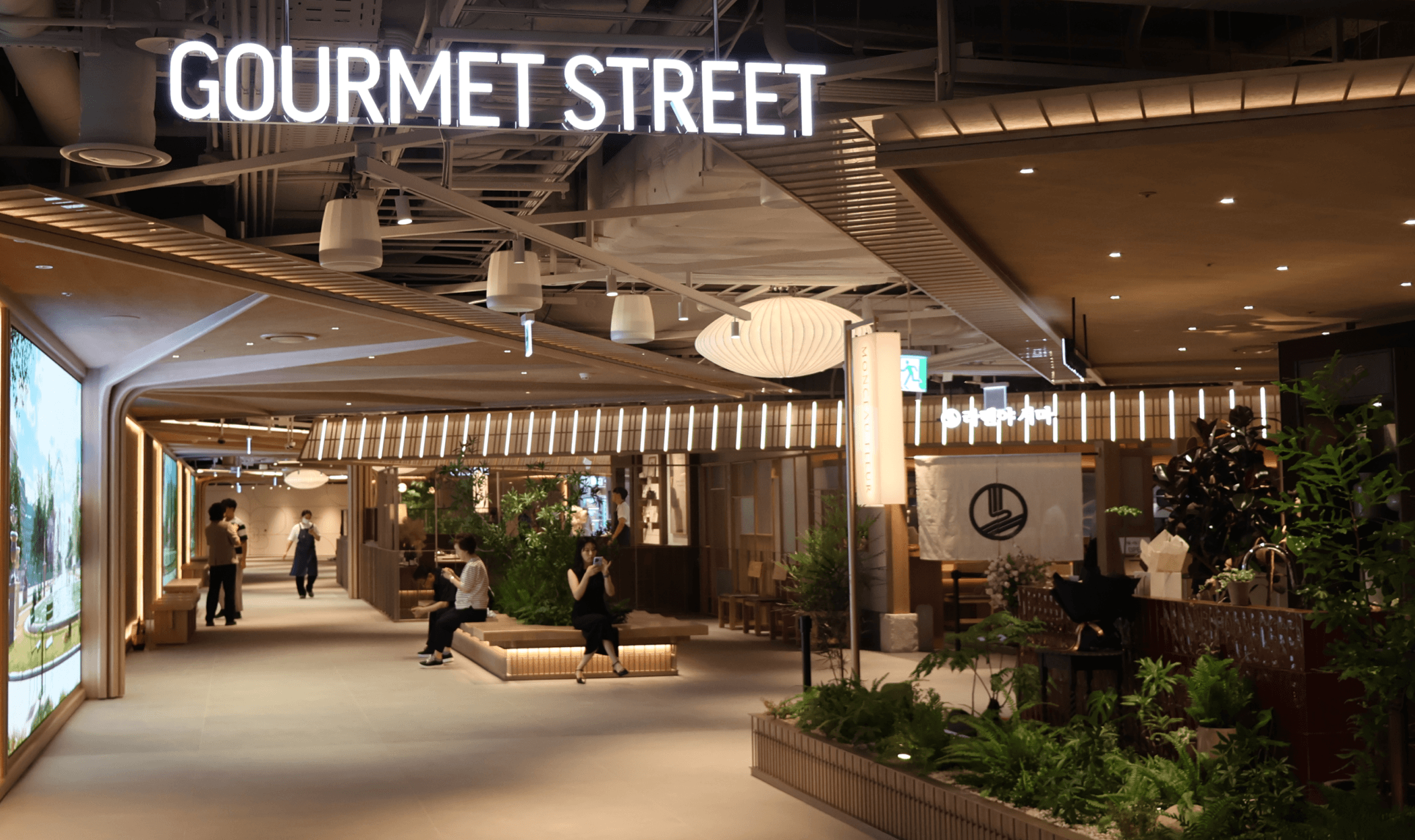
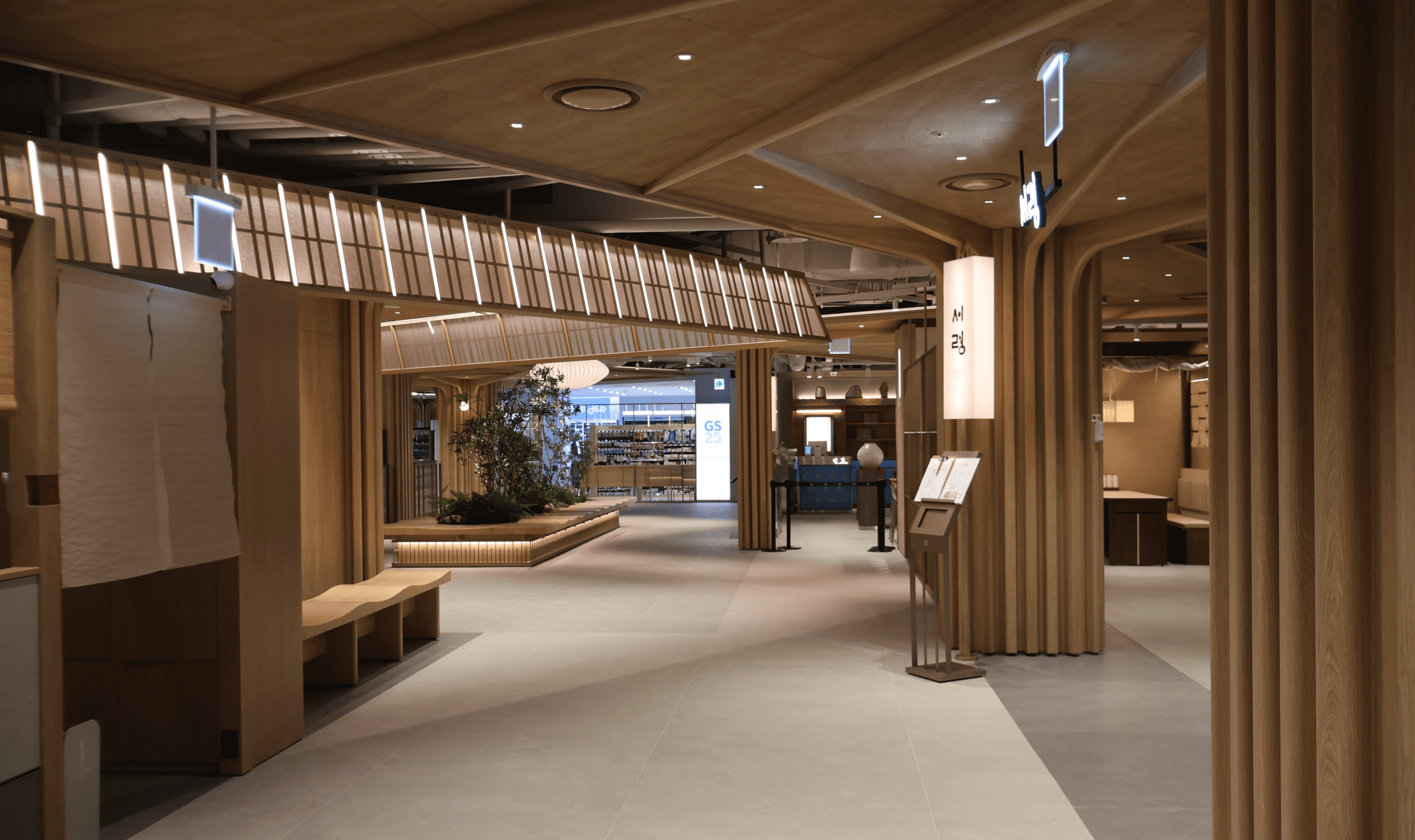
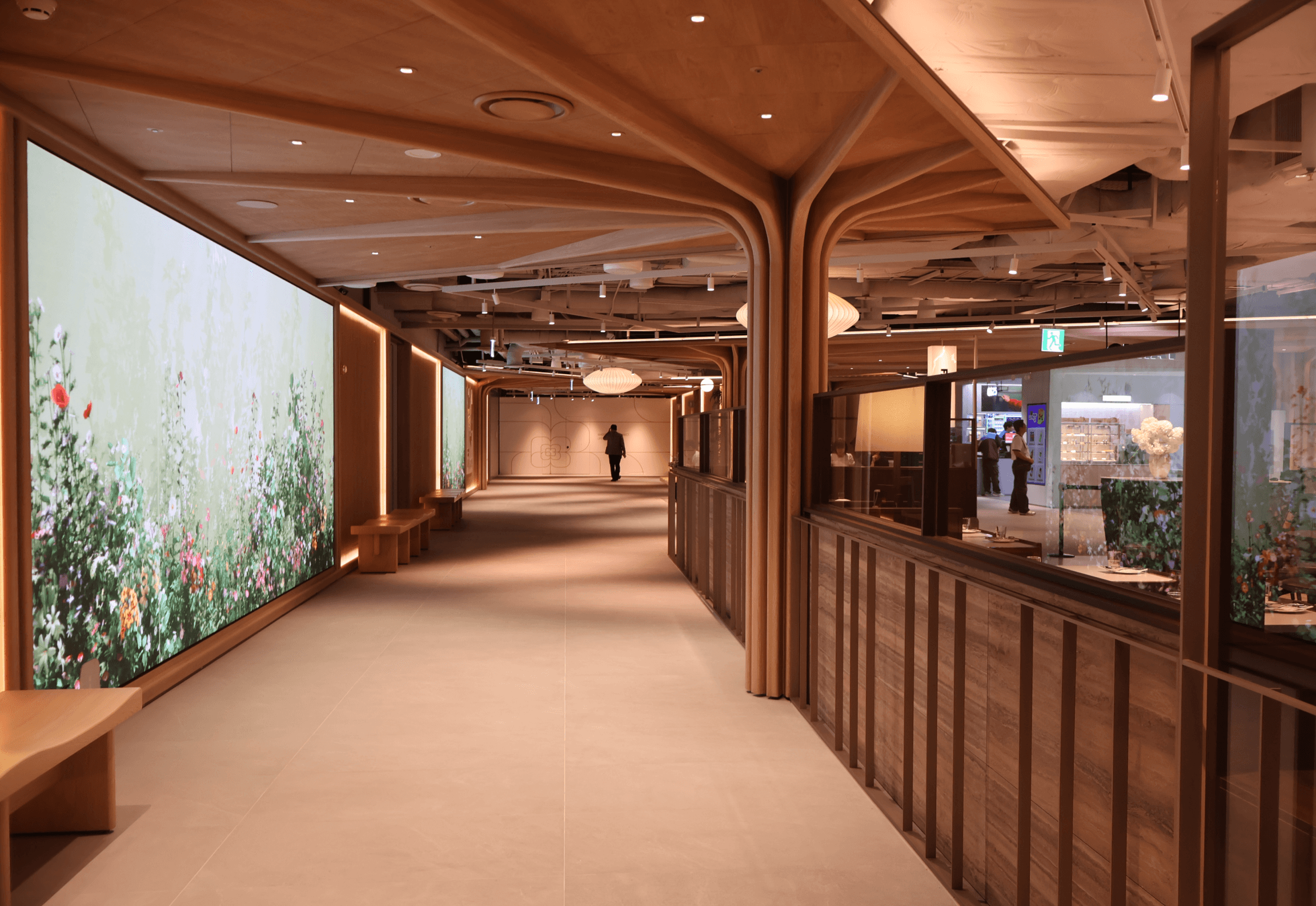
For Gourmet Street, a low finished ceiling with a height of 2.8 meters was the physical constraint of the space. It was a layout that could easily look like subdivided shopping arcade stores if each shop had been filled with only individual designs. Hanwha, led by the landlord, first established a common aesthetic for the entire zone. Ceiling finishes transitioning between private shop areas and common public areas, floor line details, and partitioning utilizing lattice screens. This is the result of the landlord intervening at the design stage to ensure the entire zone is read with a single level of quality while still preserving the individuality of each brand.
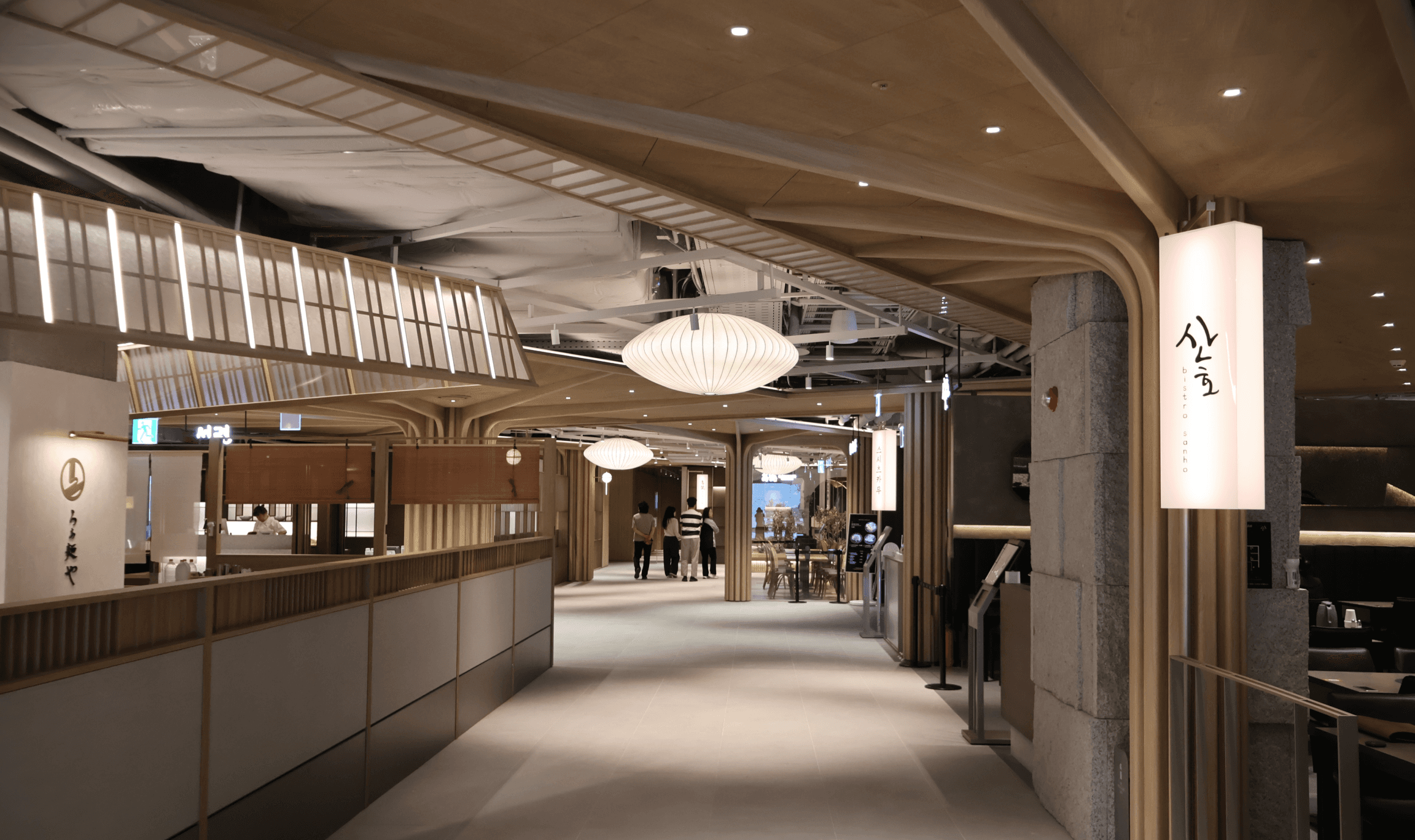
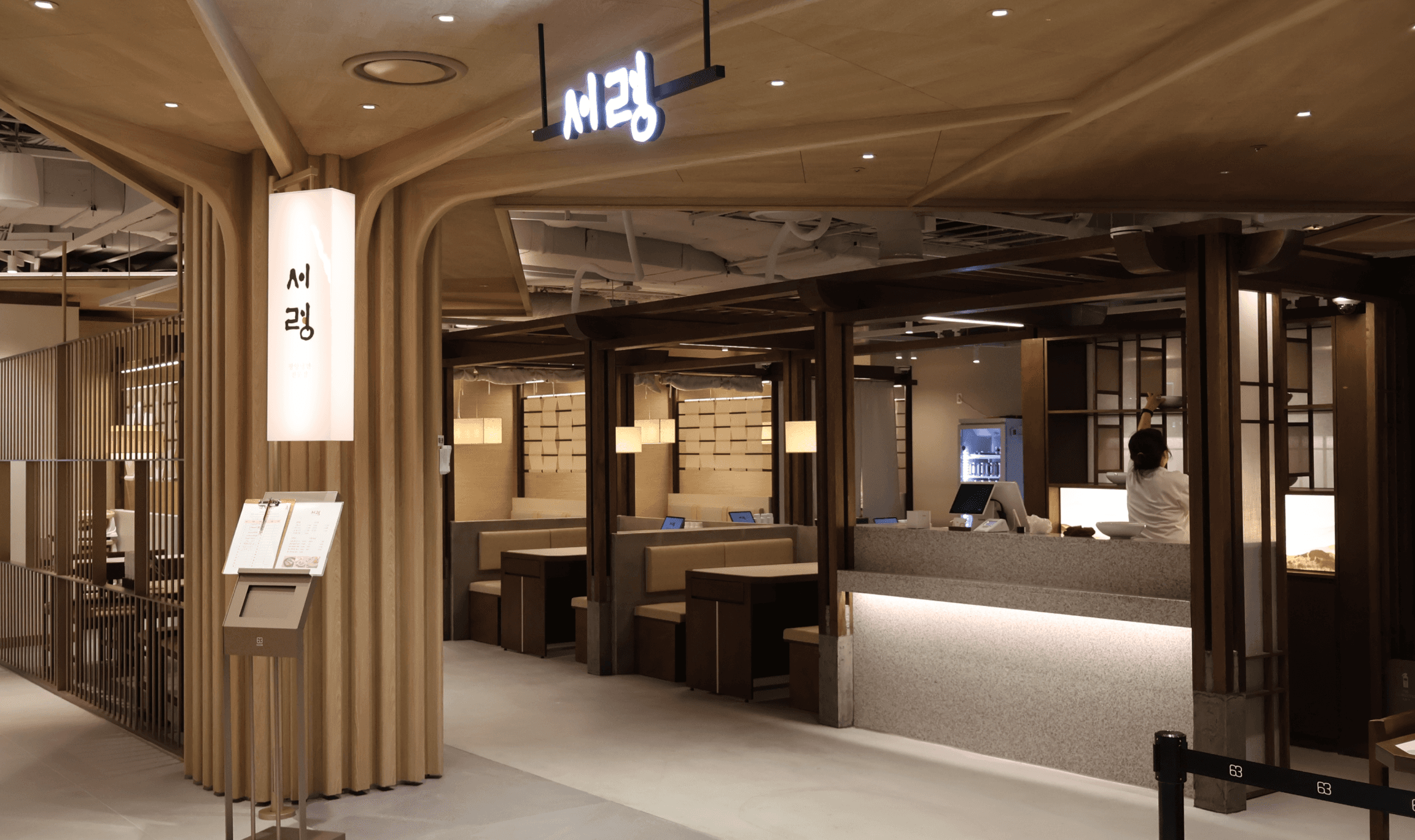
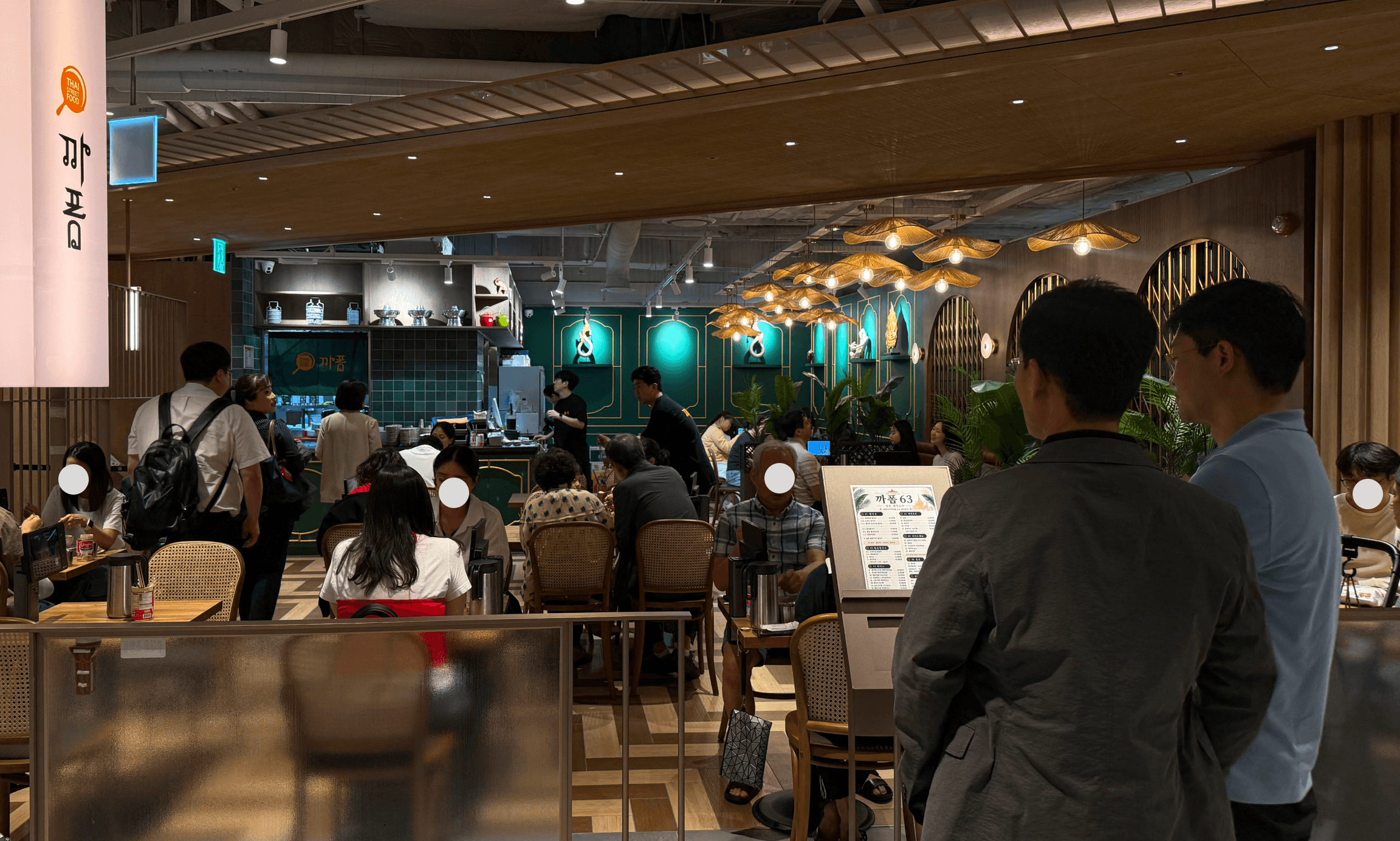
These are brands with their own distinct narratives that depart from the typical F&B formulas of large shopping malls, including Ramen-ya Sima, the first Korean branch of the popular Tokyo ramen restaurant; Seoryeong, a Pyongyang cold noodle specialty restaurant selected by the Michelin Guide; and Bistro Sanho, a Korean dining bistro. Since the basic pillar of the F&B composition is an office district with a resident population of about 4,800, lunch turnover was prioritized while simultaneously catering to apartment residents nearby and dinner-gathering demands. Added to this are museum visitors, foreign tourists, and evening guests coming down after viewing the night scenery at the observatory. The mix was structured to accommodate demands with different visiting hours and purposes on a single floor.
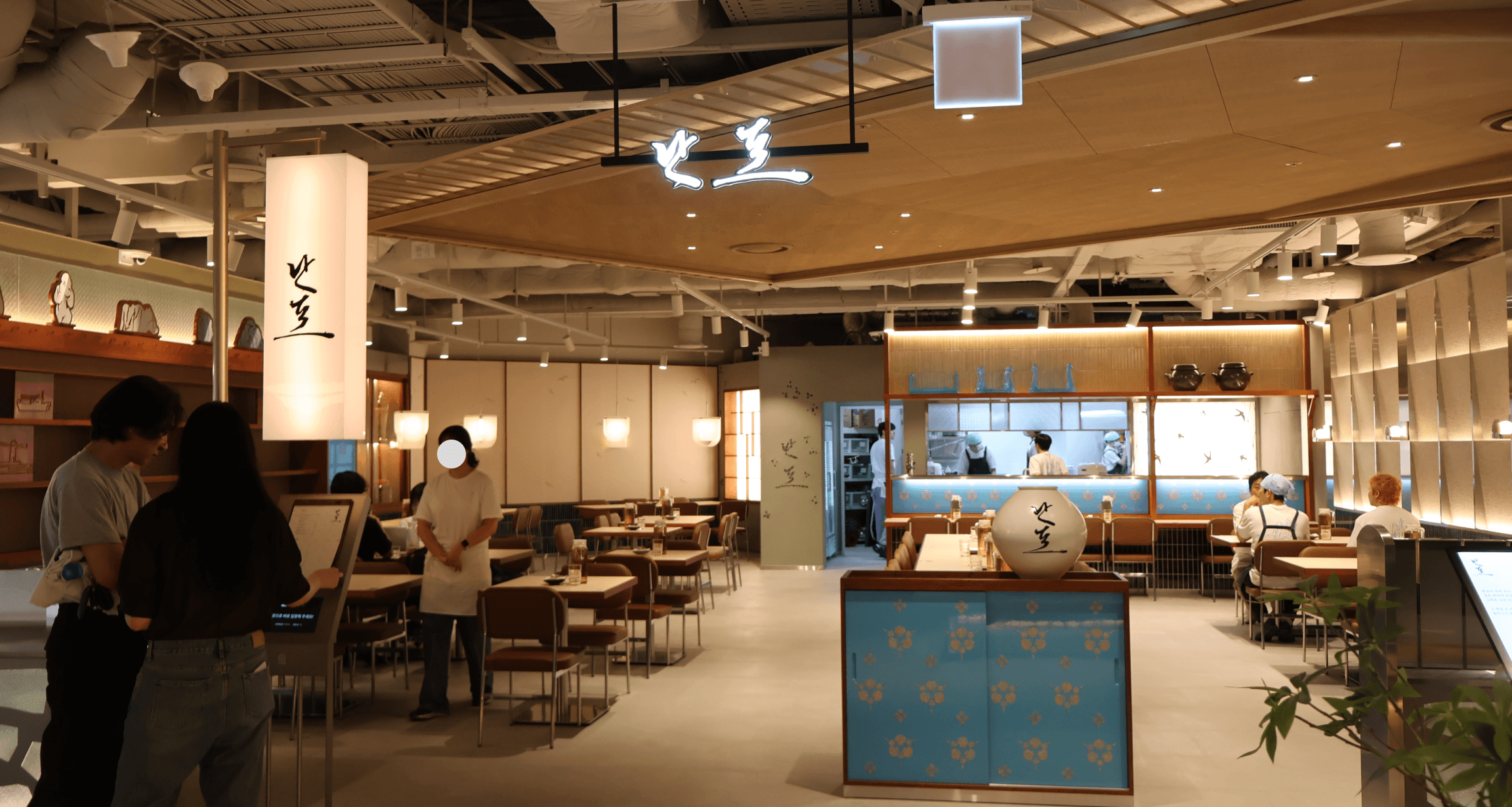
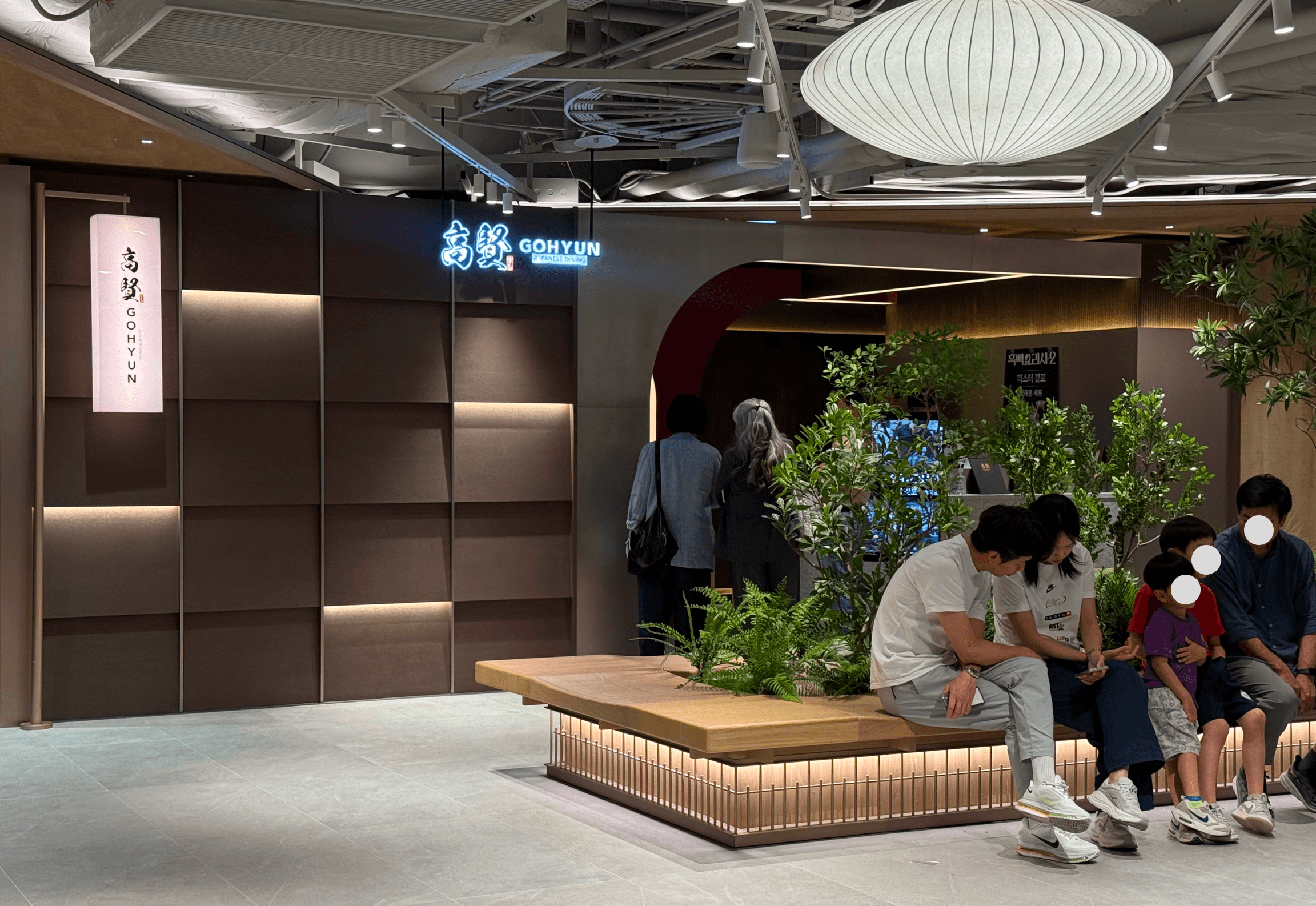
The interior space presentation also differs by brand. Go-hyeon, a new establishment by Chef Bae Jae-hoon who garnered attention for his appearance on Culinary Class Wars, is designed entirely with private rooms to accommodate private dining and gatherings. Parno, featuring a brunch and Western sensibility, is designed as an open-style space, while Nanpo, a fusion Korean restaurant colored to match the sensibility of the museum, is placed naturally along the flow of traffic following the exhibition viewing. Different brands with their own unique styles come together, creating more reasons one by one to visit the 63 Building alongside the museum and observatory.
The 63 Observatory Reopens After 16 Years, 63 Sky Picnic
The most iconic space of the 63 Building was its observatory. It still is. Although there were various internal discussions, the conclusion was reached to preserve the observatory's original function.
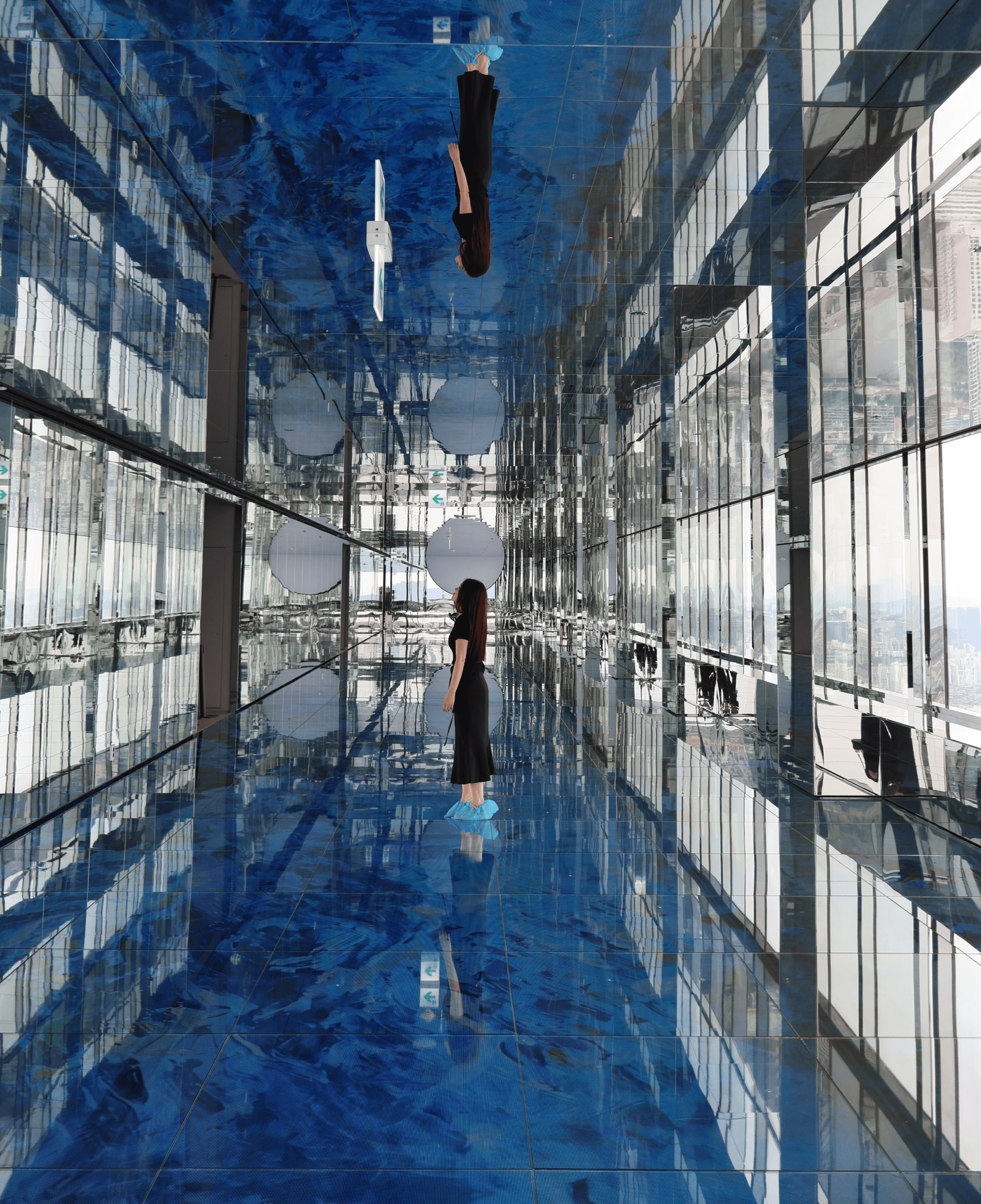
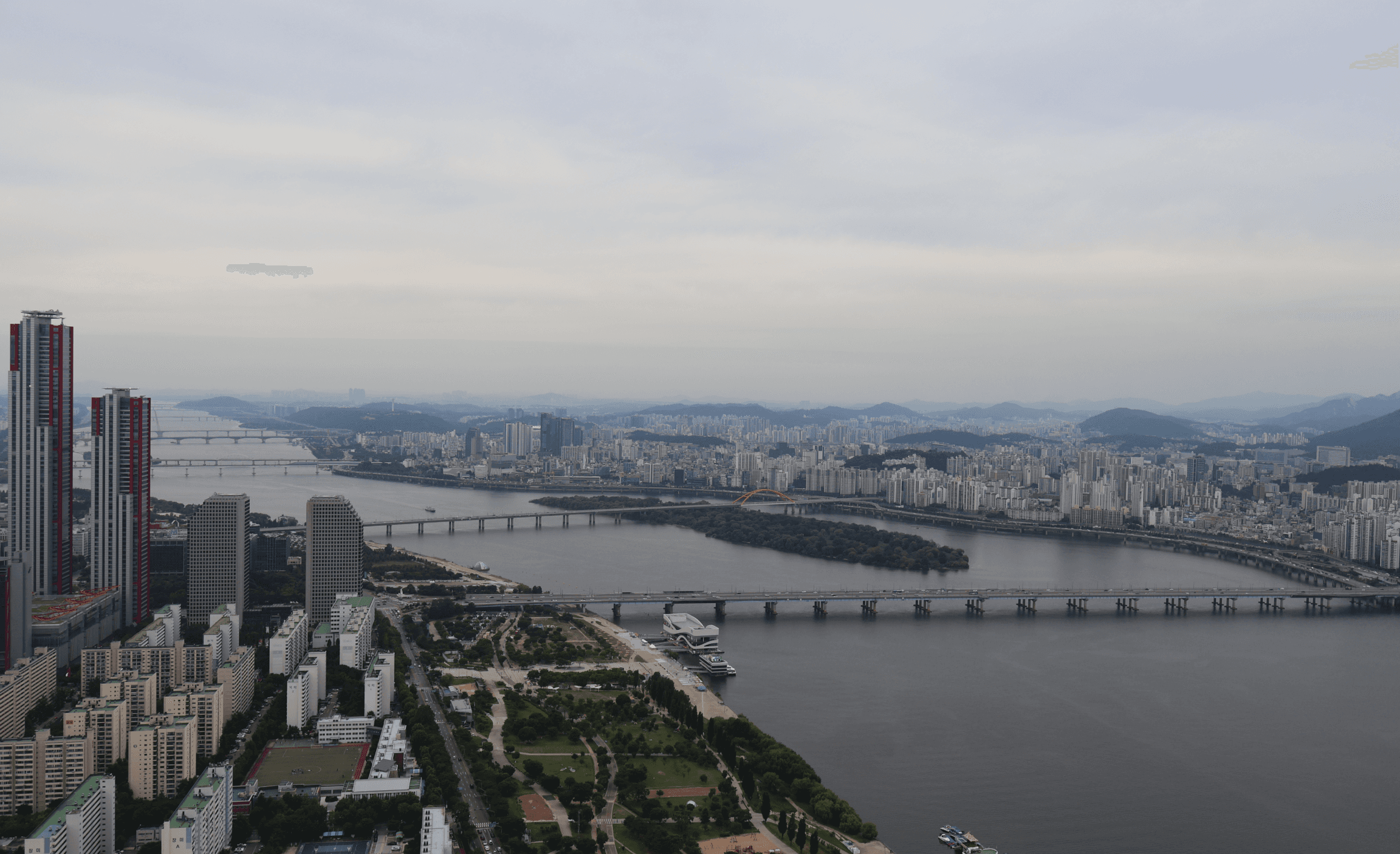
Renovated as the '63 Sky Picnic', the observatory (at about 250m above sea level) chose a method where memory and novelty coexist by integrating digital and AI technology into the space. The interior is structured with full mirrors so that the city landscape is absorbed into the space. At night, the lighting and media content change, offering an experience of a completely different density from daytime.
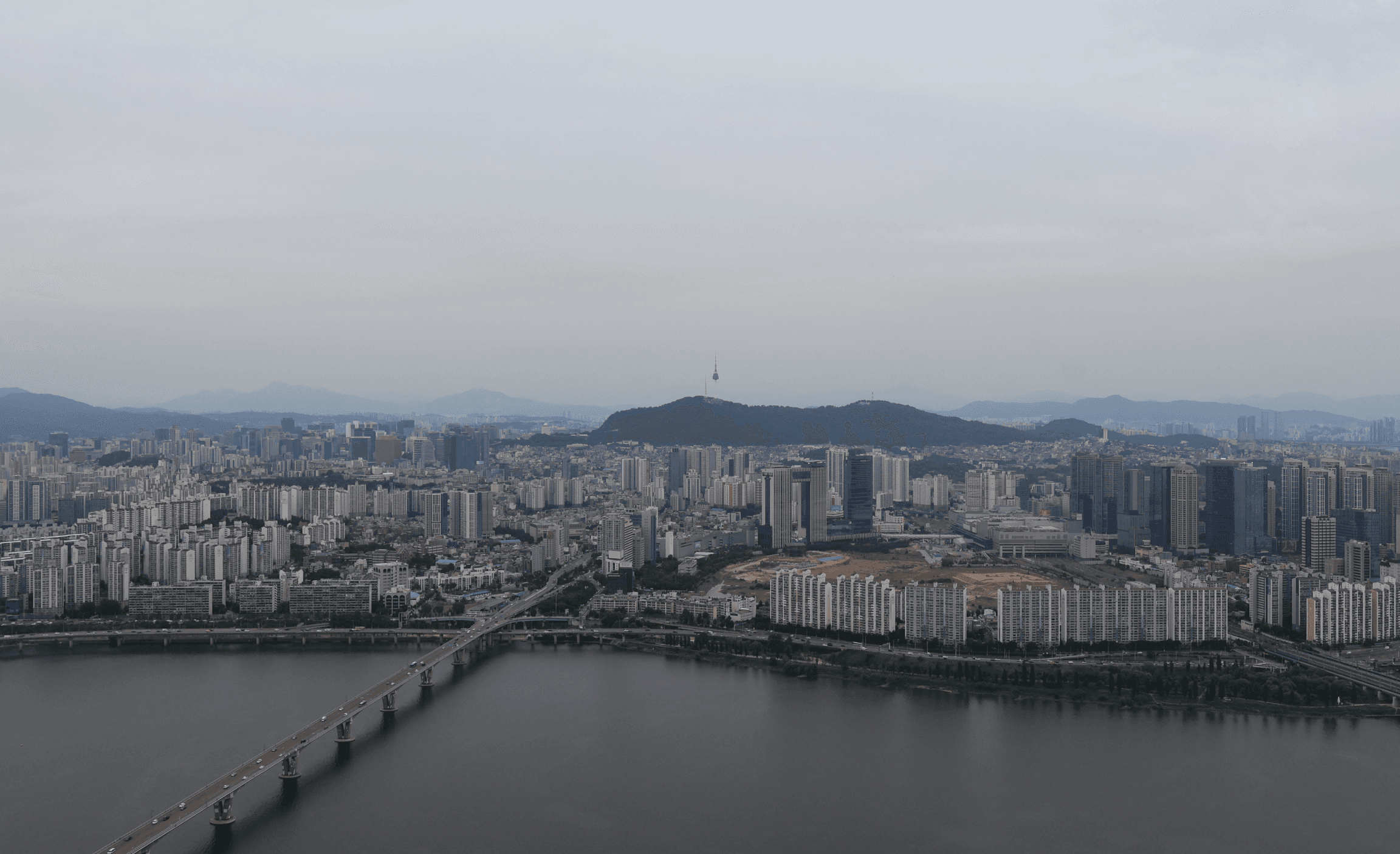
Stepping onto the rooftop allows you to face Seoul's skyline directly in a panorama. The fact that Hanwha has opened this to the public for the first time shows how fundamental a change the 63 Building chose this time. Its locational differentiation is also clear. The 63 Building is the only place where a view cutting across the Han River from east to west can be seen from this height. This view provided by the 63 Building embraces the Han River itself, offering domestic and foreign visitors alike a new perspective on Seoul.
A Reason to Visit Yeouido
The cities Deputy General Manager Lee Choong-heon referenced were Tokyo's Nakameguro and Daikanyama. "The reason people visit those places is the joy of experiencing the vibe of that neighborhood rather than each individual commercial element. Ultimately, I believe purposefulness comes from there." This means that instead of competing with The Hyundai and IFC Mall, they aim to become a destination with a completely different flow of traffic. At the foundation of that destination lie the things the 63 Building has built over a long time. The observatory was preserved, the glow of moon jars was engraved onto the facade, and the works of Korean artists along with Korean food seeped into the space. Atop the global credentials of being an international branch of one of the world's three major modern art museums, they overlaid Korean sensibility and the warmth of collective memory. The building once remembered through childhood school trip memories is now poised to become a reason to visit Yeouido once again.
This article was written based on an interview (June 1, 2026) with Deputy General Manager Lee Choong-heon of the Hanwha Life Asset Management Division.
That observatory we first climbed as children on our school trips. The place where we first realized how vast Seoul was while looking down at the sunset over the Han River. An afternoon from our childhood when we stood glued to the aquarium tank, not moving for the longest time. The 63 Building has long been a place of our memories. Regardless of the generation, if you are from Seoul, you probably have at least one story woven together with this building.
That space has now, once again, stood at a starting point.
The Journey of Pompidou to Yeouido
At the time of its completion in 1985, the 63 Building was the tallest skyscraper in South Korea. Its golden glass exterior was the symbol of the Han River skyline, and the route leading from the observatory to the aquarium and the buffet was, in itself, a signature Seoul landmark package. However, the city moved quickly. New landmarks went up in Gangnam and Jamsil, and The Hyundai Seoul and IFC Mall created a new axis of gravity even within Yeouido. The 63 Building was gradually pushed back into the category of an 'old space'.
As the city changed rapidly and new spaces continued to emerge, the time approached for the 63 Building to transform once again as a landmark, and the catalyst for that transition was the partnership with the Centre Pompidou. Opening on June 4, 2026, Centre Pompidou Hanwha is the third international branch showcased globally by the Centre Pompidou in Paris, following Malaga, Spain, and Shanghai, China. One of the world's three major modern art museums, housing masters of 20th-century modern art such as Picasso, Chagall, and Braque, has taken root in Yeouido, Seoul.
An Unprecedented Space
Architect Jean-Michel Wilmotte, who took charge of the space design, defined this building as a 'Light Box'. During the day, natural light seeps deep into the interior through the glass facade, and at night, light spills out of the building to illuminate the Han River. The exterior, composed of 80cm glass modules, absorbs and reflects the surrounding landscape, becoming an objet d'art in its own right.
Looking not just at the design but the composition of the space itself, such a combination of spaces is rare globally. Deputy General Manager Lee Choong-heon shared, "It's usually one of the two — either a gift shop inside an art museum, or an exhibition space partially located in a large shopping mall. It is hard to find a case like ours globally, where an independent art museum is combined with a commercial facility of this scale." He explains that the format in which the museum and retail coexist in equal scale is, in itself, a new typology. Consequently, this also means there are no prior precedents to reference.
This very point was what Deputy General Manager Lee Choong-heon picked as his biggest concern. "Seoul's trends move faster than any other city in the world, and trying to respond to customers who constantly demand something new must be a concern for all commercial facility operations," he answered, yet he did not look for the solution in 'the speed of novelty'. "We think we should go in the direction of being a space where people can consume the sensibility of art and culture, continuously creating our own content." Instead of chasing trends, they chose to maintain a certain high-quality standard, completing preparations to welcome visitors who will return home with new memories of 63.
A Select Shop Cluster and % Arabica Only at 63 (Culture Street)
The commercial facilities, entirely restructured alongside the museum, completely discarded the grammar of traditional office arcades. The commercial space, spanning a total gross floor area of about 11,500 square meters, did not position itself to compete directly with IFC Mall or The Hyundai Seoul from the beginning. Deputy General Manager Lee Choong-heon drew a clear line. "The biggest thought was that we had to differentiate ourselves with our own unique content."
The resulting retail space resembles 'one massive select shop' where individual boutique shops are tied together under one cohesive concept. Rooming & HAY, a global design brand with a Nordic sensibility; LOPA Seoul, a subculture-based select shop; the first offline store of Hand to Home, which distributes works of rising domestic and international artists online and offline; Present Moment Hoho, a gift curation shop; and Poses, which houses postcards from 300 artists in a library format. While each brand is independent, packing them together shapes a cultural and artistic consumption ecosystem linkable to the Pompidou.
Right in the center sits % Arabica Coffee, designed in collaboration with Spanish architects Selgascano. It was the first brand Deputy General Manager Lee Choong-heon had in mind when planning this project. "The coffee market already has so many diverse and excellent brands, but I couldn't think of any brand other than % Arabica that fits so perfectly with these cultural elements." Completed in collaboration with the architects, the Arabica space functions as a commercial lounge and simultaneously serves as a prelude leading to the museum.
Passing Arabica on the way to the 63 Sky Picnic, you will find WAB (What a Bread), a wellness-concept second brand of Yongsan's What a Bread. The entry of a social media sensation brand, rarely seen in Yeouido, adds buzz to attract crowds, while naturally aligning with the trend of wellness rising as a central pillar of consumption. The structure where the path starting at the museum leads to coffee, wellness, and views — the flow of a unique visitor experience engineered by the 63 Building can be read here too.
A High-Sensibility Gastronomy Cluster (Welcome Street & Gourmet Street)
There is deliberate intent behind the F&B lineup as well. The Welcome Street zone begins the moment you enter Gate A. While it is the main corridor with the highest foot traffic, its wide width risked making it a space where people simply flow past. Hanwha chose a method of styling the public area of this corridor like a shop terrace. By arranging tables and chairs, they created seats naturally situated within the flow of traffic, and unified the ceiling and floor finishes of only that section to give the space a single identity. It is a device designed to give the impression that visitors have arrived at a shopping mall rather than an office building from the moment they step into the 63 Building. Starting with Island Vintage Coffee, its first domestic store directly entering from Hawaii, liquid nitrogen ice cream shop Benson, and Pajak, a Neapolitan-style wood-fired sandwich shop opening its third location following Cheonggyecheon and Seongsu, fill up the adjacent spaces.
For Gourmet Street, a low finished ceiling with a height of 2.8 meters was the physical constraint of the space. It was a layout that could easily look like subdivided shopping arcade stores if each shop had been filled with only individual designs. Hanwha, led by the landlord, first established a common aesthetic for the entire zone. Ceiling finishes transitioning between private shop areas and common public areas, floor line details, and partitioning utilizing lattice screens. This is the result of the landlord intervening at the design stage to ensure the entire zone is read with a single level of quality while still preserving the individuality of each brand.
These are brands with their own distinct narratives that depart from the typical F&B formulas of large shopping malls, including Ramen-ya Sima, the first Korean branch of the popular Tokyo ramen restaurant; Seoryeong, a Pyongyang cold noodle specialty restaurant selected by the Michelin Guide; and Bistro Sanho, a Korean dining bistro. Since the basic pillar of the F&B composition is an office district with a resident population of about 4,800, lunch turnover was prioritized while simultaneously catering to apartment residents nearby and dinner-gathering demands. Added to this are museum visitors, foreign tourists, and evening guests coming down after viewing the night scenery at the observatory. The mix was structured to accommodate demands with different visiting hours and purposes on a single floor.
The interior space presentation also differs by brand. Go-hyeon, a new establishment by Chef Bae Jae-hoon who garnered attention for his appearance on Culinary Class Wars, is designed entirely with private rooms to accommodate private dining and gatherings. Parno, featuring a brunch and Western sensibility, is designed as an open-style space, while Nanpo, a fusion Korean restaurant colored to match the sensibility of the museum, is placed naturally along the flow of traffic following the exhibition viewing. Different brands with their own unique styles come together, creating more reasons one by one to visit the 63 Building alongside the museum and observatory.
The 63 Observatory Reopens After 16 Years, 63 Sky Picnic
The most iconic space of the 63 Building was its observatory. It still is. Although there were various internal discussions, the conclusion was reached to preserve the observatory's original function.
Renovated as the '63 Sky Picnic', the observatory (at about 250m above sea level) chose a method where memory and novelty coexist by integrating digital and AI technology into the space. The interior is structured with full mirrors so that the city landscape is absorbed into the space. At night, the lighting and media content change, offering an experience of a completely different density from daytime.
Stepping onto the rooftop allows you to face Seoul's skyline directly in a panorama. The fact that Hanwha has opened this to the public for the first time shows how fundamental a change the 63 Building chose this time. Its locational differentiation is also clear. The 63 Building is the only place where a view cutting across the Han River from east to west can be seen from this height. This view provided by the 63 Building embraces the Han River itself, offering domestic and foreign visitors alike a new perspective on Seoul.
A Reason to Visit Yeouido
The cities Deputy General Manager Lee Choong-heon referenced were Tokyo's Nakameguro and Daikanyama. "The reason people visit those places is the joy of experiencing the vibe of that neighborhood rather than each individual commercial element. Ultimately, I believe purposefulness comes from there." This means that instead of competing with The Hyundai and IFC Mall, they aim to become a destination with a completely different flow of traffic. At the foundation of that destination lie the things the 63 Building has built over a long time. The observatory was preserved, the glow of moon jars was engraved onto the facade, and the works of Korean artists along with Korean food seeped into the space. Atop the global credentials of being an international branch of one of the world's three major modern art museums, they overlaid Korean sensibility and the warmth of collective memory. The building once remembered through childhood school trip memories is now poised to become a reason to visit Yeouido once again.
This article was written based on an interview (June 1, 2026) with Deputy General Manager Lee Choong-heon of the Hanwha Life Asset Management Division.
© Copyright 2026. All rights reserved.
This publication has been prepared in good faith, based on CBRE Korea's current anecdotal and evidence based views of the commercial real estate market. Although CBRE Korea believes its views reflect market conditions on the date of this presentation, they are subject to significant uncertainties and contingencies, many of which are beyond CBRE Korea’s control. In addition, many of CBRE Korea’s views are opinion and/or projections based on CBRE Korea’s subjective analyses of current market circumstances. Other firms may have different opinions, projections and analyses, and actual market conditions in the future may cause CBRE Korea’s current views to later be incorrect. CBRE Korea has no obligation to update its views herein if its opinions, projections, analyses or market circumstances later change.
Nothing in this publication should be construed as an indicator of the future performance of CBRE’s securities or of the performance of any other company’s securities. You should not purchase or sell securities-of CBRE or any other company-based on the views herein. CBRE Korea disclaims all liability for securities purchased or sold based on information herein, and by viewing this publication, you waive all claims against CBRE Korea as well as against CBRE Korea’s affiliates, officers, directors, employees, agents, advisers and representatives arising out of the accuracy, completeness, adequacy or your use of the information herein. No part of this publication may be reproduced, quoted, distributed, or disclosed to any third party without the prior written consent of CBRE Korea.
More in
More in
More in
place
place
place

place
Aug 10, 2026
A Department Store Where It Rains Twice: Takanawa Gateway City
Japan's Largest Retail Redevelopment Strategy: Selling 'Dwell Time'

place
Jul 20, 2026
How Traditional Markets Become Retail Again
The Evolution of K-Markets: A Look at Gwangjang Market and Namdaemun

place
Jun 29, 2026
Our Wellness, Unfolded by Mapo Butfit Clubhouse
A place where an entire building is dedicated to a day for people who workout.
place
Apr 20, 2026
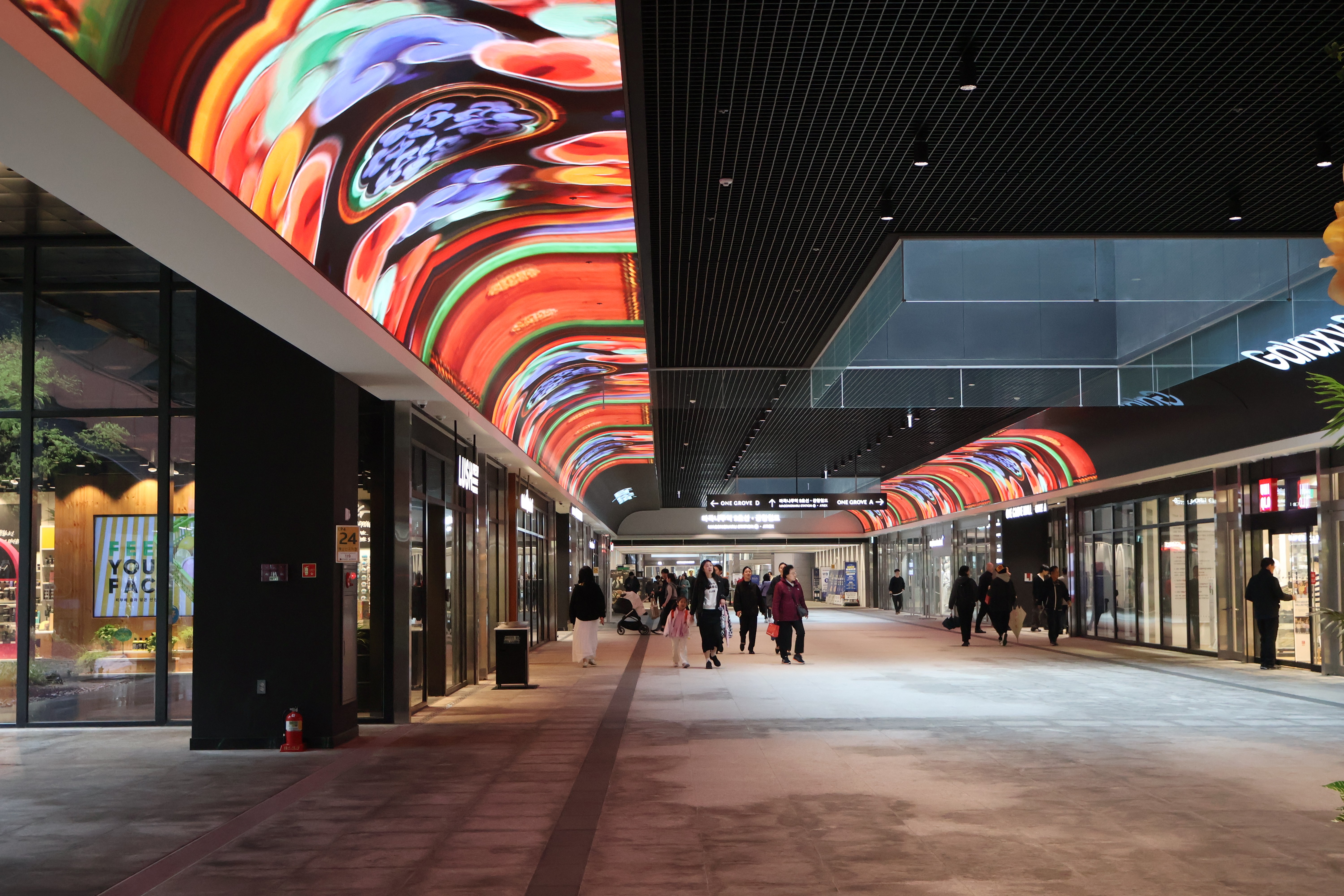
One Grove Magok: The Strategy Behind Filling 460,000 Sq Ft
A bold MD strategy, braving vacancy risks: Details of the 24/7 Hybrid Mall’s 141% Sales Growth
place
Apr 13, 2026
The Language Space Speaks
How spatial narrative drives dwell time, social content, and retail asset value in Seoul
place
Apr 13, 2026
CBD Retail: The Evolution of a 7-Day Asset
D-Tower, KT WEST, Gran Seoul — how Gwanghwamun's office retail moved from lunch-hour dependency to genuine all-day destination
Fresh Retail Insights, Every Week
Retail Dynamics & Edge Insights | by CBRE Korea Retail
매주 한 번, 새롭게 업데이트되는 리테일 인사이트
Fresh Retail Insights, Every Week
Retail Dynamics & Edge Insights
| by CBRE Korea Retail
매주 월요일, 새롭게 업데이트되는
리테일 인사이트
Fresh Retail Insights, Every Week
Retail Dynamics & Edge Insights | by CBRE Korea Retail
매주 한 번, 새롭게 업데이트되는 리테일 인사이트