Back
Share
Like
trend
Article Highlights
Luxury bag price hikes shifted consumer desire toward luxury jewelry.
Entry lines are cheaper than bags and perceived as a rational purchase due to their asset value as gold.
Consumption is shifting from outward, conspicuous displays to inward, daily self-satisfaction.
During the pandemic, travel funds with nowhere to go gathered in front of luxury department store boutiques. Under circumstances where overseas travel and dining out were blocked, suppressed consumption desire condensed into a single outlet: luxury bags. Neologisms like 'luxury-tech' emerged, and while the concept of reselling itself existed in various forms such as Joonggonara, it served as an opportunity for platforms like KREAM to grow.
Waiting in line for hours, and if you couldn't get it that day, trying again the next day, and the day after that. The bags acquired in this manner were traded like financial products. Brands raised their prices two or three times a year, and the price of a certain luxury brand's classic bag skyrocketed by nearly 70% in five years, yet the lines only grew longer. A structure was completed in which price hikes did not deter demand but instead worked as a powerful purchasing signal that 'now is the cheapest.'
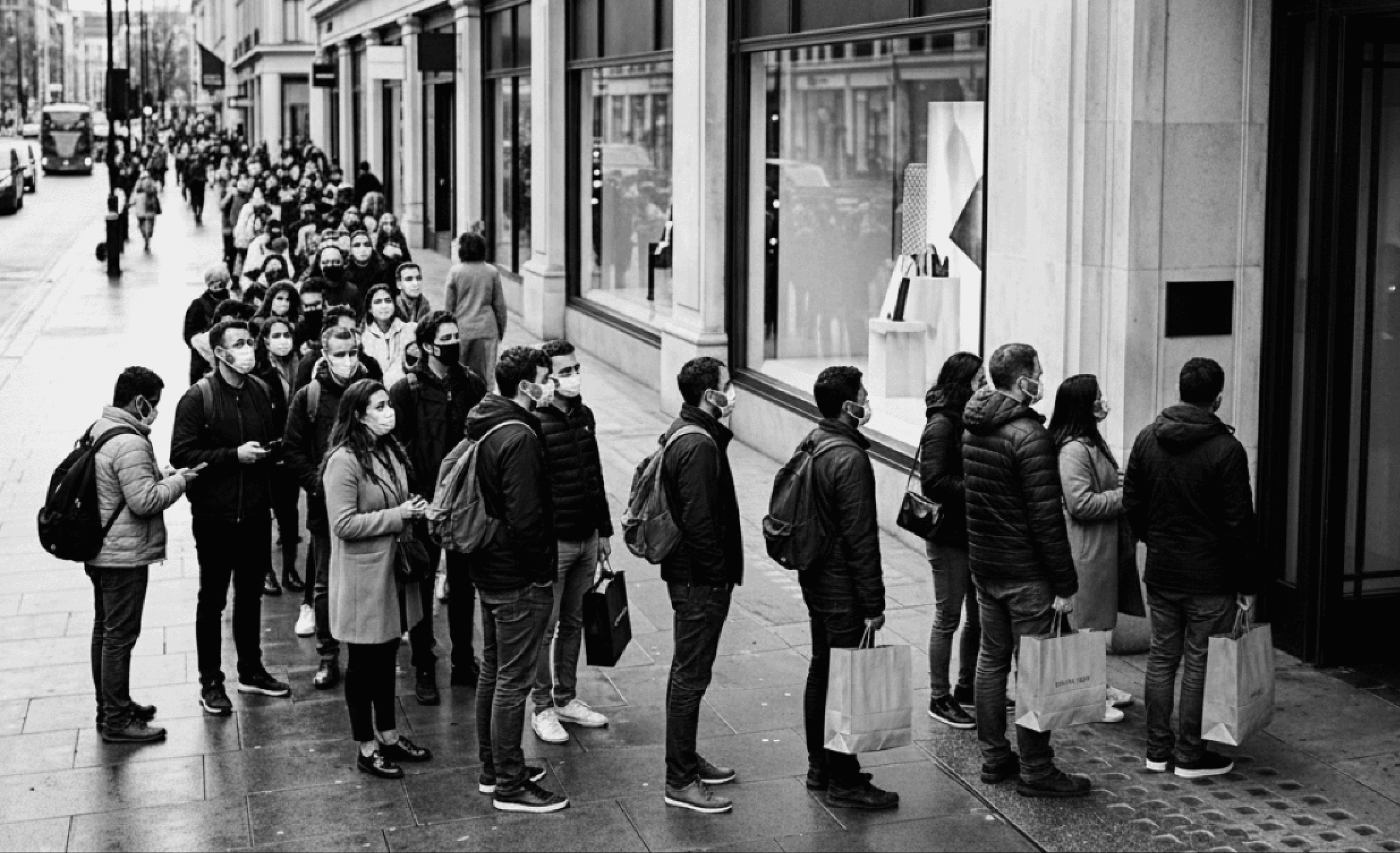
A symbolic scene from the era when bags reigned as 'assets' beyond simple consumer goods (Source: AI-generated image)
Is that structure still valid today? The answer is 'YES'
It's not that luxury brands have become boring to the general public. As always, the seasonal bags and classic bags released by brands every year are still hard to get. However, even if they are hard to obtain, it no longer creates scenes of people lining up from dawn for an 'open run' outside the stores like before. Open runs have now become common news, and waiting numbers have become an ordinary content one must go through to purchase luxury goods. There was once a time when the anxiety of "only I don't have it" stimulated purchases, but now, that anxiety itself has faded. Sales are still robust, but as of 2026, a classic medium bag is in the 14-million-won range. This amount has created a psychological resistance line that is difficult to check out with mere excitement as before.
Is the final stop this time jewelry?
A representative luxury jewelry brand's bracelet is in the 8 to 9 million won range, and a steel watch is in the mid-7 million won range. The calculation that one can buy the sense of 'knowing luxury' at half the price of a bag began to spread among consumers. On top of this, brands instilled confidence by shaking up their price tags.
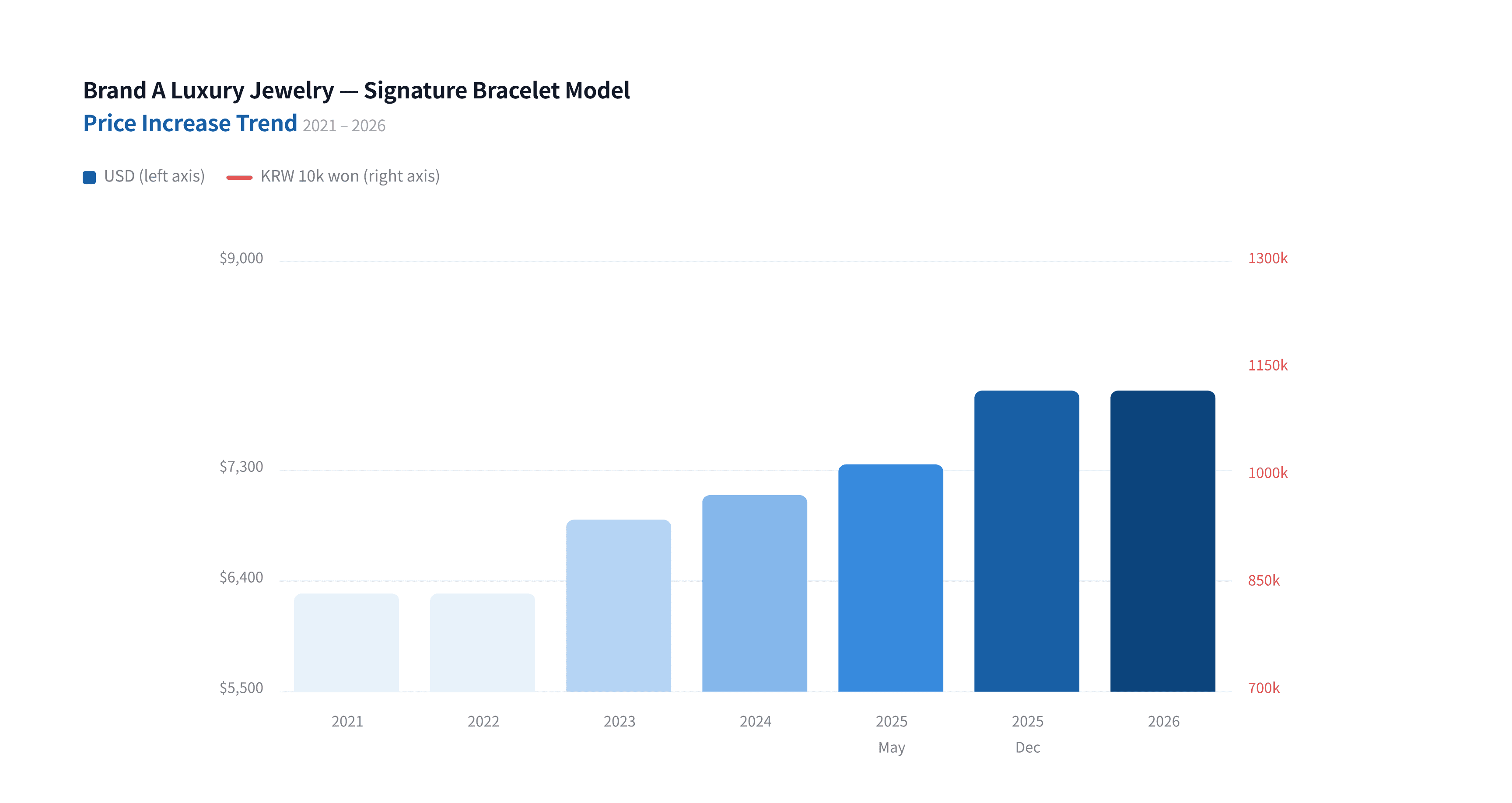
Price Increase Trend for Representative Model of Major Jewelry Brand A
A certain luxury jewelry brand A raised prices twice in the second half of 2025 alone, driving up the price of some items by more than 20%. Luxury jewelry brand B raised major collection prices by about 10% at the end of 2025, and brand C also raised prices in April this year. In particular, the prices of all items known for entry-level buyers were increased. Once price increase signals spread, instincts learned during the luxury-tech era revive. However, rather than an approach of 'I should buy and sell it,' it made the minds of potential customers who had only been watching luxury jewelry from afar very rushed in a way of 'now is the cheapest' or 'buying now is saving money.'
The words of a consumer who recently purchased jewelry at a luxury jewelry store represent this sentiment.
"When it was in the 4 million won range five years ago, I thought 'I'll buy it later,' but it kept going up. Eventually, I bought it a few weeks ago in the late 8 million won range, and the seller said it's going up again in May. What crossed my mind then wasn't 'Wow, it's so expensive,' but 'Thank goodness, I caught the last train. As expected, today is the cheapest.' Just like how you're considered a fool if you don't do stocks these days, I feel like I'm losing out if I don't buy jewelry now."
Why jewelry instead of a bag?
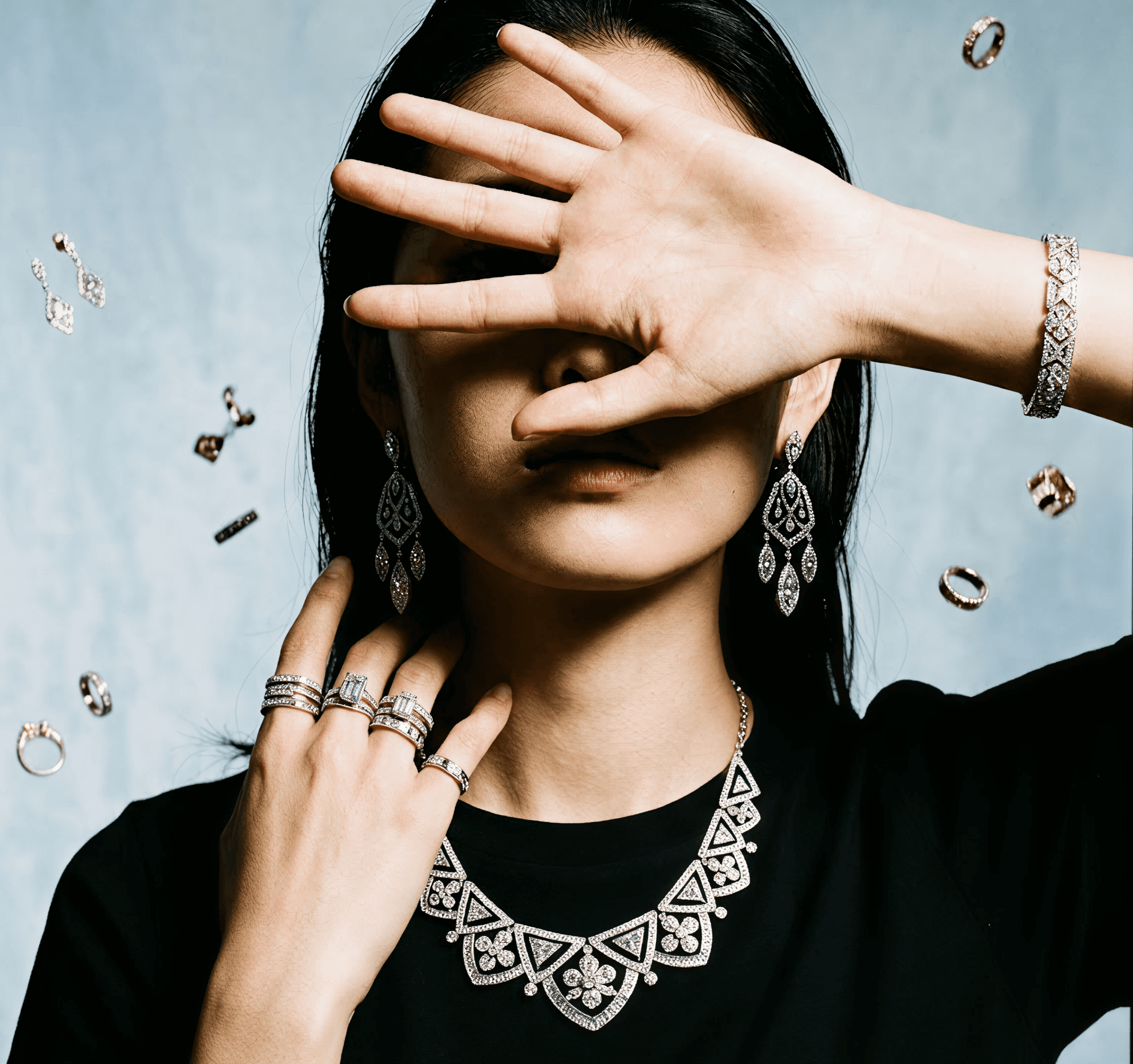
There is a decisive difference other than price. While bags require considering the TPO, jewelry is worn daily like a tattoo. Self-rationalization like 'I spent this much money, but if I wear it every day for three years, don’t I break even?' fits well with today's consumer behavior that pursues clear and reasonably rational spending. A consumer who consistently purchases luxury jewelry says:
"They pop up one by one in my Instagram feed, which might be because I've been looking at them with interest, but reviews of luxury jewelry have definitely increased a lot. For me, unlike bags, jewelry felt like 'a sparkling gift for myself.' But in fact, there are many fakes and others don't really know, right? In the end, it's self-satisfaction. It is a feeling of 'I work so hard, so I want to reward myself with something,' but to be honest, rather than a bag, it's my hand looked down upon on the desk while working, the sparkle of my finger that caught my eye while typing on the keyboard. Once I start feeling satisfaction from this, whenever the urge to resign surges, I suppress it with something small and sparkling, and that seems to be the utility that only jewelry can provide."
Unlike bags, jewelry stays within sight all day long. (Source: AI-generated image)

On top of this, the fact that the material itself is an asset seals the deal. Bags depreciate the more you use them, but gold and platinum are safe assets. According to the World Gold Council, the price of gold broke all-time highs 53 times in 2025. Although there was a temporary correction due to the recent surge, J.P. Morgan maintains a target of $6,000 per ounce by the end of 2026 — which translates to the era of 1 million won per 'don' (approx. 3.75g) in Korean units being just around the corner. McKinsey & Business of Fashion's 『The State of Fashion 2026』 (November 2025) identified jewelry as the fastest-growing category by unit sales within the fashion segment. Growing four times faster than apparel, and outperforming handbags and accessories by a 15-percentage-point margin as the 'category with the highest investment value' in a consumer survey, shows that the dual structure of jewelry—where brand premium is coupled with the rising value of raw materials—is an area that bags cannot catch up to.
The domestic resale market is also reflecting this trend in real-time. According to Bunjang, a domestic secondhand trading platform centered on luxury and limited edition goods, the transaction volume of the jewelry category exploded by 381%. While a necklace from a snake-motif house sold in just 53 seconds after registration, a bag from a French house took 70 seconds. The speed of the resale market is the temperature of demand. We are in an era where jewelry sells faster than bags.
Assets with no expiration date
Ultimately, the shift from luxury bags to jewelry is not just a simple change in trend. It is closer to a rational survival strategy found by consumers amid the reality of recession and high inflation. With the asset market stagnating and bag prices crossing psychological resistance lines, they have discovered an alternative that offers both brand symbolism and value as a physical asset.
The era of consuming for extroverted showing-off, dependent on the eyes of others, is also slowly fading. Now, while it is of course important for others to recognize it, self-satisfaction and solace felt on the wrist and fingers where my eyes linger, whether working or resting, have become more important. This is why jewelry is drawing attention as a 'daily partner' that goes beyond an item for outings to show others, sharing the entirety of daily life while satisfying psychological comfort, practicality, and asset value altogether.
The learned instinct of 'now is the cheapest,' the practical calculation of 'getting your money's worth by wearing it every day,' plus the value of gold as a 'safe asset.' Today's luxury jewelry has become the most secure option that simultaneously satisfies consumers' emotions and reason. At a time when the gravity of consumption has shifted from showing others to spending on oneself, the sparkle of jewelry has established itself beyond simple luxury as one's own asset with no expiration date.
© Copyright 2026. All rights reserved.
This publication has been prepared in good faith, based on CBRE Korea's current anecdotal and evidence based views of the commercial real estate market. Although CBRE Korea believes its views reflect market conditions on the date of this presentation, they are subject to significant uncertainties and contingencies, many of which are beyond CBRE Korea’s control. In addition, many of CBRE Korea’s views are opinion and/or projections based on CBRE Korea’s subjective analyses of current market circumstances. Other firms may have different opinions, projections and analyses, and actual market conditions in the future may cause CBRE Korea’s current views to later be incorrect. CBRE Korea has no obligation to update its views herein if its opinions, projections, analyses or market circumstances later change.
Nothing in this publication should be construed as an indicator of the future performance of CBRE’s securities or of the performance of any other company’s securities. You should not purchase or sell securities-of CBRE or any other company-based on the views herein. CBRE Korea disclaims all liability for securities purchased or sold based on information herein, and by viewing this publication, you waive all claims against CBRE Korea as well as against CBRE Korea’s affiliates, officers, directors, employees, agents, advisers and representatives arising out of the accuracy, completeness, adequacy or your use of the information herein. No part of this publication may be reproduced, quoted, distributed, or disclosed to any third party without the prior written consent of CBRE Korea.

trend
Aug 31, 2026
24,000 Traditional Pubs Disappeared
Lowest Alcohol Consumption in 27 Years and a 46% Plunge in Bars: The Next Formula for Nightlife Economy

trend
Jul 6, 2026
The footsteps of runners change the commercial districts
Runners' Basecamp: SEOUL's second article, commercial districts transformed by runners centering around Seochon and Bukchon
trend
Apr 13, 2026
The Secrets Behind the Success of Eulji Kankan
Appeared in Culinary Class Wars Season 2, Representative Cho Kyung-chan of Eulji KkanKkan—who brought the taste of real, local Vietnam to Korea—talks about his laws of entrepreneurship, space, and expansion.

trend
Apr 13, 2026
Runners' Basecamp: SEOUL
UVU chose Seongsu over London for its world-first store — how Seoul's running scene is redrawing the retail map.
trend
Apr 13, 2026
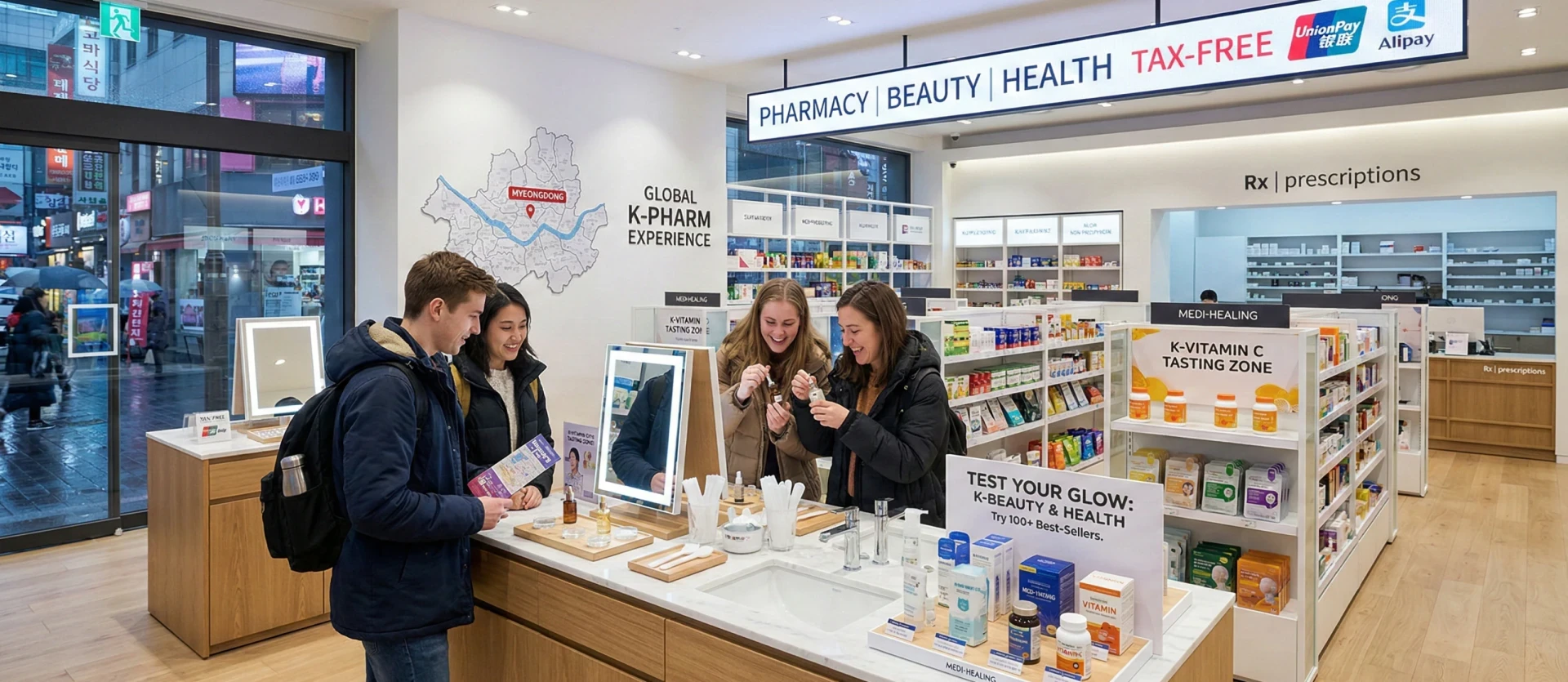
Pharmacy or Olive Young?
How K-pharmacy became Seoul's most unexpected anchor tenant category.
trend
Apr 13, 2026
2026 Retail Trend: Keep the Taste, Cut the Risk
Frugal and indulgent in the same afternoon — how South Korea's ambivalent spending pattern is reshaping retail strategy in 2026.