Back
Share
Like
street
Article Highlights
Apgujeong-ro North Side (South-facing): Direct natural light clusters high-jewelry houses (Rolex, Van Cleef, Tiffany).
Capital Lock-in: Whether buying land (LVMH, Chanel) or high-CapEx long-term leasing (Cartier), massive capital is locked into Cheongdam.
Destination Market: Unlike walkable Ginza, Cheongdam is built for vehicle access and valet. Its core value is purposeful arrival, not pedestrian flow.
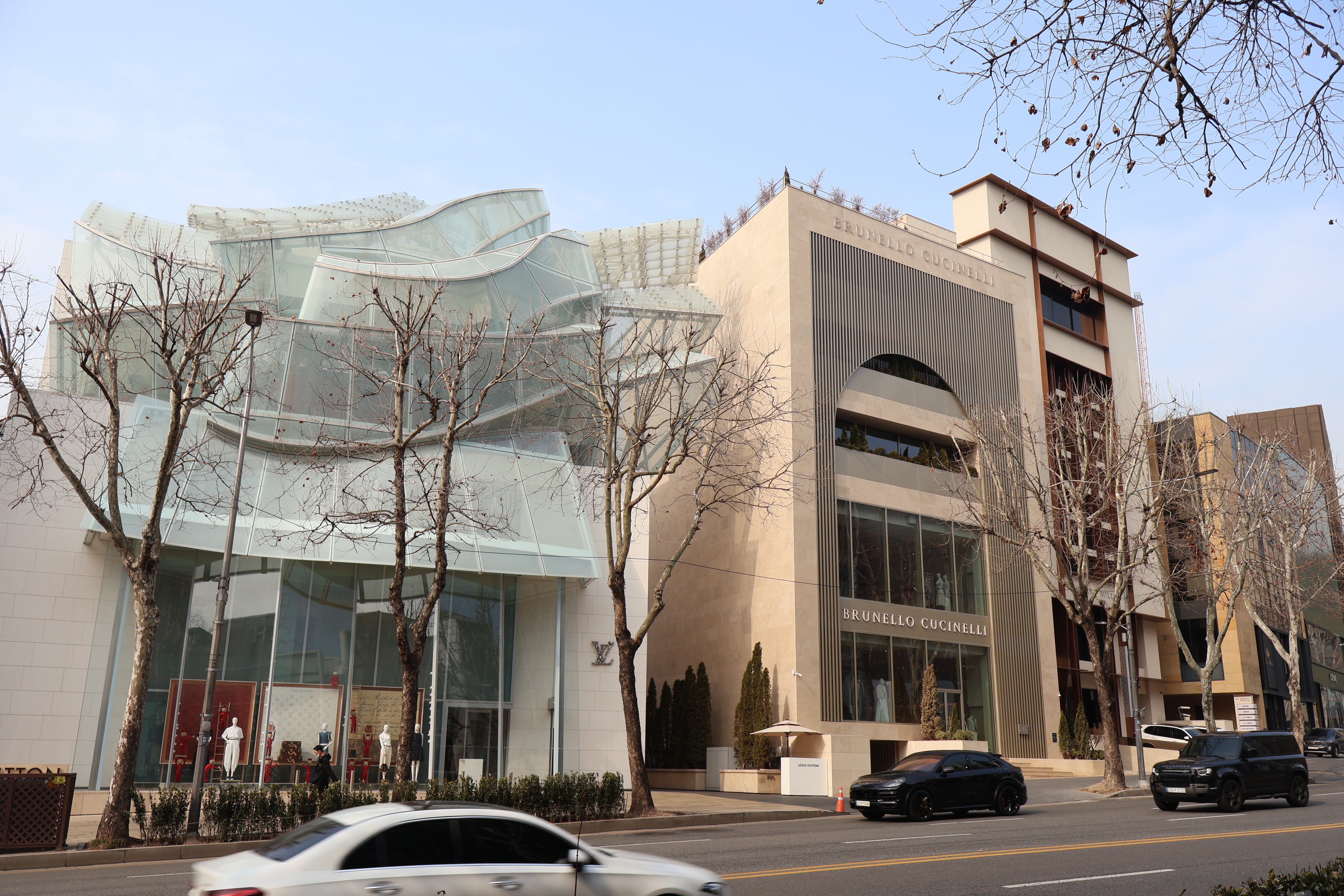
Foreign visitors who step onto the luxury streets of Cheongdam-dong, imagining New York’s Fifth Avenue or Paris’s Avenue Montaigne, are struck by two distinct surprises. First, they are taken aback by the strictly car-centric streetscape and pedestrians are nearly non-existent. Second, they are awestruck by the overwhelming facades of global luxury brands that stand firm despite such challenging pedestrian conditions. While some might describe this as an "unfriendly area," Cheongdam-dong is, in fact, a meticulously calculated "Secret Fortress." Here, even a single ray of sunlight is part of a brand’s strategy.
Behind the retail landscape of Cheongdam lies a logic of occupancy that defies conventional market analysis. Through the expert insights of Ryan Kim (Head of CBRE Korea Retail), we delve deep into the unrivaled value of Cheongdam-dong’s retail street—a place that transcends simple luxury shopping to operate on its own hidden business mechanism.

Confrontation of North and South: Those Who Seek 'Light' and Those Who Build 'Branding'
The stark division along the northern (south-facing) and southern (north-facing) lines centered around Apgujeong-ro is not mere coincidence. It is the result of retail engineering meticulously calculating the characteristics of products by category and the customer purchasing journey. Within the limited territory of Cheongdam-dong, global houses are fighting an invisible war to seize the optimal orientation to maximize their respective armaments.
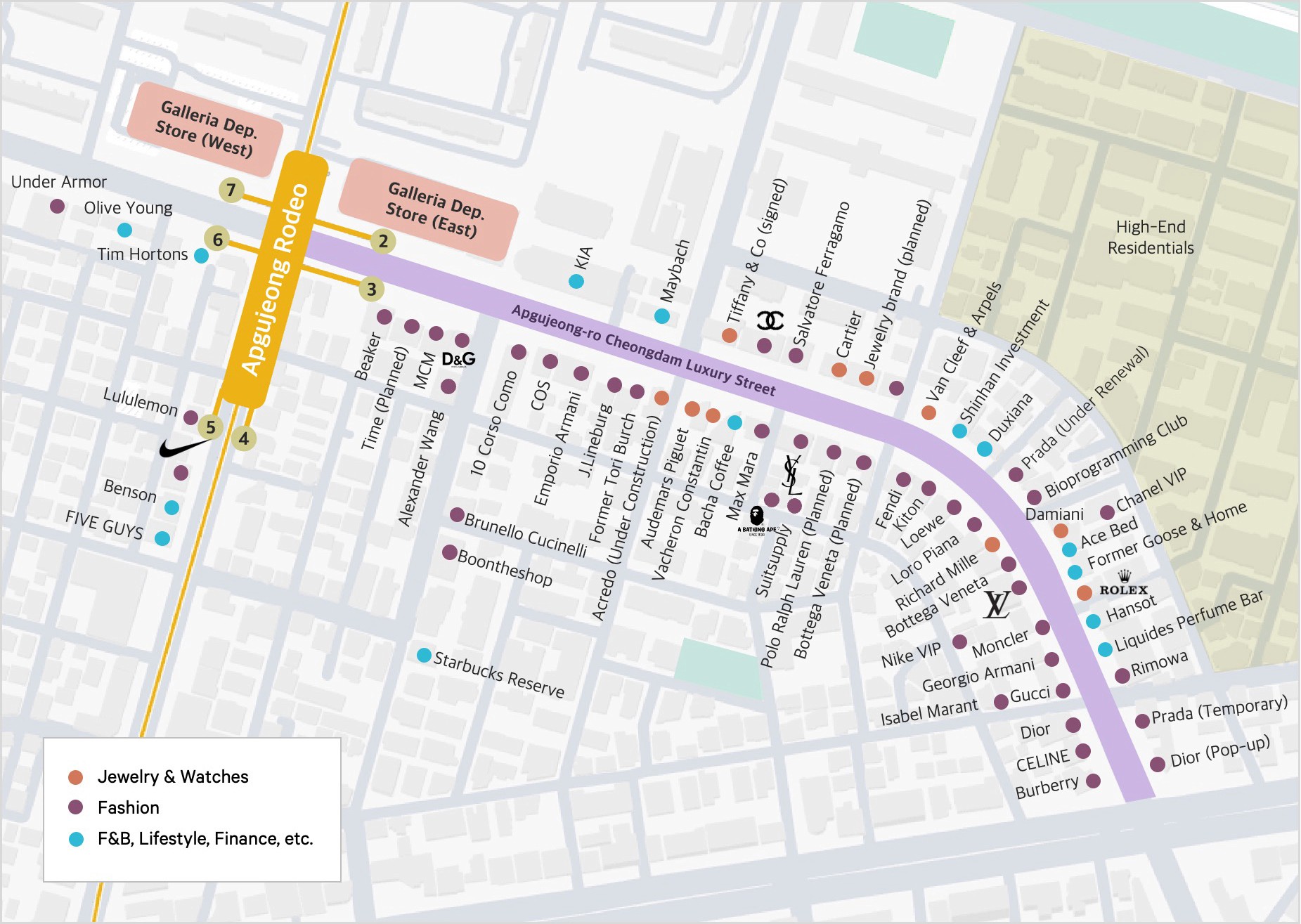
The North-South Divide: A Battle for Natural Light and Strategic Branding
The stark contrast in positioning between the North side (South-facing) and the South side (North-facing) along Apgujeong-ro is by no means a coincidence. It is the calculated result of Retail Engineering, meticulously designed around category-specific product traits and the customer journey. Within the exclusive territory of Cheongdam-dong, global luxury houses are engaged in an invisible war to preemptively secure the optimal Orientation that maximizes their brand’s strategic weaponry.
The concentration of High Jewelry and Watch houses (such as Rolex, Van Cleef & Arpels, Tiffany & Co., Damiani, etc.) along the Northern line of Apgujeong-ro is driven by a clear objective: securing the rich natural light of a South-facing orientation.
These brands prioritize a South-facing position to maximize the "Fire" (dispersion of light) inherent in gemstones. However, the strategy extends beyond illuminating the products themselves. These houses design the building exteriors to function as gems. By utilizing specialized cladding materials that react to direct sunlight, the architectures shimmer like massive diamonds, projecting a powerful brand presence that can be felt from a distance. For these brands, the Northern line is a strategic stronghold where both product and architecture are perfected through the "Art of Light."
One of the high Jewelry brand serves as a prime case study, solidifying its market dominance by operating two separate locations (the Seoul Maison and the legacy boutique) exclusively along this strategic Northern line. Their recently established Maison does more than just showcase jewelry; the exterior itself is engineered to sparkle. The specialized facade materials, when hit by direct sunlight, radiate a brilliance that powerfully broadcasts the brand’s prestige not just to pedestrians, but to high-net-worth individuals traveling by vehicle.
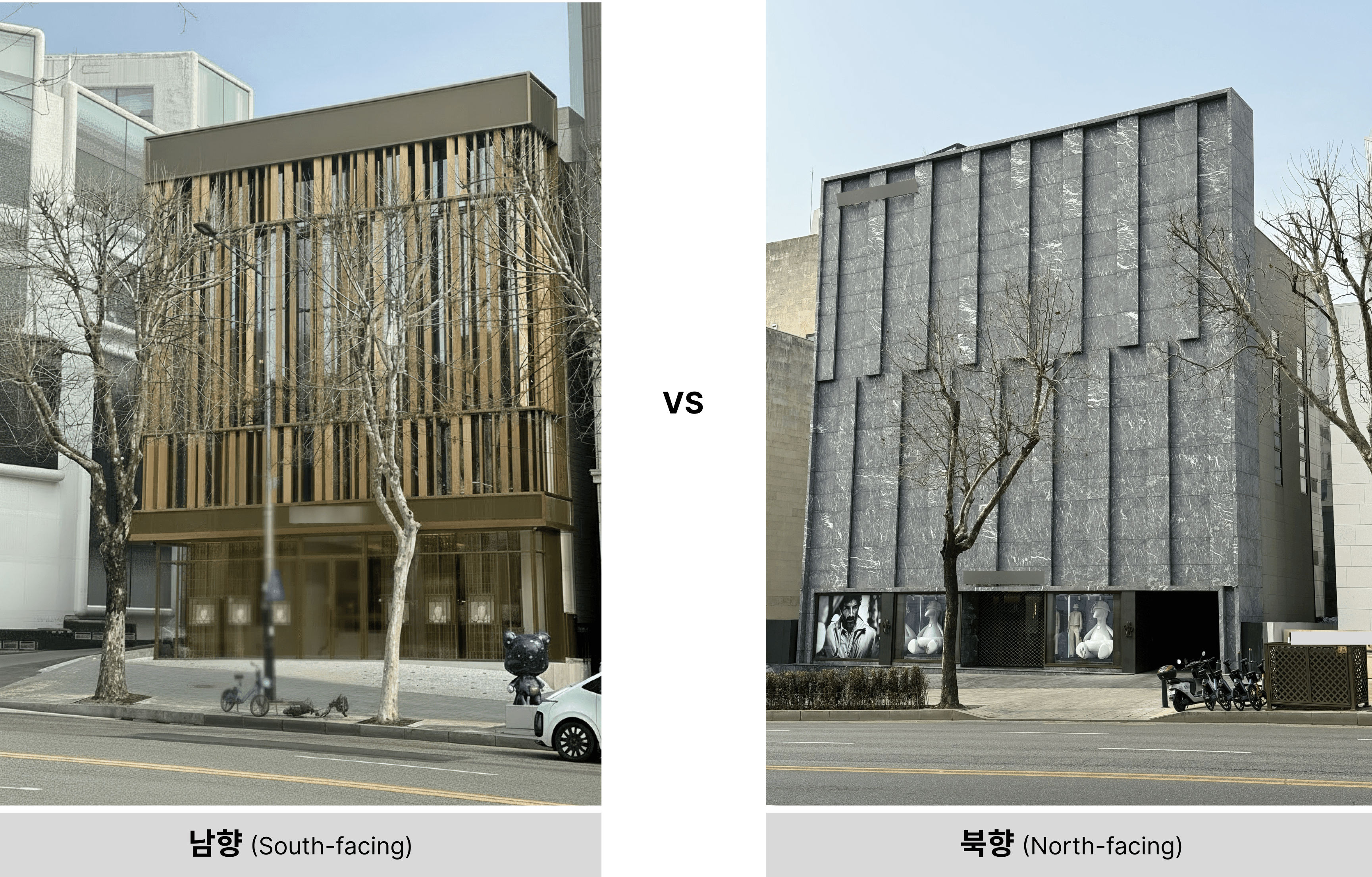
The South Side Concentration: Fashion Houses and the Construction of a Visual Sanctuary
Conversely, the fashion houses positioned along the Southern line—including Louis Vuitton, Dior, Burberry, and Gucci, as well as Loro Piana, Moncler, Fendi, Celine, and Loewe—adopt an entirely different spatial strategy. Their facades are less about windows looking in and more akin to "Monolithic Sculptures" that visualize the brand's heritage. The core objective is not merely to enclose the interior, but to maximize the exterior design to symbolically project the brand’s entire worldview through the architecture itself.
One of the fashion brand's facade is finished in black and white marble — materiality in place of transparency. The interior is not visible from the street. The brand’s world sits behind the facade, not in front of it. For the fashion houses on the Southern line, the location is not a place to catch the light, but a stage to anchor an urban landmark by architecturally manifesting the brand’s narrative.
[Expert's Insight]
"For jewelry brands, location is synonymous with 'securing light.' Conversely, fashion houses prioritize manifesting the brand’s essence over natural vistas to expand the consumer experience.
It is crucial to understand that Cheongdam-dong is fundamentally a 'Non-pedestrian District,' where vehicular movement overwhelmingly dominates foot traffic. Consequently, brands focus on 'Grand Visibility'—achieved through the architectural sculpturing of the entire building and strategic nocturnal lighting—rather than intricate window displays.
These designs are engineered to be imprinted on the mind even from a car traveling at 40km/h. This strategic execution effectively transforms the entire streetscape of Cheongdam into a massive, open-air gallery for the brands."
How Capital Occupies Space: High-Stakes Real Estate Strategies
The attitudes toward real estate among global luxury groups are starkly divided. This transcends the simple act of leasing; it is a major capital play—a strategic bet placed on the high-end Korean market. In Cheongdam-dong, for a brand to occupy a specific site is not merely about opening a store, but rather a process of physically enshrining the brand’s permanence.
Direct Ownership Strategy: Canonizing the Brand through Territorial Expansion
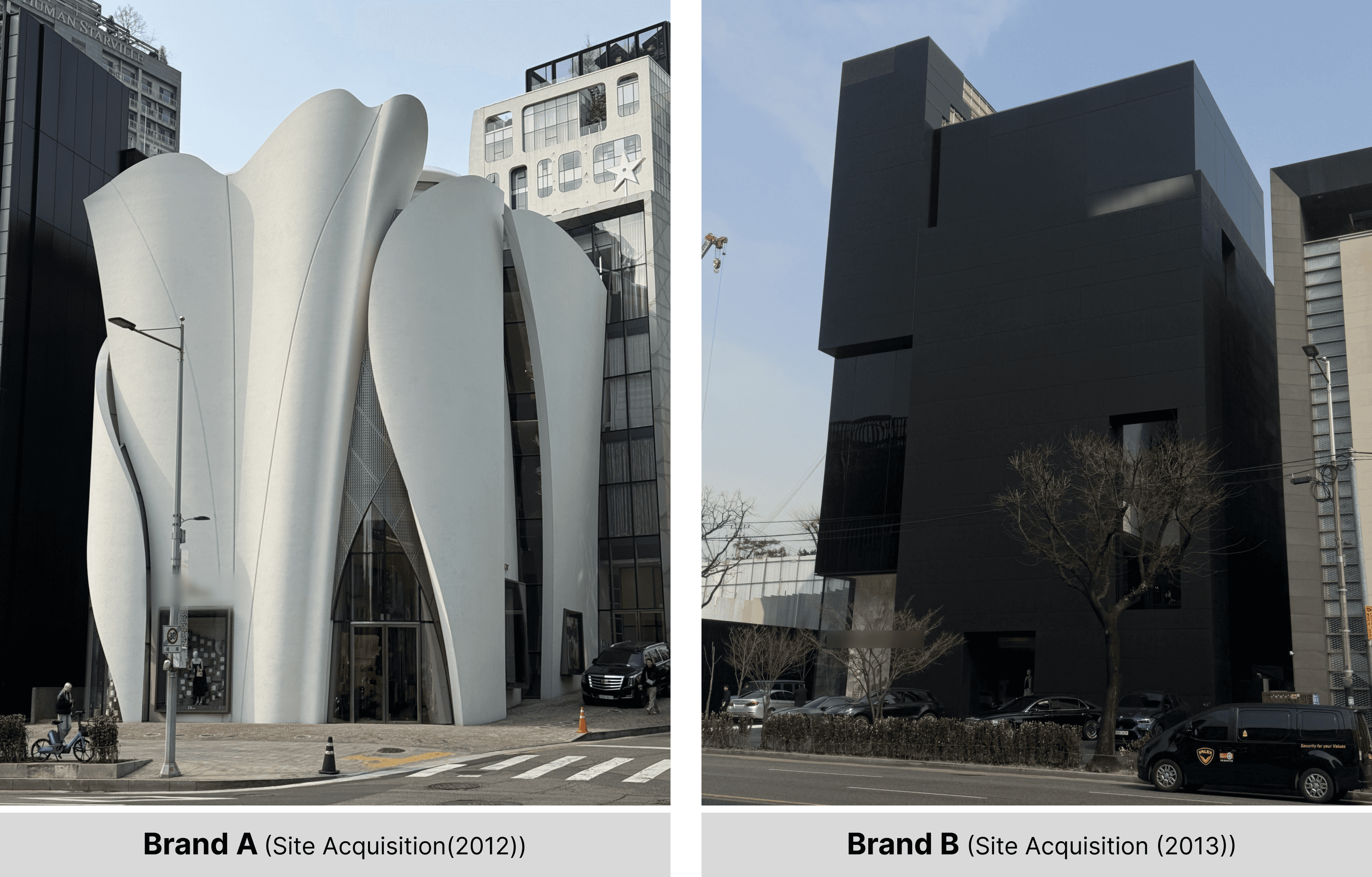
LVMH and Chanel adopt an Asset-Heavy Strategy, acquiring core land parcels and constructing new buildings from the ground up. In 2013, Brand B made headlines by purchasing its site for a record-breaking sum of approximately 70 billion KRW. Similarly, Brand A secured its own strategic foothold by acquiring a multi-billion KRW parcel.
What is particularly noteworthy is that the capital injected into interior architecture and spatial production often rivals the astronomical costs of the land acquisition itself. To manifest a brand’s philosophy through spatial aesthetics, these luxury houses frequently pour an amount equal to the combined cost of the land and construction into interior detailing alone.
The motivation behind choosing to build these "sanctuaries" over paying rent is clear: it is not only to capture capital gains from rising land values but, more importantly, to exert absolute control over every detail—from the building’s facade and internal flow to the finest finishing materials—ensuring the brand identity is projected without even a marginal margin of error.
Lease-Hold Strategy: Strategic Flexibility Meets Long-Term Occupancy
In contrast, brands like Brand D adhere to an operational model that intentionally avoids direct real estate ownership or capital investment in fixed assets. Rather than locking capital into physical buildings, they focus on redirecting those resources into the core essence of the brand: Craftsmanship, the elevation of customer experience, and strategic marketing. This is a philosophical choice to stay true to their primary mission—the dissemination of brand heritage—rather than pursuing real estate gains.
However, the "lease" they enter into is fundamentally different from a standard rental agreement. These houses inject tens of billions of KRW in Capital Expenditure (CAPEX) to manifest the brand’s universe, securing this investment through ultra-long-term lease agreements that typically span a minimum of 10 years.
By securing occupancy rights for over a decade, they execute a pragmatic "territorial strategy." This allows them to establish a dominant presence in the strategic stronghold of Cheongdam-dong while mitigating the risks associated with asset ownership. Ultimately, for these brands, a Cheongdam flagship is not an object of real estate investment, but a "Strategic Transmission Point" for the brand experience, staked on a ten-year horizon.
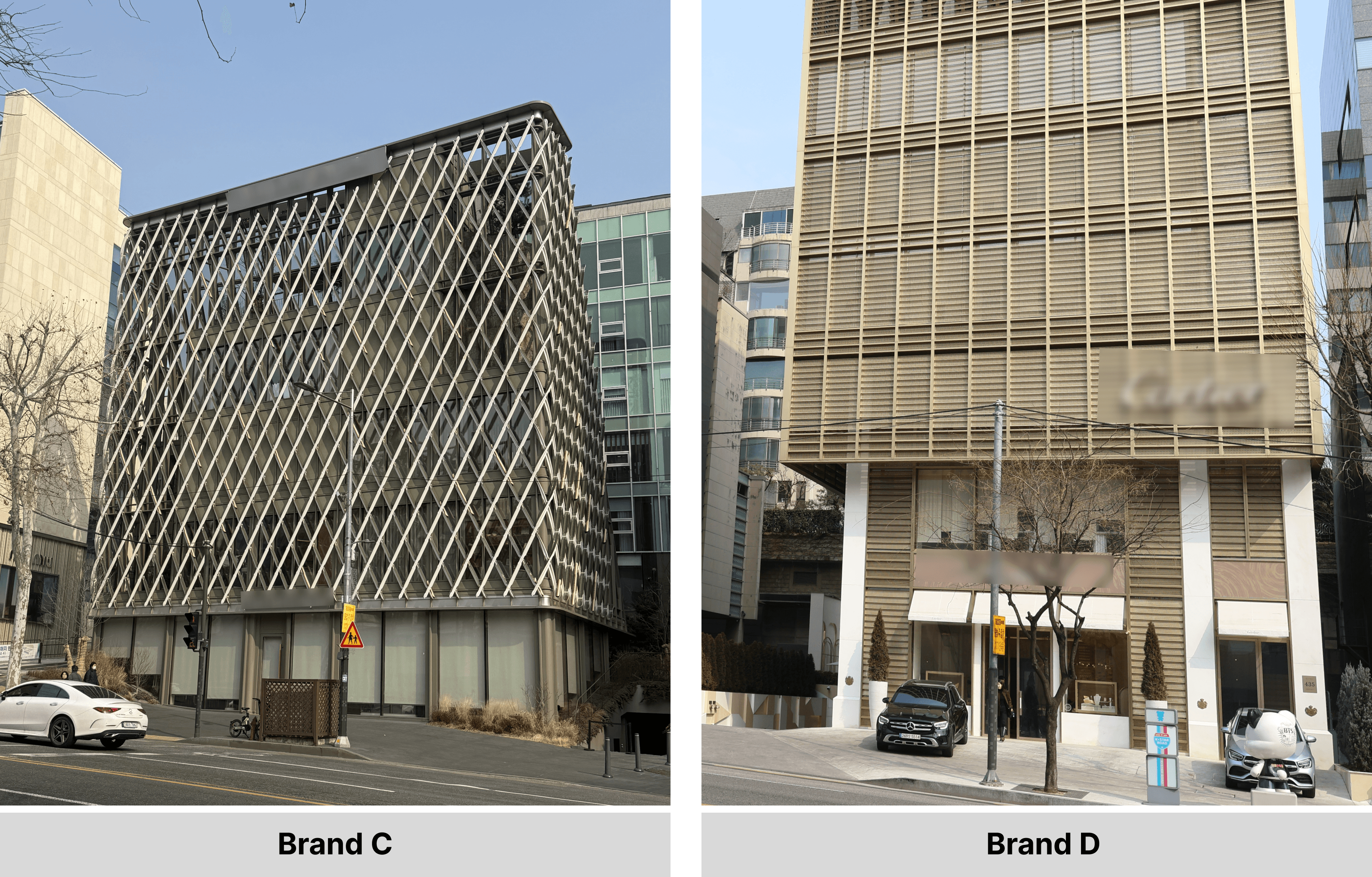
A critical point of distinction here is the extraordinary duration of these lease terms, which typically span a minimum of 10 years. Securing such a decadal tenure of occupancy is an absolute prerequisite for these brands to amortize the staggering initial Capital Expenditure (CAPEX)—often reaching tens of billions of KRW—and to ensure the stable operation of the site.
For these global houses, a flagship in Cheongdam-dong is far more than a mere retail outlet; it is a strategic stronghold where the brand stakes its destiny for the next decade.
[Expert's Insight]
"The reason global brands inject tens of billions of KRW into Cheongdam—whether through direct ownership or long-term leases—is that these locations have evolved far beyond mere sales channels. Today, they represent a complex of specialized formats, seamlessly integrating private VVIP lounges, curated exhibition spaces, and branded lifestyle cafes.
By investing such staggering capital to erect these 'architectural fortresses,' brands effectively raise the barrier to entry for the entire district. Within these walls, they provide an intimate and overwhelming brand experience—one that is strictly reserved for the chosen few who are permitted to step inside."
The League of Solid Lineage and Capital
The land ownership structure of Cheongdam-dong’s luxury district is a complex web involving retail giants, traditional old-money families, and elite high-net-worth individual investors.
Major domestic retail conglomerates act as dominant landlords, owning extensive portfolios of luxury brand buildings and core land parcels. Furthermore, there is a clear trend where conglomerate owner families and global luxury groups strategically acquire land to operate their own flagship stores, effectively forming "Brand Towns."
Among individual owners, the landscape is populated by figures with immense wealth, such as traditional dynastic families or world-renowned designers. Notably, high-income professionals and successful entrepreneurs also participate as key players, acquiring prime locations as part of their real estate investment portfolios. These owners often operate within a closed community, trading assets amongst themselves rather than listing them on the open market. This opaque structure creates a unique barrier to entry in Cheongdam-dong that cannot be breached by capital alone.
[Expert's Insight]
"Landlords in Cheongdam-dong do not simply chase rental yields. Instead, they equate the caliber of the brand occupying their building with their own social standing. Whether they are conglomerate-affiliated heirs managing third-generation succession or ultra-high-net-worth individuals, these owners prioritize a brand’s Grade and Prestige over lease terms. This is precisely why a closed ecosystem persists—one where local brands lacking significant capital and global recognition find it nearly impossible even to gain a foothold."
The Discreet Expansion: Seclusion as a Strategic Asset
Beyond the dazzling facades of the main thoroughfare, Cheongdam-dong continues its "Vertical and Horizontal Expansion" through back alleys and upper floors. Designing clandestine routes that evade the public eye—reserved exclusively for high-net-worth individuals—is the core strategy that has transformed Cheongdam into a global sanctuary for high-end luxury.
Hidden VVIP Sanctuaries: The "Enclave" Beyond the Glitz
As general foot traffic began to increase on the main Apgujeong-ro strip, luxury houses started relocating their most exclusive VVIP zones to the backstreets and upper levels of their buildings. A prime example is Brand B, which, in addition to its public-facing flagship, maintains separate strongholds in secluded rear areas or private floors. These spaces provide an extremely exclusive environment shielded from the gaze of outsiders.
This "Discreet Expansion" is a sophisticated psychological tool used to maintain brand scarcity by severing contact with the masses. These closed-off spaces, where window shopping is impossible, operate like "Private Member Clubs" accessible only by invitation. Here, clients enjoy the brand’s most prestigious collections and bespoke hospitality services.
"Who Walks to a Cheongdam Boutique?": The Logic of Private Access
By global retail standards, narrow sidewalks and steep inclines are considered major site flaws. However, for Korea’s VVIPs, these are strategic advantages. The district's structure is meticulously optimized for vehicular flow and valet parking, enabling "Point-to-Point" shopping—allowing clients to arrive privately at the entrance of their destination without any public exposure. While this "unfriendliness" may seem bizarre to foreigners, in Korea, it is the defining element that establishes the prestige of a high-end trade area.
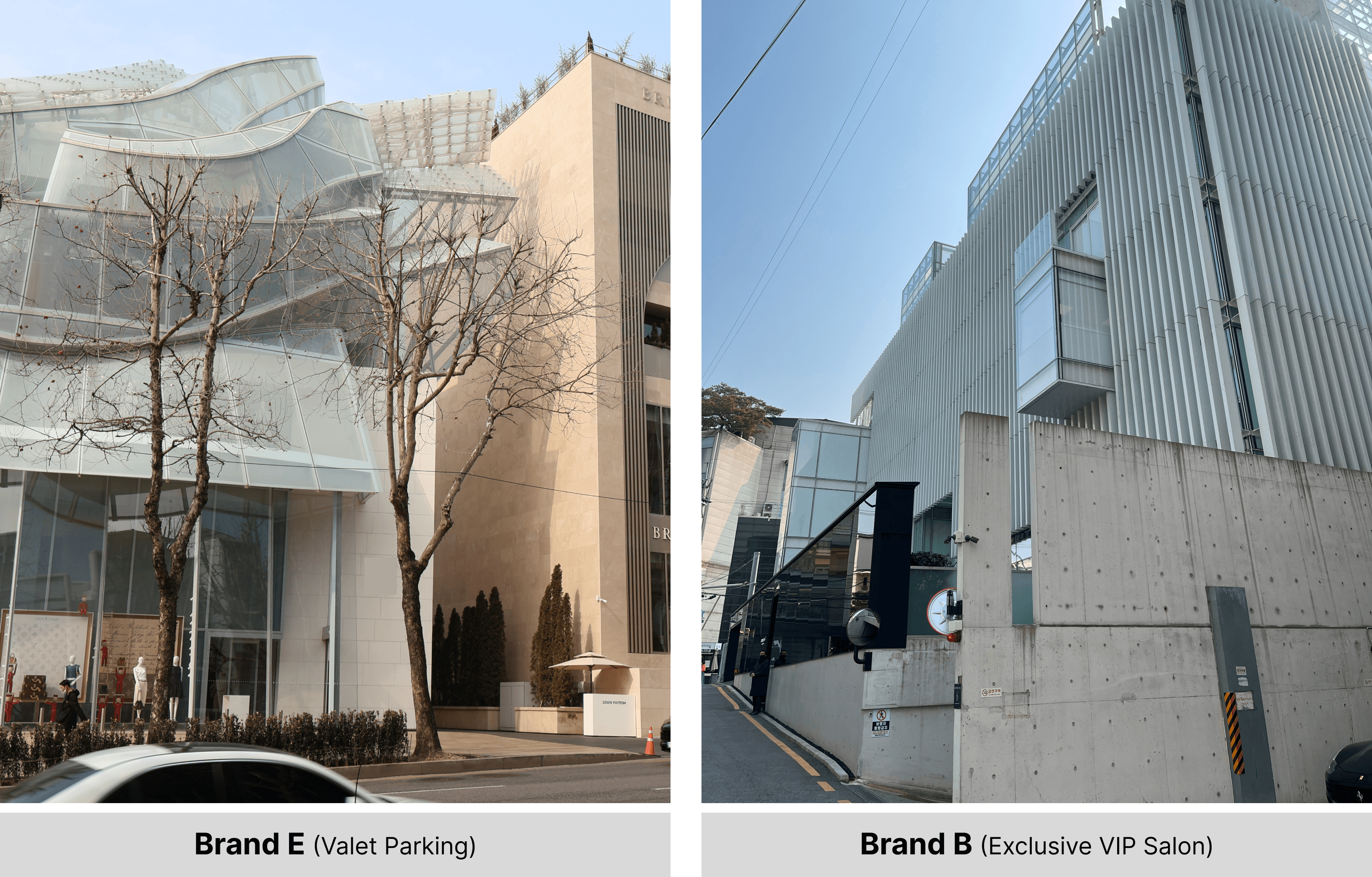
[Expert's Insight]
"In Cheongdam-dong, valet parking service is more than a mere convenience; it is the definitive 'final touch' that establishes a retail site’s prestige. The reason the value of back alleys is surging over main thoroughfares is that they provide the optimal secure environment for high-profile clients to come and go quietly by vehicle.
In the unique ecosystem of Cheongdam, a district that is 'friendly' to the general public cannot, by definition, be high-end. By effectively abandoning the sidewalk, Cheongdam has achieved its most discreet and beautiful victory."
Ultimately, Cheongdam-dong is a peculiar district that overtly defies the universal urban formula of the "Walkable City." Instead, it functions as an exclusive social arena where brands preemptively secure the natural light that best illuminates their products, enshrine tens of billions in capital over a ten-year horizon, and where landlords and brands mutually validate each other’s "Social Grade."
This is precisely why the back alleys of Cheongdam—which may seem like nothing more than narrow, inconvenient lanes to an outsider—become a far more intense and discreet battlefield for global houses than any main thoroughfare. The true value of Cheongdam-dong is not found in the dazzling show windows visible to the public; it is perfected beyond the tinted glass of a vehicle and behind the closed doors of the backstreets.
© Copyright 2026. All rights reserved.
This publication has been prepared in good faith, based on CBRE Korea's current anecdotal and evidence based views of the commercial real estate market. Although CBRE Korea believes its views reflect market conditions on the date of this presentation, they are subject to significant uncertainties and contingencies, many of which are beyond CBRE Korea’s control. In addition, many of CBRE Korea’s views are opinion and/or projections based on CBRE Korea’s subjective analyses of current market circumstances. Other firms may have different opinions, projections and analyses, and actual market conditions in the future may cause CBRE Korea’s current views to later be incorrect. CBRE Korea has no obligation to update its views herein if its opinions, projections, analyses or market circumstances later change.
Nothing in this publication should be construed as an indicator of the future performance of CBRE’s securities or of the performance of any other company’s securities. You should not purchase or sell securities-of CBRE or any other company-based on the views herein. CBRE Korea disclaims all liability for securities purchased or sold based on information herein, and by viewing this publication, you waive all claims against CBRE Korea as well as against CBRE Korea’s affiliates, officers, directors, employees, agents, advisers and representatives arising out of the accuracy, completeness, adequacy or your use of the information herein. No part of this publication may be reproduced, quoted, distributed, or disclosed to any third party without the prior written consent of CBRE Korea.

street
Sep 3, 2026
Why Global Brands Are Heading Back to Myeong-dong
The Generational Shift and Retail Analysis of a 100-Year-Old Prime Shopping District

Street
Jul 27, 2026
Dosan Park Commercial District Analysis | The Alley Where Brand Drives Land Value
Comparing Seongsu with Dosan: the opposite growth formulas of two Seoul hotspots

street
Jul 13, 2026
Gangnam ② - 75% of Gangnam-daero is Medical
A place where hospitals fill the upper floors emptied by the pandemic, and the wallets of foreigners crowd.

street
Jun 22, 2026
Gangnam ① - Gangnam-daero Retail, Chosen by Global Brands
From 18 vacancies three years ago to just two. The real reason why low-floor retail along Gangnam-daero has made a complete comeback.

street
May 26, 2026
Bangkok Retail 101 ②
Bangkok shopping malls want K-brands. The question is how to get in.
street
May 26, 2026
Bangkok Retail 101 ①
The Developer's Playground: What Sets Bangkok's Retail Evolution Apart from Seoul

street
Apr 13, 2026
Hannam-dong, Seoul's private club. ②
Zero vacancy. Key money reaching 1.3 billion Korean won. Inside Hannam-dong's brand selection market, where who you are matters more than what you offer to pay.
street
Apr 13, 2026
Hannam-dong, a private club in Seoul. ①
Between Seongsu's raw energy and Dosan's polish — how Hannam-dong became Asia's most credible ground for testing a global brand's Korea positioning.
street
Apr 13, 2026
Same Bukchon, Different Strategy ③
Blue Bottle, New Balance, Adidas, Le Labo — how Hwadong and Sogyeokdong became the global flagship core of Seoul's Bukchon retail market.

street
Apr 13, 2026
Same Bukchon, Different Strategy ②
Why Amorepacific spent 30 billion won acquiring a hanok compound in Gahoe-dong — and how Bukchon-ro 5-gil became Seoul's fastest-growing K-brand retail cluster.
street
Apr 13, 2026
Same Bukchon, Different Strategy ①
Anguk Station and Gye-dong-gil: The entrance to Bukchon, focusing on the flagship near Anguk Station and the concentration of F&B on Gye-dong-gil.