Back
Share
Like

street
Article Highlights
0% Vacancy Rate and Location Competitiveness: Vacancies on the main first floor of Myeongdong exhausted and pre-leases surging, quarterly retail sales rebounding by +69%.
Tenant Generational Shift: Mega flagships, large drugstore pharmacies, and mainland Chinese brands directly entering the market due to the increase in Free Independent Travelers (FIT).
No. 1 Sales Hexagonal Commercial District: Dominating 6 out of the top 10 sales locations in Seoul High Streets, proving both branding and actual sales simultaneously.
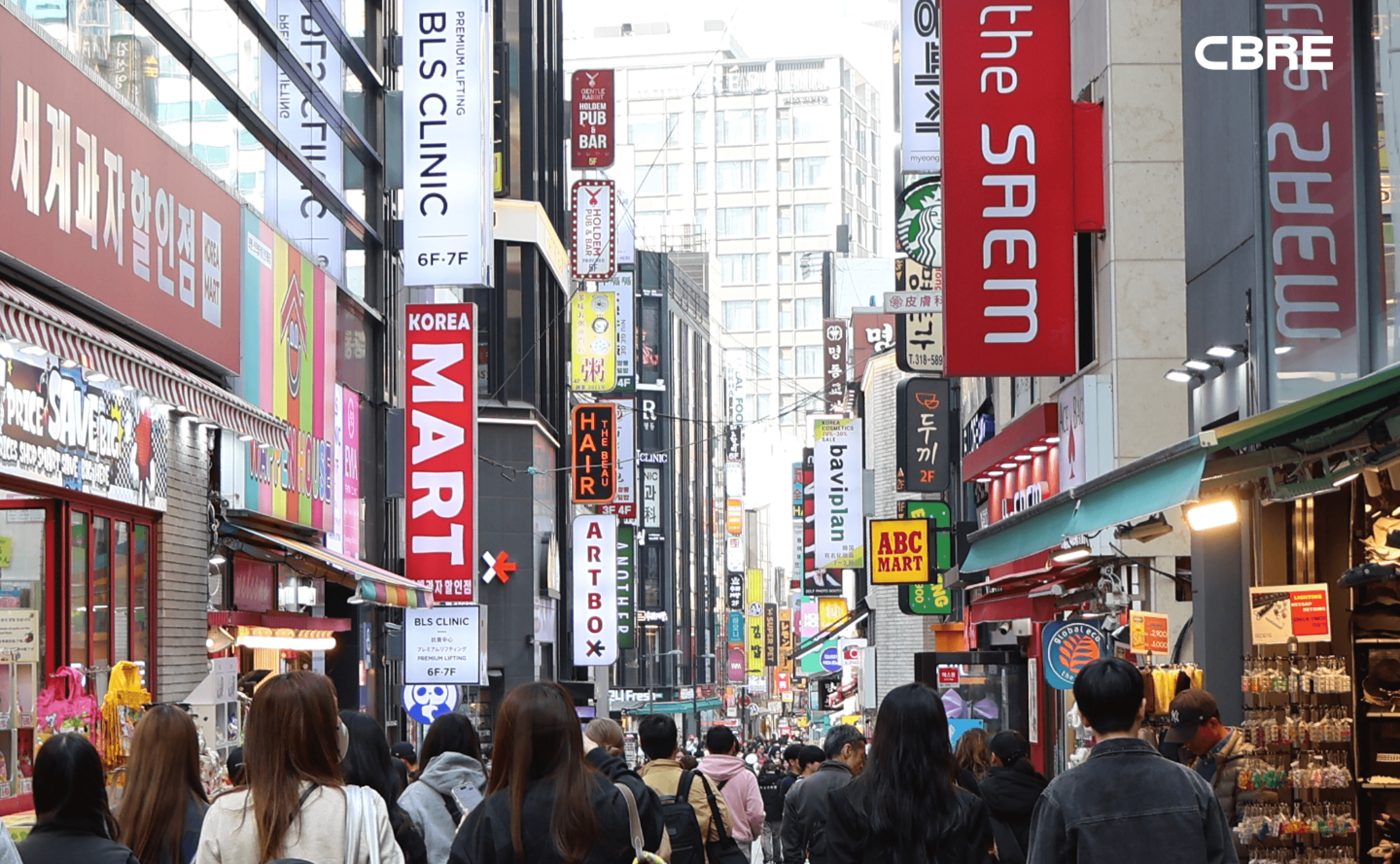
Myeongdong is not just an old bustling district. It is the main stage of Seoul that has never relinquished its hold on Korea's most expensive land and the leadership of trends whenever the times changed over the past 100 years.
The Birth of Modern Commerce and Culture (1920s–1960s): It was Gyeongseong's busiest district, home to Mitsukoshi Department Store (now the Shinsegae Main Store) and the Bank of Joseon, and a cradle of modernist culture where writers and artists gathered around post-war teahouses.
The Mecca of Local Trends and Youth Culture (1970s–1980s): "Myeongdong Fashion" was born in the tailor shop alleys, and the youth culture, represented by acoustic guitars and draft beer, combined with Myeongdong Kyoja and large theater districts to set the standard for Korean shopping and dining out.
Global SPA and K-Beauty Inbound Special Zone (1990s–2010s): Following the development of Gangnam, it transformed into the first port of call for global SPAs and a holy land for road shop cosmetics, restructuring itself into an inbound-only shopping commercial area where Chinese tourists (Youke) and foreign tourists opened their wallets.
Overcoming Crisis and Evolving into a Mega Platform (2020s–Present): Although it experienced a crisis with an official statistical vacancy rate of around 50% due to THAAD and pandemic shutdowns (industry experts evaluate that the perceived vacancy rate was well over 50% based on core ground-floor retail stores, excluding upper floors), after the endemic, it reorganized its commercial district power from single road shops into a complex inbound platform where conglomerate mega-flagships and global capital are concentrated.
A Complete Return Proven by Numbers
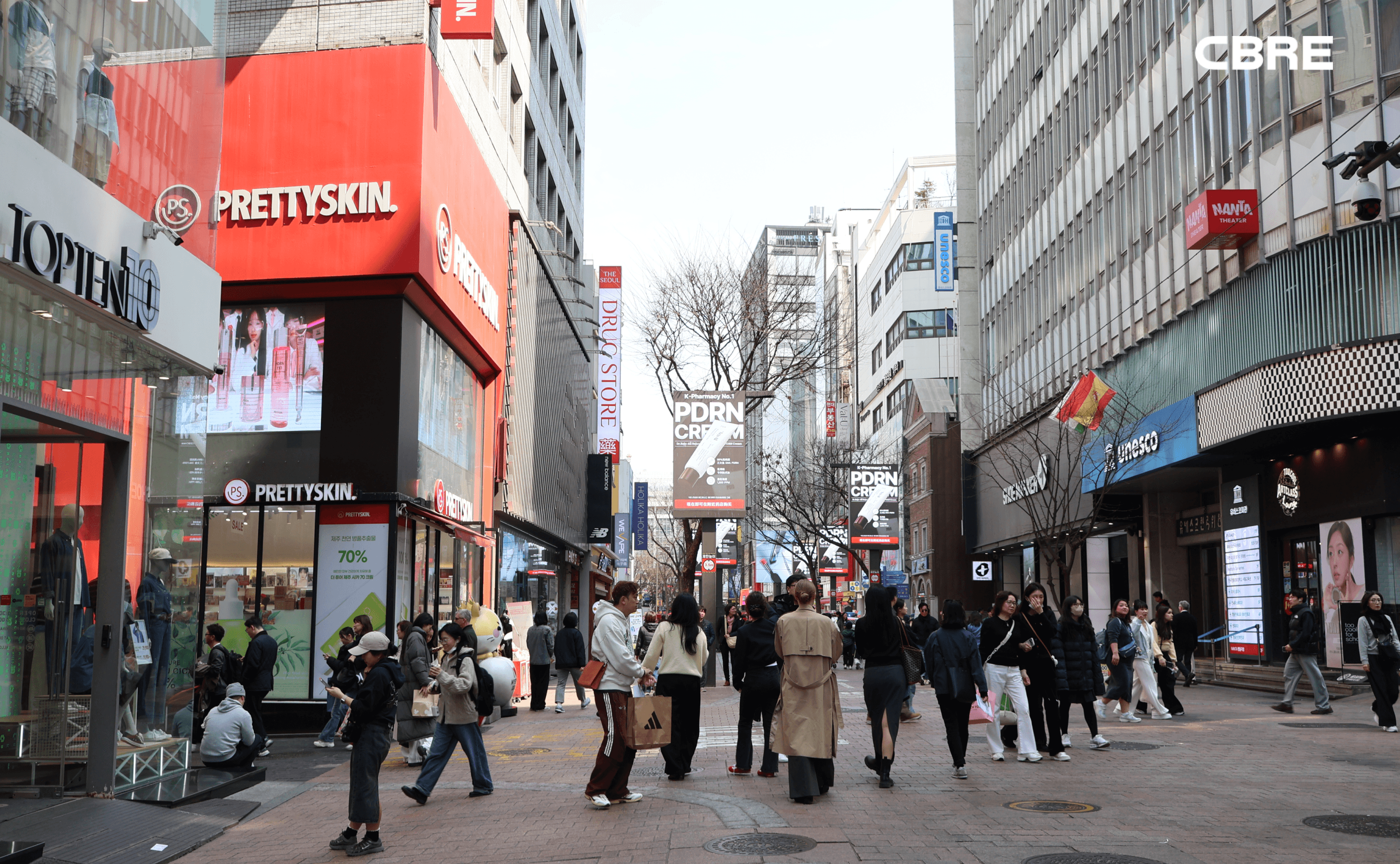
The essence of Myeongdong has never changed. It simply suffered the deepest slump during the three years when inbound travel stopped, and recovered most explosively once the borders opened.
The data proves this. According to CBRE Korea Retail Research, quarterly retail sales reached KRW 109.9 billion, an increase of +69% compared to five years ago, and the quarterly floating population increased by +61% to 1.61 million. The number of passengers getting on and off at Myeongdong Station surged by +153% in 2025 compared to 2021, leading the recovery of the downtown area. The foreign short-term resident population also averaged 14,931 per day, ranking an overwhelming first among Seoul's 11 major high streets (1.5 times that of second-placed Hongdae with 9,866).
Therefore, the core analysis of Myeongdong now is not simply the "recovery rate." It is the structural shift leading from "vacancy exhaustion → rent increases → tenant qualitative improvement" on top of the massive recovered traffic.
0% Real Vacancy Rate on the Main Street: The 'Location Battle' Begins
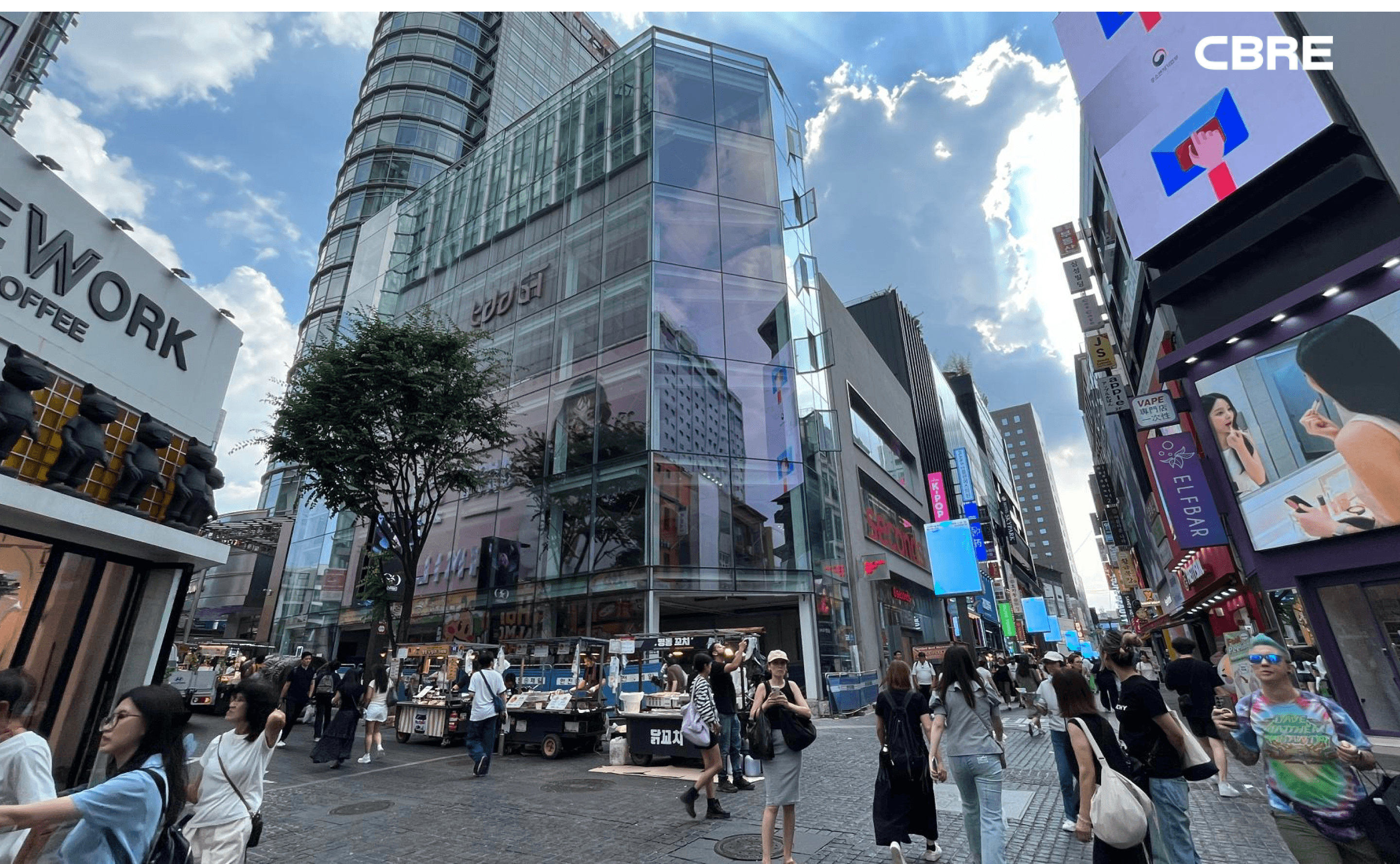
According to the Korea Real Estate Board, the vacancy rate for medium-to-large commercial properties in Myeongdong in the second quarter of 2026 is calculated at 6.5%. This is a sharp drop of over 12 percentage points from 18.7% in the third quarter of 2024, perfectly contrasting with the rise in Seoul's average vacancy rate from 8.7% to 9.7% during the same period.
However, the statistical 6.5% only includes the outskirts and upper floors of the commercial district; the actual vacancy rate on the first floor of Myeongdong's main street practically converges to 0%. Remaining vacancies are limited to back alleys and non-core axes. Myeongdong has already finished the "vacancy-filling" phase and entered a "location battle" to secure top-tier positions. Indeed, even in field operations, it is difficult to find instantly available first-floor vacancies, so we are visibly sensing an increase in pre-contracting cases to secure key properties whose leases expire next year.

This battle immediately manifests as a rent gap. According to the Korea Real Estate Board, first-floor rents in Myeongdong rank first among major commercial districts in Seoul, reaching 1.7 times that of second-placed Gangnam-daero and 3.9 times the Seoul average. Since the first-floor premium is extreme, second-floor rents plummet to about 36% of those on the first floor, but when converted to absolute amounts, second-floor rents in Myeongdong are higher than first-floor rents in Ttukseom.
Of course, current rents are not at an all-time high. Based on the rental price index, Myeongdong is at about 71% of its peak in 2016. While maintaining the absolute highest rent level in Seoul, it is still in a phase of keeping room for upward movement toward its historical upper limit.
Duty-Free Passing and FIT Consumption: The Revival of Road Shops and the Reorganization of Main Streets by Chinese Consumption Trends
The spending path of consumption has also been structurally reorganized. While the share of duty-free shops in foreigners' card shopping expenditures shrank to 10.8%, large complex shopping malls (66.1%) and street road shops completely took over that space.
In the actual industry composition, the share of lifestyle and retail expanded from 9.8% to 14.1% over five years. The rapid growth of supermarket sales from KRW 2.7 billion to KRW 8.5 billion and convenience store sales from KRW 2.7 billion to KRW 6.7 billion clearly shows that the designated shopping mall consumption of tour groups has shifted to street consumption centered on Free Independent Tourists (FIT).
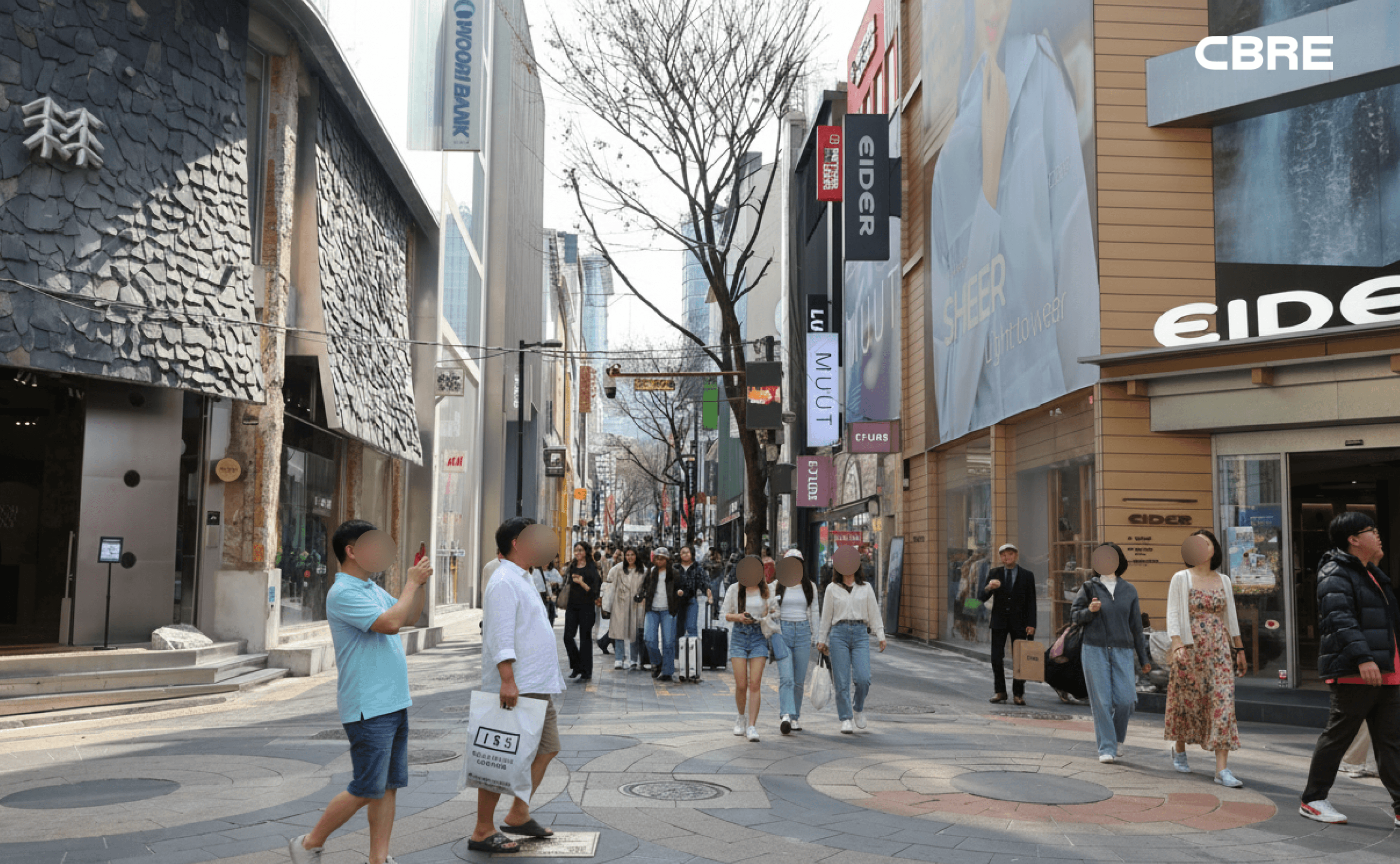
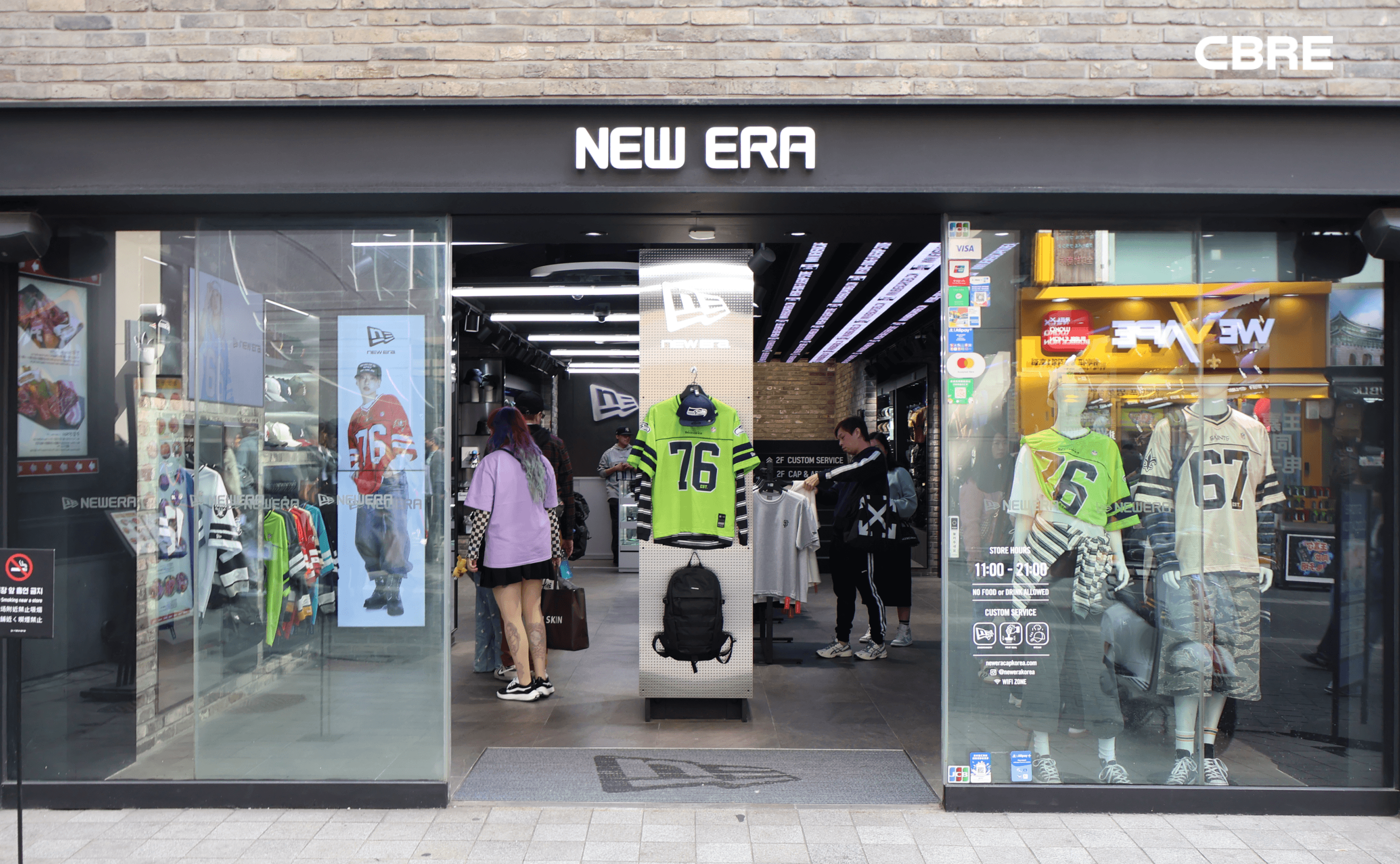
This revival of street consumption has completely realigned the tenant mix of Myeongdong's main road around targets for Chinese consumers. The most prominent axis is the occupation of main locations by major fashion brands that have proven powerful fandoms and performance in the Greater China region. Kolon Sport, which enjoys unrivaled popularity as premium outdoor wear in mainland China, MLB, the absolute powerhouse of K-street fashion, and Marithé François Girbaud and emis, which lead K-fashion, are firmly defending key spots on the main street, absorbing foreign shopping demand (with HBAF also recently completing its lease renewal).
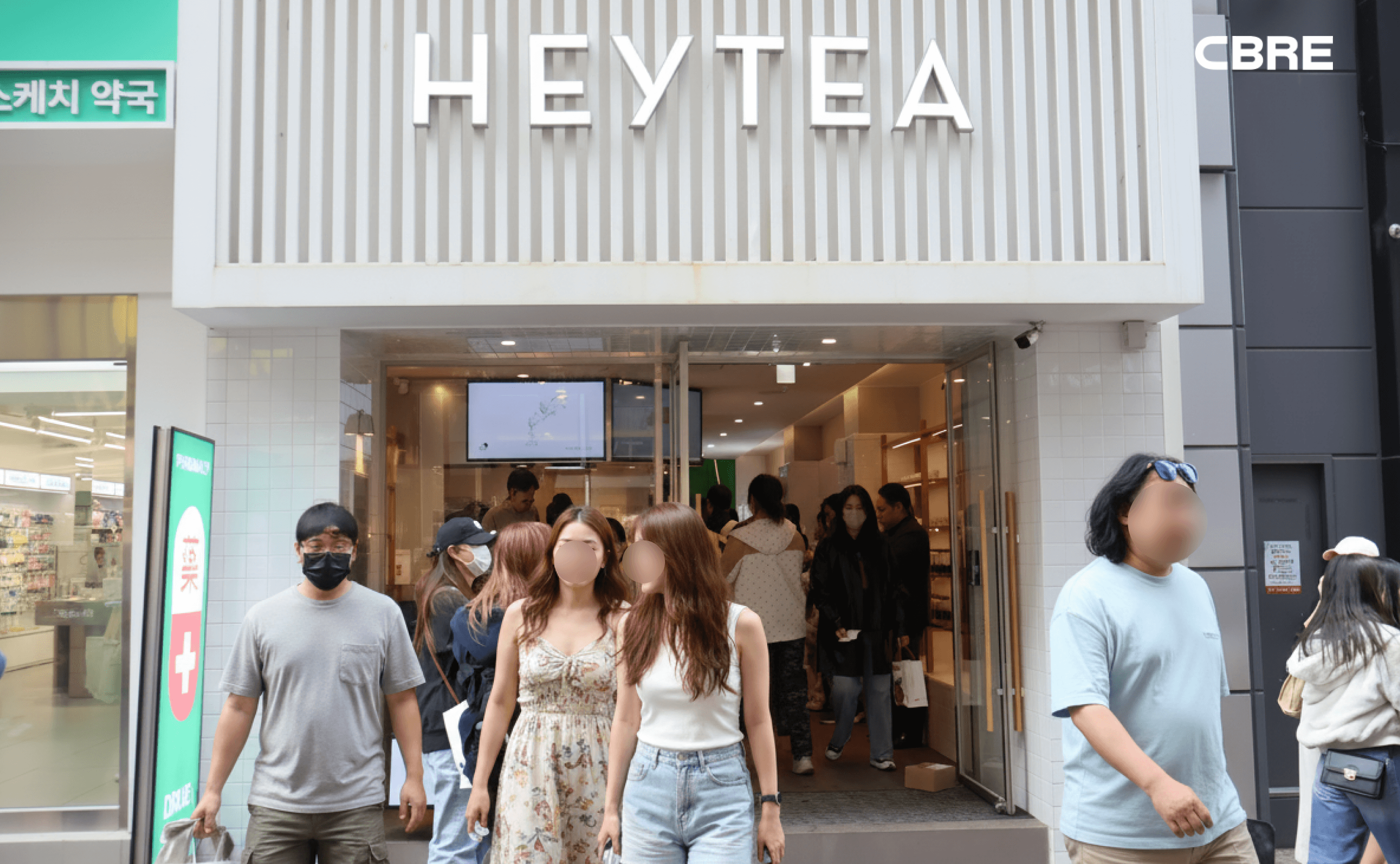
At the same time, the direct entry of mainland Chinese brands into Korea has accelerated. While China used to remain a simple "consumer" in Myeongdong, it has now stepped to the forefront as a "retail provider." Large-scale Chinese F&B, led by Haidilao, has established itself as a key anchor, and popular Chinese tea brands such as ChaPanda, Heytea, and recently "Auntea Jenny" (which opened its first store in the Sogong Hankuk Building on August 30) have joined one after another, rapidly reshaping the food and beverage landscape. With the addition of global IP retailers like Pop Mart, Myeongdong has evolved into a frontline testbed for measuring global marketability, where K-fashion favored by Chinese consumers and mainland Chinese retailers intertwine. The fact that the F&B sector ranked first in total commercial district sales with 47.3% and Korean food sales expanded to KRW 27.3 billion, 1.9 times that of five years ago, is also in line with this expansion of stay-type consumption.
Evolution of Function: From Dispensing Pharmacies to 'K-Medical Beauty Shopping Malls'
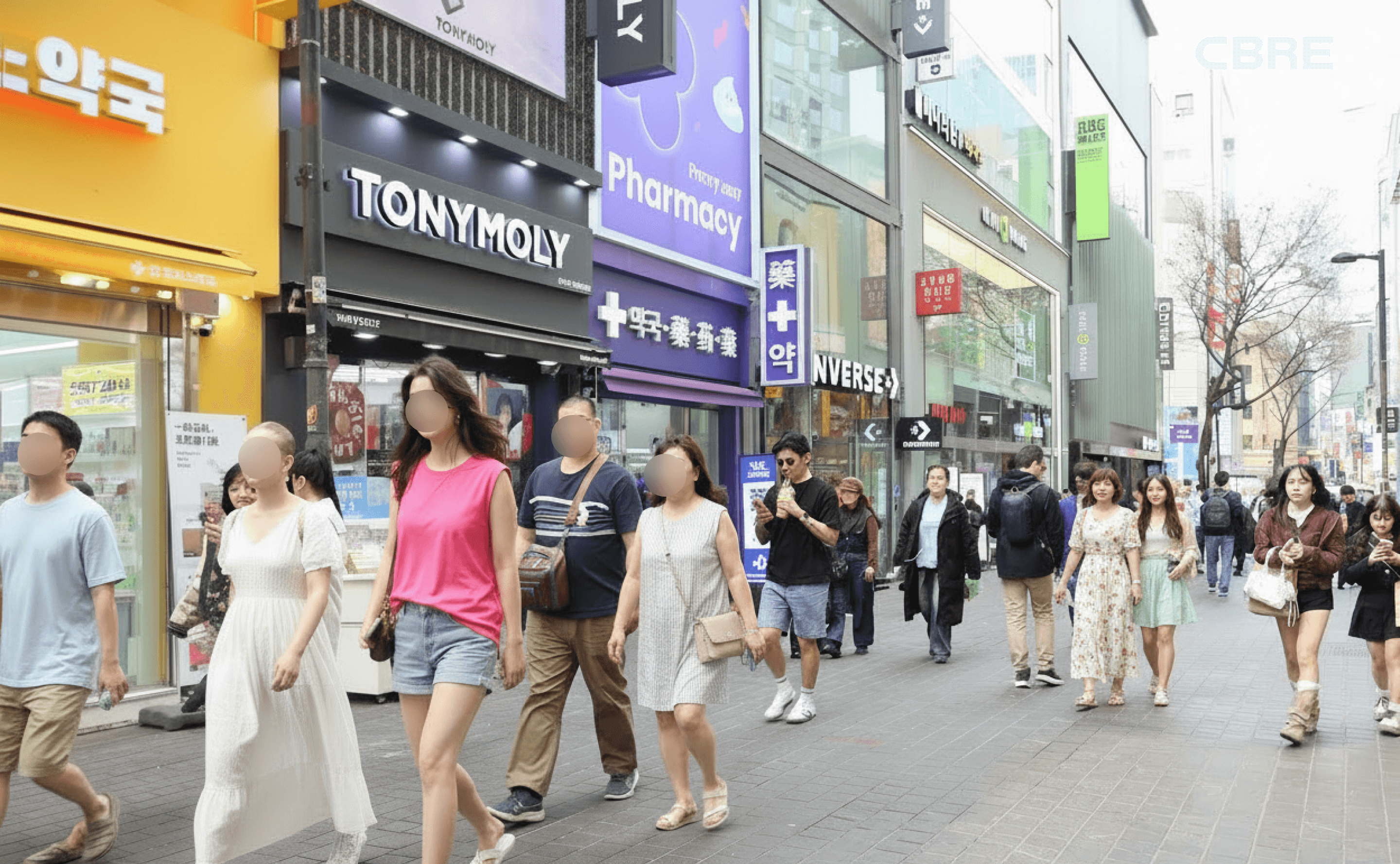
The most dramatic evolution in consumption categories is appearing in pharmacies. Pharmacies, which were traditional spaces for dispensing and selling medicines, have transformed into "derma-cosmetic & healthcare shopping spaces" for foreigners.
The data clearly proves this change. In the first half of 2026, the medical and wellness sector in foreign card consumption in Myeongdong grew by +68% year-on-year, recording the highest growth rate among all sectors. Of this, 65.8% is medical tourism, and the remaining share is beauty shopping.
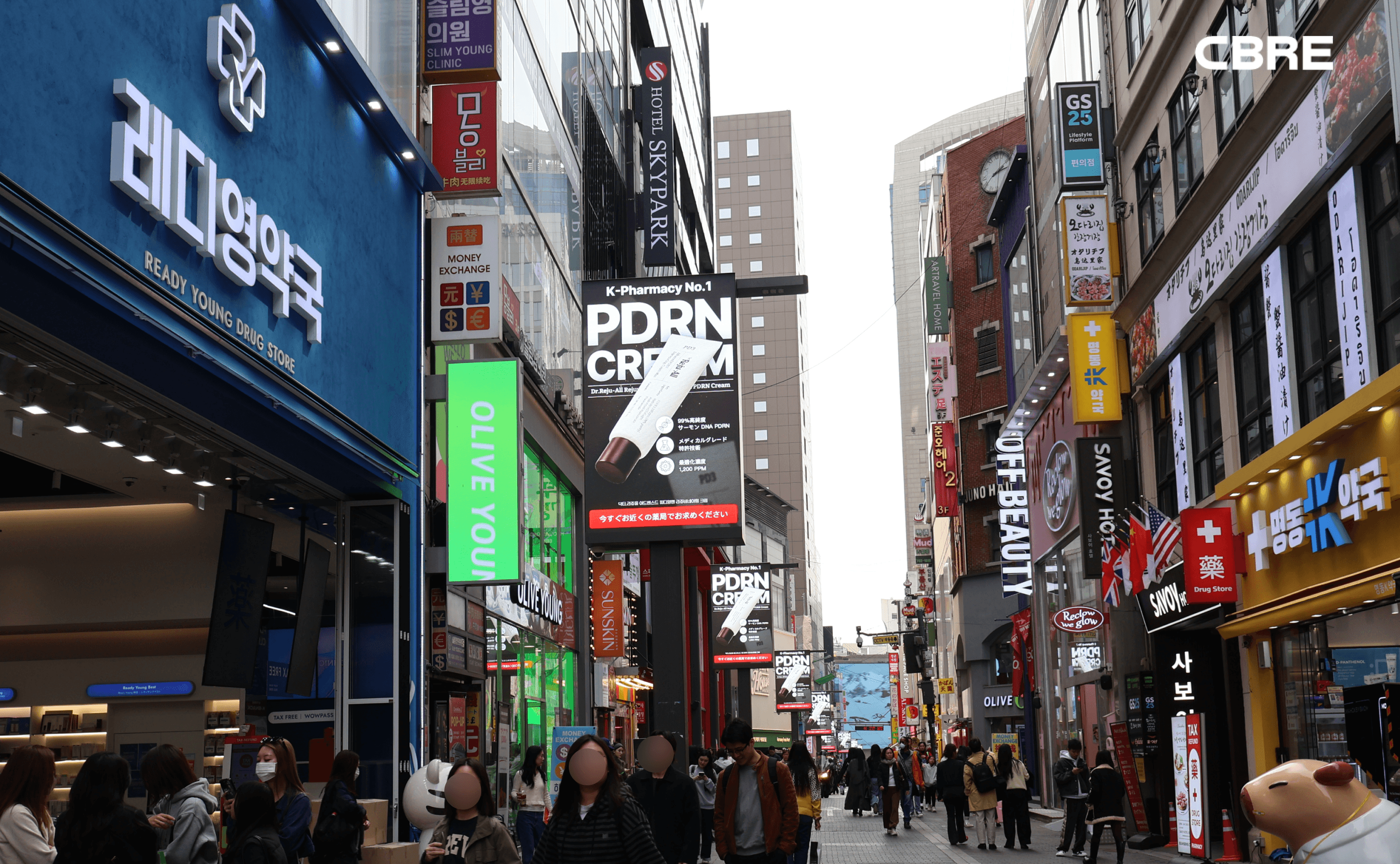
The store opening status is even more explicit. Among 11 new openings in Myeongdong over the past 30 days, 6 were pharmacies and 2 were clinics and skin aesthetic businesses, meaning more than 70% of new store openings were concentrated in medical beauty. As trust in K-beauty built through Olive Young expanded to highly functional skincare, nutritional supplements, and quasi-drugs, large drugstore-type pharmacies have completely established themselves as essential ports of call where foreign tourists fill up their suitcases.
Tenant Qualitative Improvement: Expulsion of Small Brands and Monopoly of 'Mega Flagships'
The reorganization of store sizes and brand weights is also being forced along with rising rents. Low-to-mid-priced non-brand and small K-designer brands, which enjoyed cheap short-term rents during the slump when vacancies peaked, were rapidly pushed out as soon as the commercial district normalized.
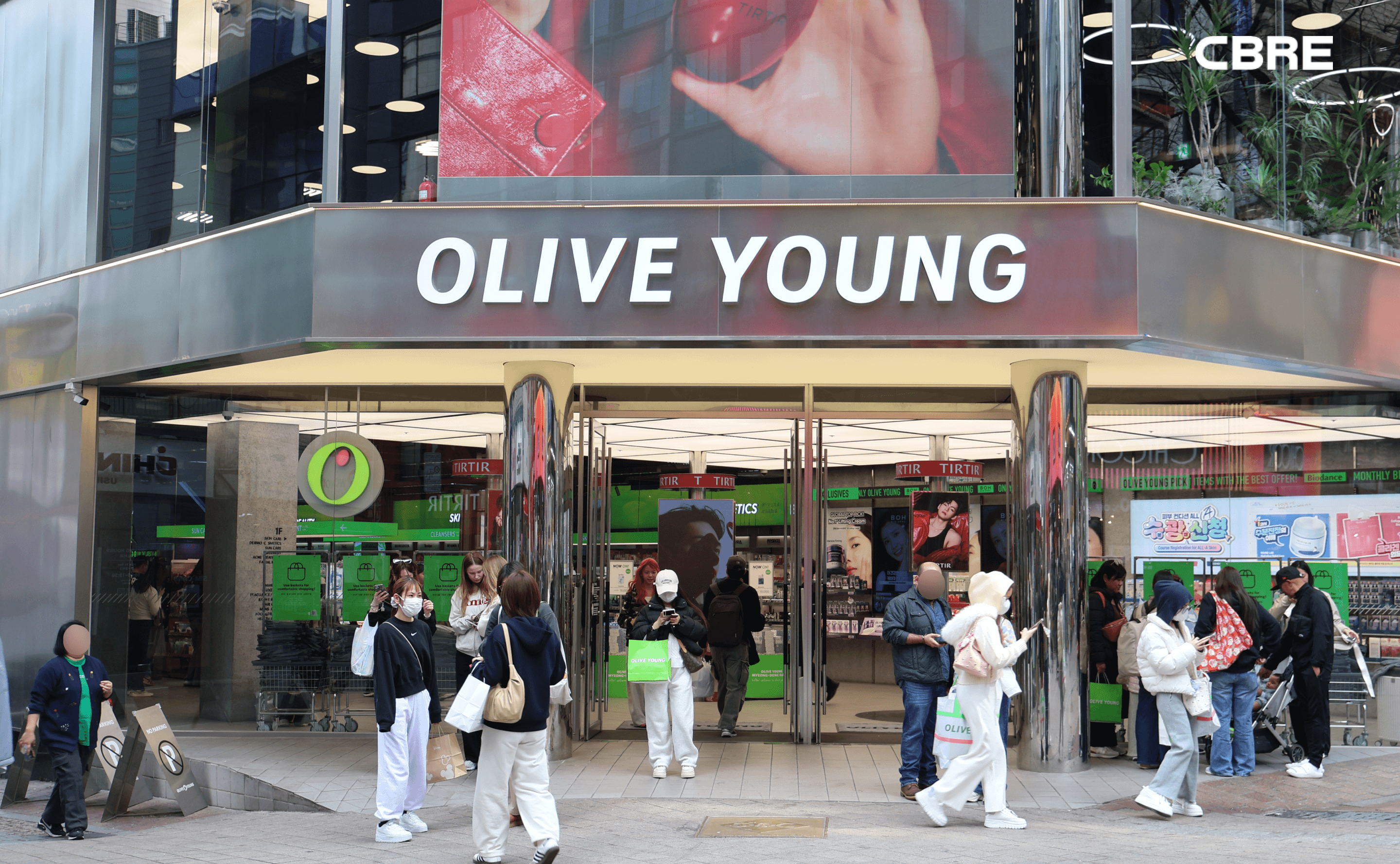
Filling those empty spots are mega flagship stores equipped with powerful capital and global distribution power, the most symbolic event of which is 'Uniqlo's re-entry into Myeongdong'. Uniqlo, which closed its giant 4-story flagship (Myeongdong Central Store) in 2021 due to the aftermath of boycotts and the pandemic and was regarded as a symbol of the commercial district's downfall, recently opened a new store in a core location in Myeongdong and made a triumphant comeback. Even from the perspective of a top-tier global SPA brand, it is decisive proof that they are confident Myeongdong's traffic and customer-drawing power have fully recovered, re-evaluating it as an irreplaceable key high street.
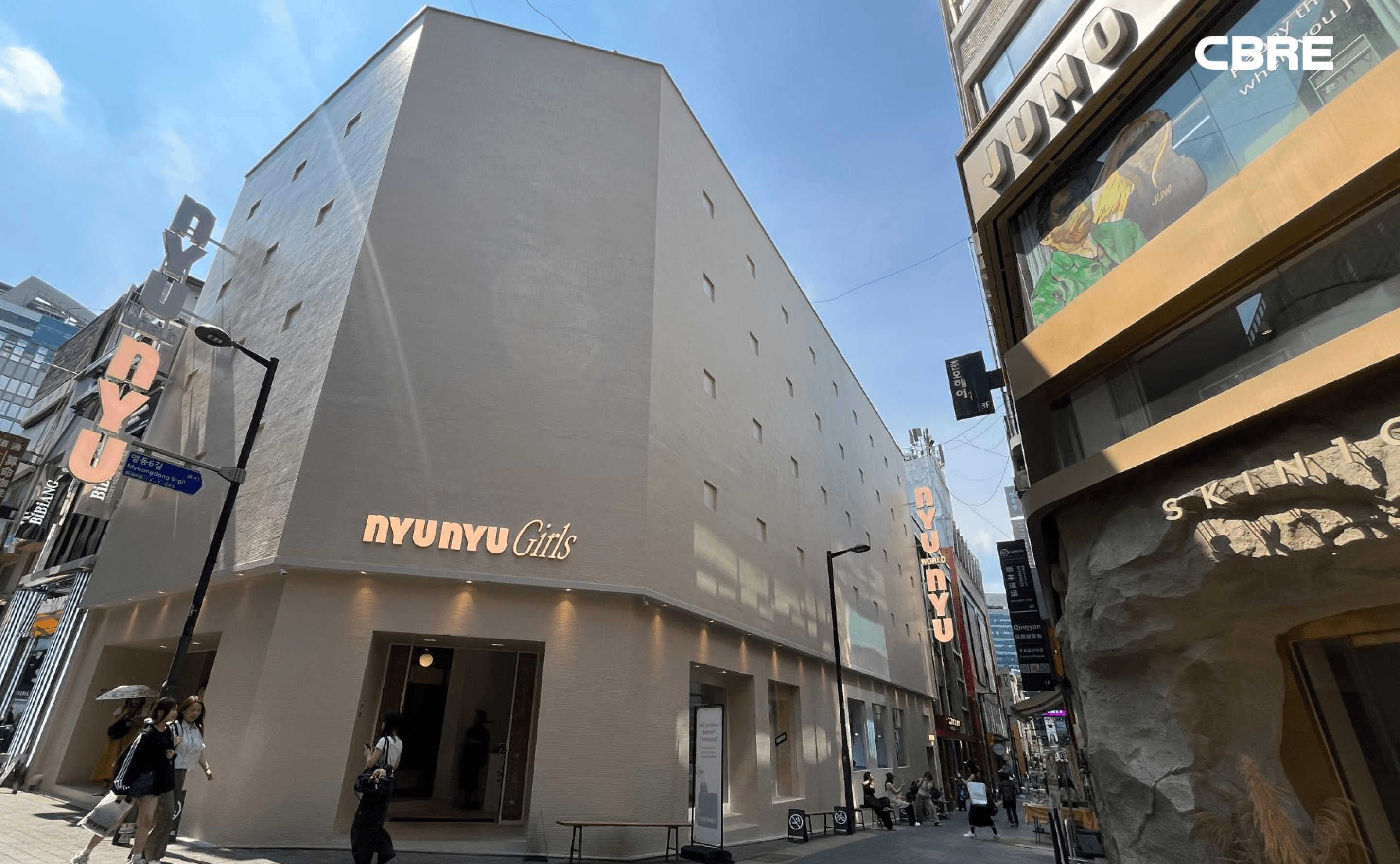
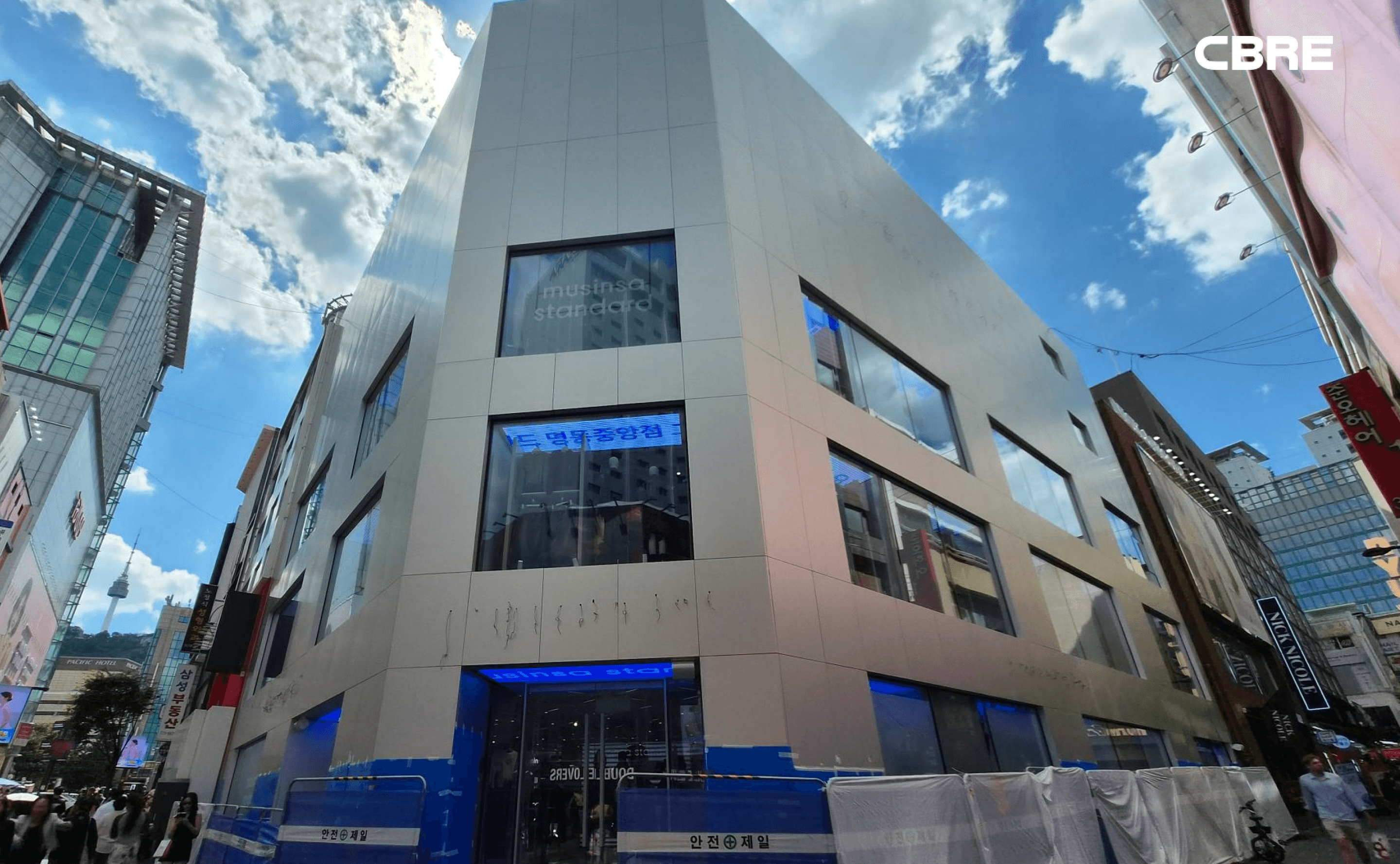
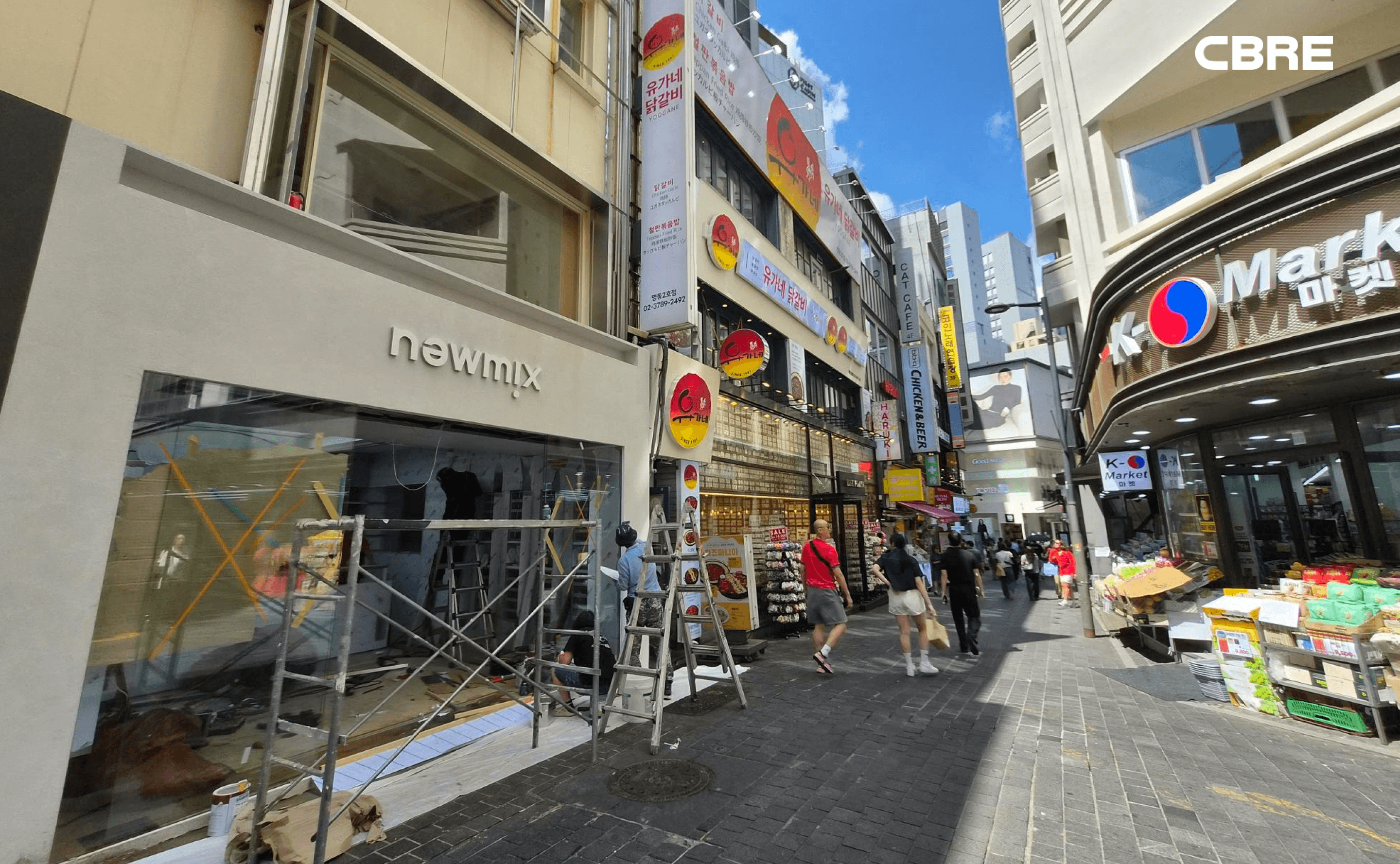
The NuNu World Myeongdong store, which opened in early June this year, and Musinsa Standard and Newmix under active construction.
The important point is that Myeongdong's flagship stores do not just stop at simple brand promotion or acting as 'showrooms for signboards'. While Seongsu is a showroom-type commercial district that emphasizes high-sensitivity branding and symbolism, Myeongdong is an unrivaled commercial district where branding effects are accompanied by explosive real-demand purchases.
According to actual store sales data from CBRE Korea Retail, 6 out of the Top 10 highest-grossing stores on major high streets in Seoul were flagship stores located in Myeongdong. Even compared to stores of the same brand located in other high street areas, the sales volume of the Myeongdong stores is overwhelming.
In the end, Myeongdong's main road is a place where, even while bearing high occupancy costs (NOC), a powerful sales conversion rate strong enough to immediately offset them is guaranteed. Since it is a "completed hexagon commercial district" that satisfies all areas including branding, global exposure, and actual sales power, global retailers count it as a top-priority base they must enter, even if it means paying high costs.
Mobility and Hotel Clusters: The Starting Point of Seoul Tourism and the 'Final Payment Hub'
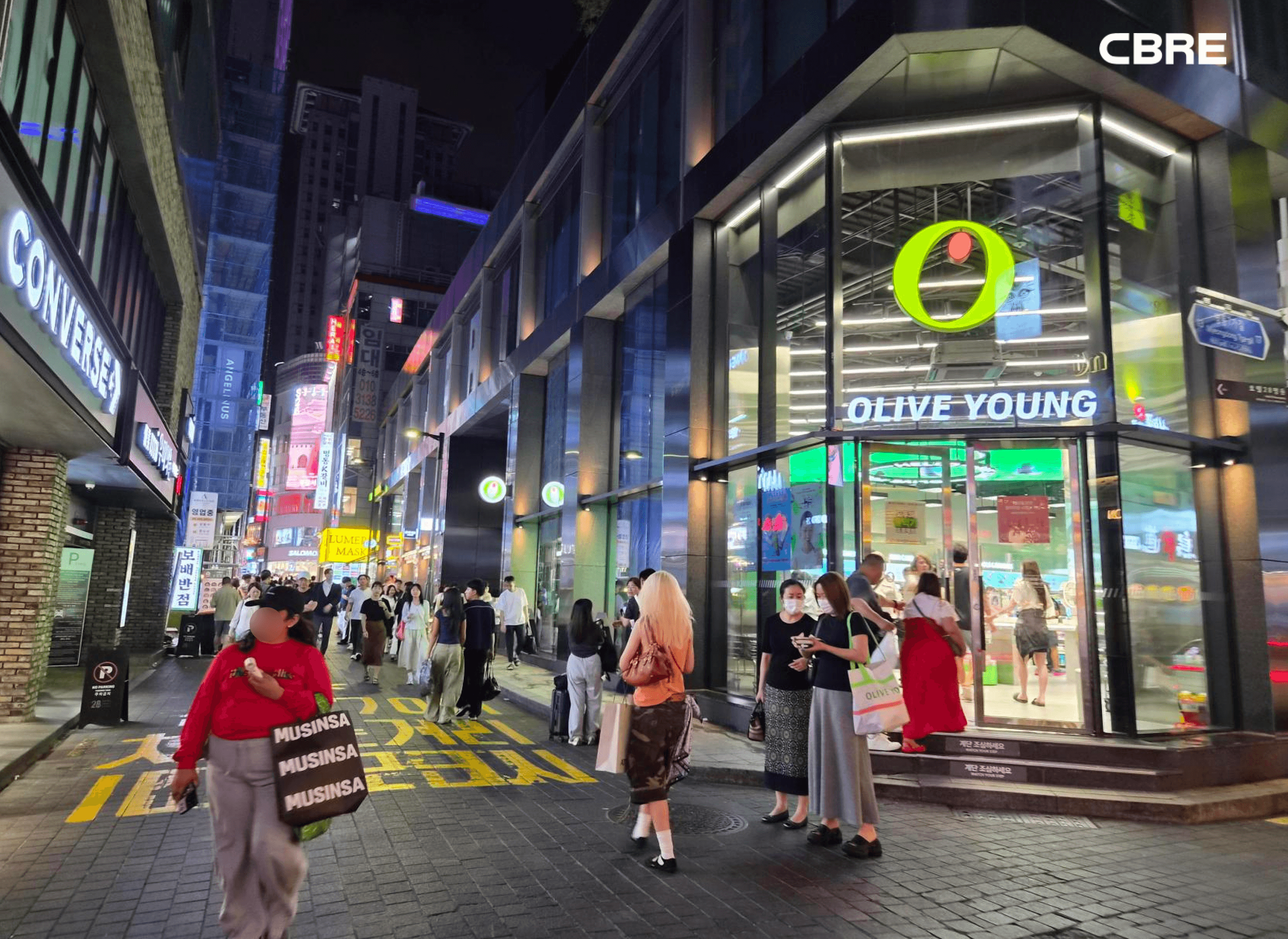
The key puzzle that completes the ecosystem of the Myeongdong commercial district is the combination of accommodation and regional mobility infrastructure. The share of the accommodation sector in foreign card consumption in Jung-gu is 19.9% (of which hotels account for 84.8%), maintaining an overwhelming first place among Seoul's autonomous districts, beating Jongno (19.3%) and Yongsan (13.2%). While Seongsu, Hannam, and Dosan Park are "transit-type commercial districts" where people visit during the day to experience trends and then leave, Myeongdong is the "physical basecamp and final departure gateway" of a Seoul itinerary.
Myeongdong, where the Airport Railroad (connected to Seoul Station) and direct limousine bus routes to Incheon and Gimpo Airports are concentrated, has a flow structure where tourists arrive in Seoul, unpack their suitcases, finish their schedule, check out, and then resolve their final shopping. It is the only commercial district where "last-minute shopping" occurs, with tourists dragging their trunks right before departure and sweeping up their remaining budget while touring Olive Young, large pharmacies, and fashion flagships on the main street.
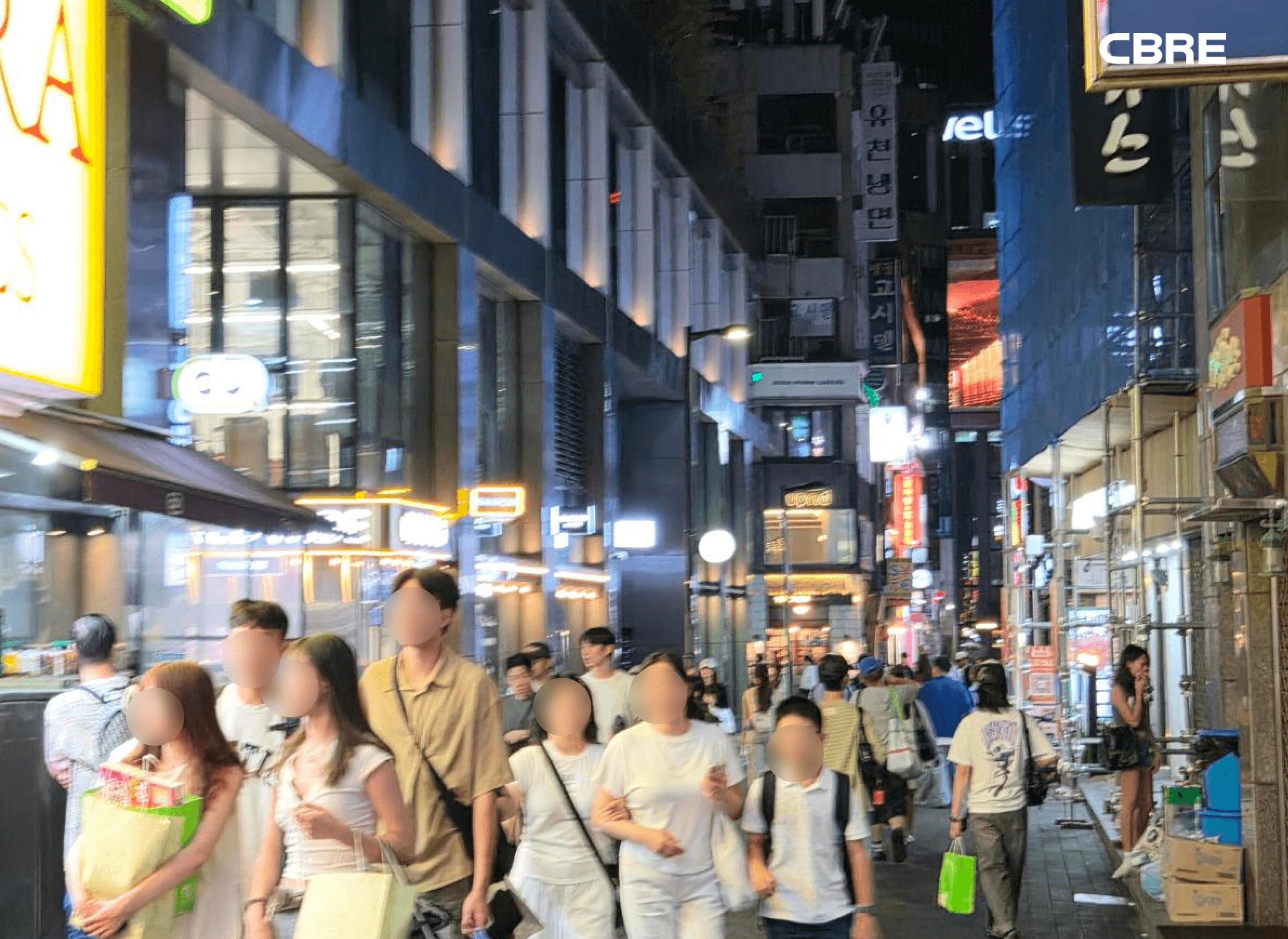
This is why, despite having a resident population of only 125 and virtually no residential backdrop, the share of the floating population from 17:00 to 21:00 in the evening thickened from 18.5% to 21.3% over five years. A stay-type cycle is operating robustly, in which tourists who had scattered across Seoul return to their hotels and consume nighttime F&B and shopping.
Immutable Stage, Swapping Players
Myeongdong is the most unique and powerful high street in Seoul, whose quarterly sales increased by +69% despite being labeled as "stagnant" in commercial district evaluation indexes over the past 21 quarters. Stagnation here does not mean a halt in growth, but rather an extreme exclusivity where only proven, top-tier tenants survive due to massive entry barriers and high rents.
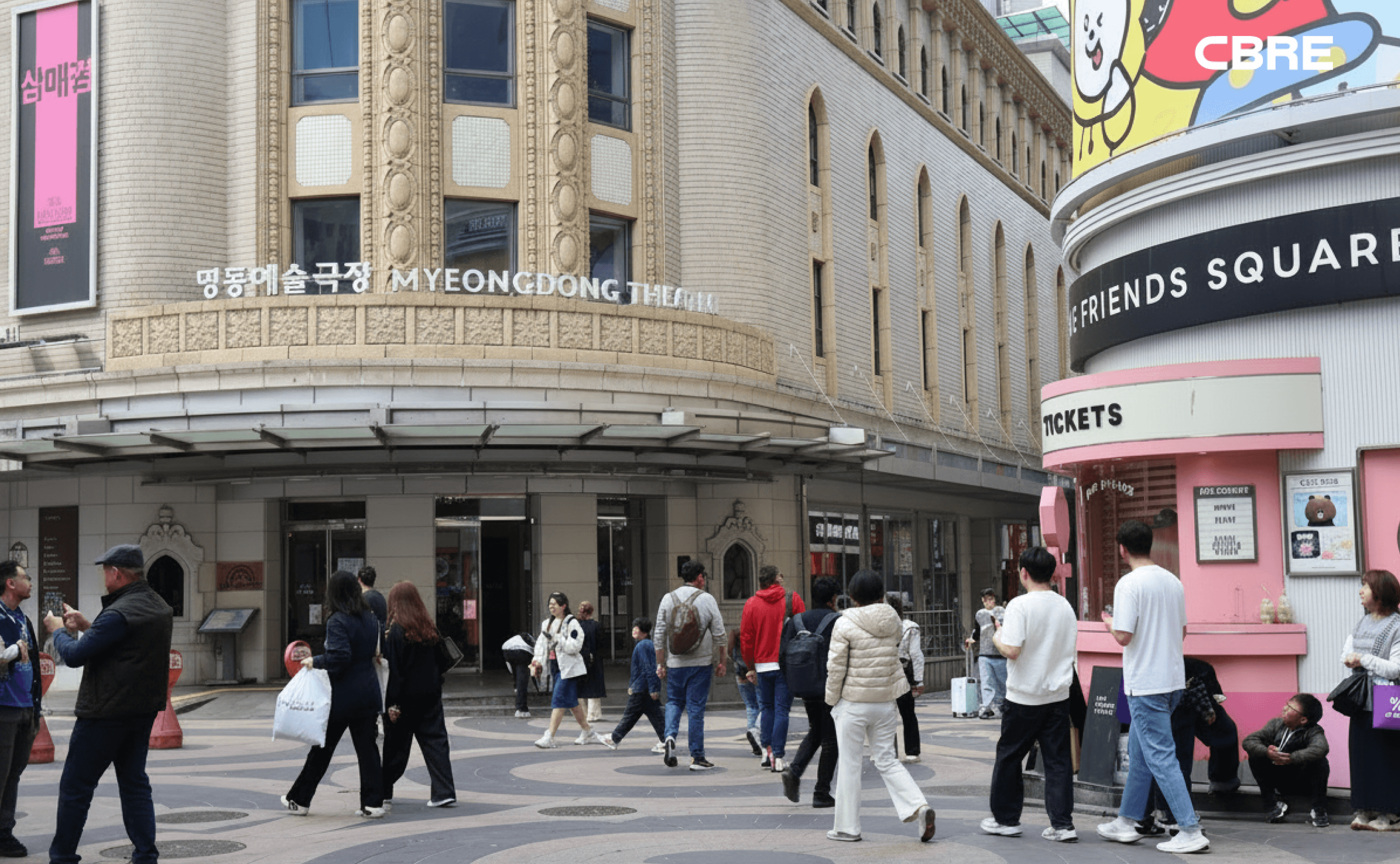
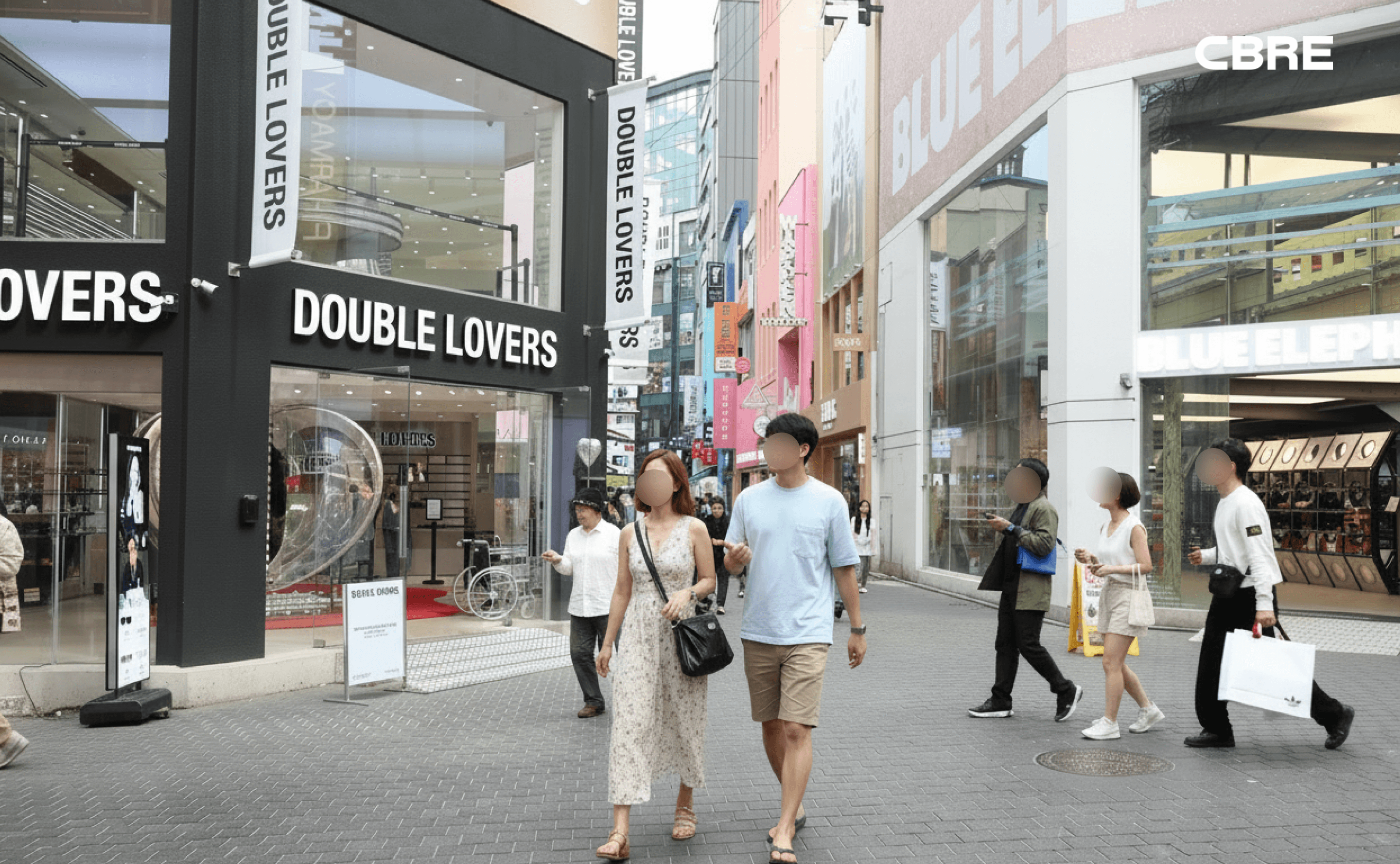
At the same time, although Myeongdong is not a commercial district centered on short-term pop-ups, brand replacements and aggressive signboard changes are unfolding at a pace rivaling Seongsu-dong. In particular, the strength of highly functional outdoor and sportswear linked to global retail trends is conspicuous. Over the past year, Dynafit on UNESCO-gil changed its banner to Nordisk, Newmix Coffee is undergoing construction for a new store opening, and large global sportswear brands are also preparing additional openings, continuing a fast-paced restructuring across the commercial district.
The center of finance and fashion, where Gyeongseong's modern boys strolled 100 years ago, has now evolved into an inbound platform where capital from all over Asia and global travelers collide. From nationality (the shift of Chinese brands to providers), industry (medical beauty, stay-type F&B, and outdoor), scale (mega flagships), to function (final payment hub based on transportation and accommodation), Myeongdong's tenant landscape has completed a full-scale generational shift.
While the essence of Myeongdong as Seoul's most expensive and powerful number-one consumption district has not changed, the caliber and signboards of the players have shifted, completely refreshing the texture of the commercial district. Now that it has reborn as a regular battleground for major global capital, attention is drawn to where these current changes will lead Myeongdong as a global retail stage in the future.
© Copyright 2026. All rights reserved.
This publication has been prepared in good faith, based on CBRE Korea's current anecdotal and evidence based views of the commercial real estate market. Although CBRE Korea believes its views reflect market conditions on the date of this presentation, they are subject to significant uncertainties and contingencies, many of which are beyond CBRE Korea’s control. In addition, many of CBRE Korea’s views are opinion and/or projections based on CBRE Korea’s subjective analyses of current market circumstances. Other firms may have different opinions, projections and analyses, and actual market conditions in the future may cause CBRE Korea’s current views to later be incorrect. CBRE Korea has no obligation to update its views herein if its opinions, projections, analyses or market circumstances later change.
Nothing in this publication should be construed as an indicator of the future performance of CBRE’s securities or of the performance of any other company’s securities. You should not purchase or sell securities-of CBRE or any other company-based on the views herein. CBRE Korea disclaims all liability for securities purchased or sold based on information herein, and by viewing this publication, you waive all claims against CBRE Korea as well as against CBRE Korea’s affiliates, officers, directors, employees, agents, advisers and representatives arising out of the accuracy, completeness, adequacy or your use of the information herein. No part of this publication may be reproduced, quoted, distributed, or disclosed to any third party without the prior written consent of CBRE Korea.

Street
Jul 27, 2026
Dosan Park Commercial District Analysis | The Alley Where Brand Drives Land Value
Comparing Seongsu with Dosan: the opposite growth formulas of two Seoul hotspots

street
Jul 13, 2026
Gangnam ② - 75% of Gangnam-daero is Medical
A place where hospitals fill the upper floors emptied by the pandemic, and the wallets of foreigners crowd.

street
Jun 22, 2026
Gangnam ① - Gangnam-daero Retail, Chosen by Global Brands
From 18 vacancies three years ago to just two. The real reason why low-floor retail along Gangnam-daero has made a complete comeback.

street
May 26, 2026
Bangkok Retail 101 ②
Bangkok shopping malls want K-brands. The question is how to get in.
street
May 26, 2026
Bangkok Retail 101 ①
The Developer's Playground: What Sets Bangkok's Retail Evolution Apart from Seoul
street
Apr 13, 2026
Cheongdam: The Art of Elegant Detachment
High jewelry chases the light. Fashion houses build walls. A structural analysis of how capital occupies Cheongdam — and why this street operates by rules that apply nowhere else in Seoul.

street
Apr 13, 2026
Hannam-dong, Seoul's private club. ②
Zero vacancy. Key money reaching 1.3 billion Korean won. Inside Hannam-dong's brand selection market, where who you are matters more than what you offer to pay.
street
Apr 13, 2026
Hannam-dong, a private club in Seoul. ①
Between Seongsu's raw energy and Dosan's polish — how Hannam-dong became Asia's most credible ground for testing a global brand's Korea positioning.
street
Apr 13, 2026
Same Bukchon, Different Strategy ③
Blue Bottle, New Balance, Adidas, Le Labo — how Hwadong and Sogyeokdong became the global flagship core of Seoul's Bukchon retail market.

street
Apr 13, 2026
Same Bukchon, Different Strategy ②
Why Amorepacific spent 30 billion won acquiring a hanok compound in Gahoe-dong — and how Bukchon-ro 5-gil became Seoul's fastest-growing K-brand retail cluster.
street
Apr 13, 2026
Same Bukchon, Different Strategy ①
Anguk Station and Gye-dong-gil: The entrance to Bukchon, focusing on the flagship near Anguk Station and the concentration of F&B on Gye-dong-gil.