Back
Copy
Share
Like

market
The Busan Commercial District Transformed by Foreigners
The Busan Commercial District Transformed by Foreigners
The Busan Commercial District Transformed by Foreigners
Foreigners' card spending increases 2.3 times in 2 years
Foreigners' card spending increases 2.3 times in 2 years
Foreigners' card spending increases 2.3 times in 2 years
Article Highlights
2025 Busan foreign tourists reach 3.64 million (highest ever), spending exceeds 1 trillion won
Foreigner card consumption increases 2.3 times in 2 years — driving more than half of Busan's consumption growth
Amid competition for brand preoccupation and the dual structure of rent/vacancy, 'location that accommodates foreign demand' is a key variable in investment decisions
Just a few years ago, shopping for foreign tourists visiting Busan was something they finished in Seoul. Today, things are different. Tri-lingual signs are posted in Haeundae's alleys, and travelers from Taiwan and Singapore line up in front of Musinsa Standard in Seomyeon. In 2025, 3.64 million foreigners visited Busan, a record high, and the amount they spent exceeded 1 trillion won for the first time. The influx of tourists is redrawing the landscape of local commercial districts.
To the 3.6 Million Era — Recovery and Growth Hand in Hand
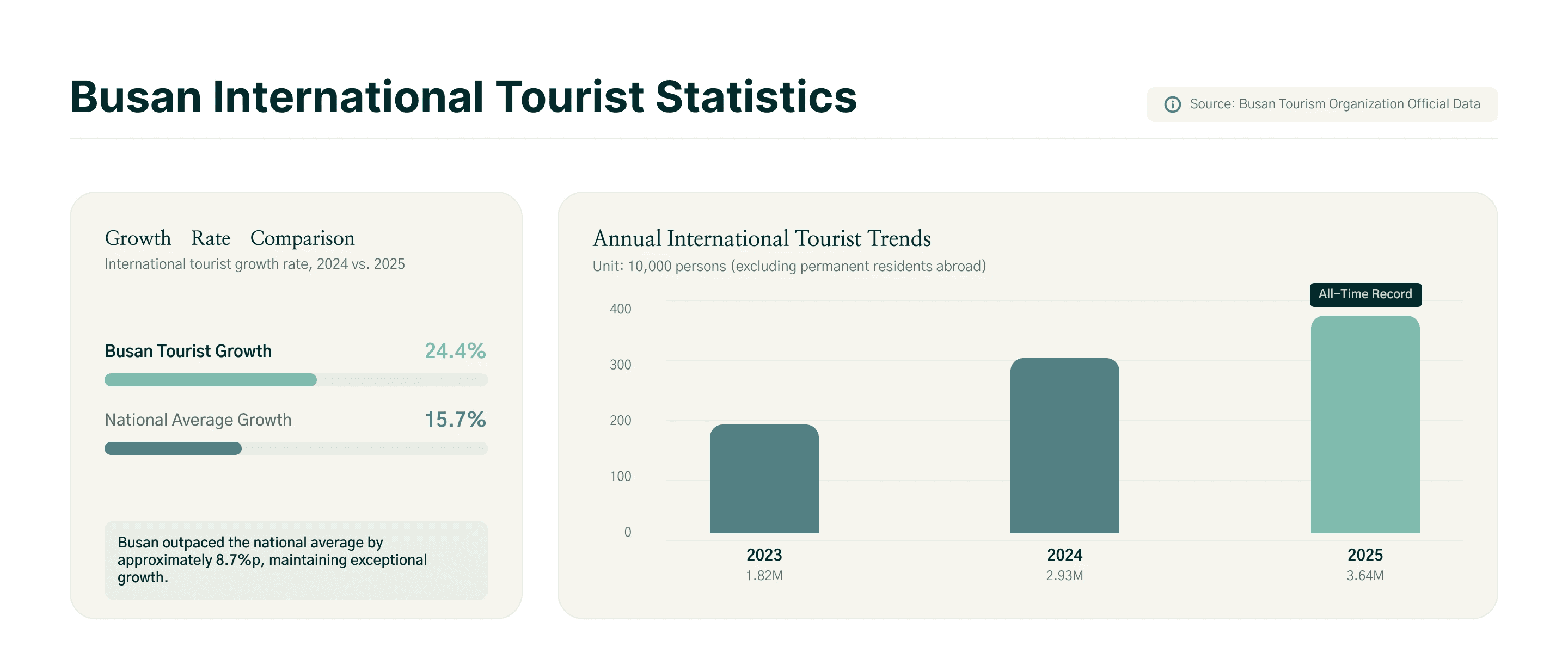
Busan is currently rewriting the history of inbound tourism. In 2025, the number of foreign tourists visiting Busan was tallied at 3.64 million, setting an all-time record. This is a 24.4% increase compared to 2024 (2.93 million), and significantly outpaces the nationwide growth rate of foreign visitors (15.7%) during the same period. This means that even amidst the overall trend of increasing tourists visiting Korea from abroad, Busan is growing at an even faster pace.
The reason this number draws even more attention is the speed of recovery. The void left by the COVID-19 pandemic was filled in just 2 to 3 years. The number surged nearly 61% in just one year, from 1.82 million in 2023 to 2.93 million in 2024, and continuing that momentum, it broke the 3.5 million mark for the first time in history in 2025. In the tourism industry, "recovery" and "growth" are often distinguished, but as far as Busan is concerned, it is safe to say that these two stages occurred virtually simultaneously.
Nationalities have also diversified. In 2024, the top three countries—Taiwan (500k), Japan (450k), and China (420k)—accounted for 46%, followed by the United States, the Philippines, Hong Kong, and Vietnam. The fading dependence on specific countries is a sign that structural demand expansion, rather than a one-off event, is underway.
Why Busan Now? — Three Drivers of Demand Change
① The "Must-Visit City" Created by K-Content
The first is the K-content effect. Dramas, movies, and K-pop have carried the aesthetics of everyday Korean life (alleyway cafes, select shops, MZ fashion) to the world, and Busan stimulates the image of "a Korea different from Seoul" with its scenery where the sea and city coexist, the Gwangan Bridge night view, and the cultural image of BIFF. It was also named on the New York Times' "5 Beautiful Beach Cities" and TripAdvisor's Best Beaches.
In an on-site survey of 50 foreigners in Seongsu conducted by CBRE Korea Retail, short-form content like TikTok and Xiaohongshu was overwhelmingly the way they learned about their destinations. This is an era where feeds, not searches, determine destinations. The same algorithm places Busan on the next screen.
② From "Alternative to Seoul" to "Independent Destination"
In the past, Busan was a "half-day course during a Seoul trip." Today, Busan has become both the starting and ending point of journeys. Spending is also spreading from Haeundae and Gwangalli to local commercial districts in Seomyeon, Nampo, and Bujeon-dong.
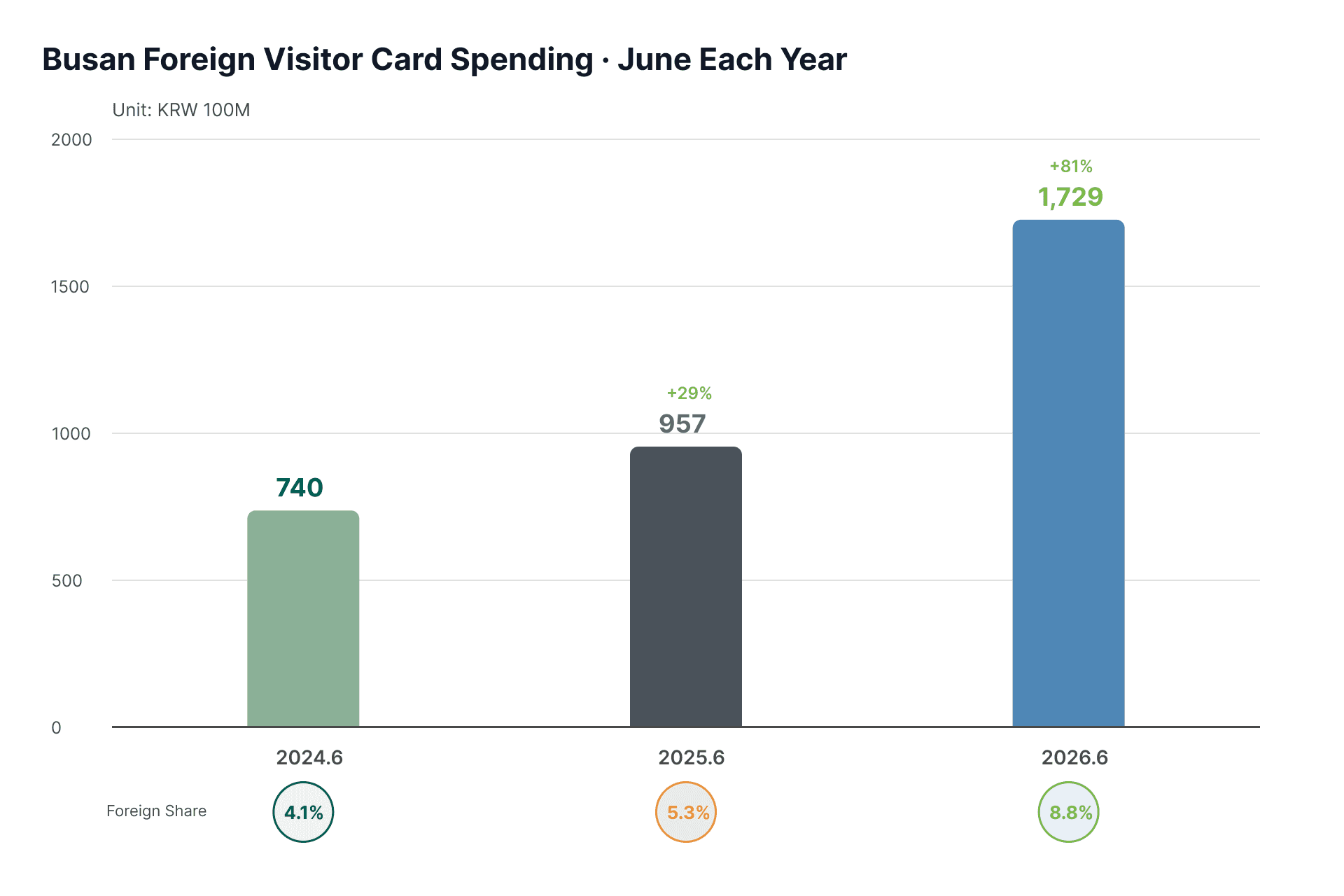
Card spending data directly analyzed by CBRE Korea Retail supports this. Every June, foreign (overseas resident) card spending in Busan jumped from approximately 74 billion won in 2024 to 95.7 billion won in 2025, and 172.9 billion won in 2026. That is a 1.8-fold increase between 2025 and 2026 alone, and a 2.3-fold increase in just two years. This contrasts with the 9% growth in overall card spending in Busan during the same period. The proportion of spending by foreigners more than doubled from 4.1% to 8.8%. Foreigners accounted for more than half of Busan's consumption growth over the last two years.
③ Consumption Desire for K-Beauty and K-Fashion
The third driver is the desire for "experiential consumption." The spending structure of foreign tourists itself has changed. As seen in the case of Lotte Department Store's Gwangbok branch, fashion accounts for the largest share at about 65% among purchase categories, followed by beauty, accessories, IT, and food. The trend is to choose K-fashion brands and K-beauty procedures instead of luxury handbags.
The same direction can be read in the Seongsu survey. Foreigners' spending was concentrated on apparel, jewelry, and accessories. It is K-fashion and lifestyle items, not luxury goods. This perfectly overlaps with the shift "from luxury to local" observed in Busan department stores.
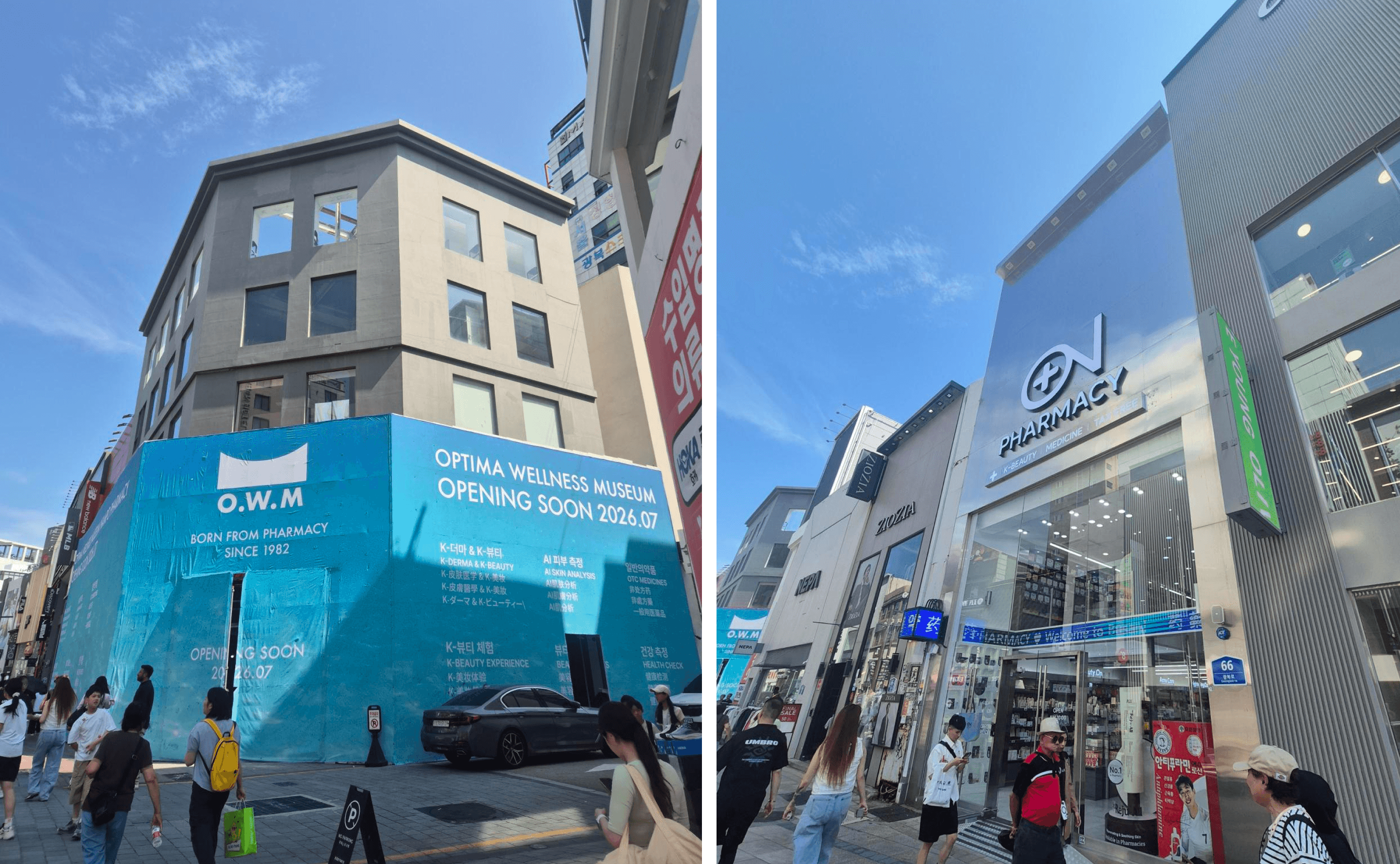
Optima Pharmacy, scheduled to open in Gwangbok-ro, and Nampo ON Pharmacy targeting tourists. Pharmacies, which have spread rapidly in Seoul retail, are also expanding aggressively in Busan.
Entering 2025, the top categories of foreign tourism spending in Busan shifted from transport products like trains and airport pickups to "beauty and medical care," with a pattern of dermatology clinic usage surging starting from the first quarter. Now, the key keyword for Busan tourism is not just scenery, but "experiences that transform me."
Card data makes this even clearer. Comparing June 2026 to June 2024, foreign card spending on retail increased about 2.7 times and food increased 2.5 times, while medical care, including pharmacies, exploded more than nine-fold from 1.9 billion won to 18.2 billion won. In contrast, lodging grew only 1.5 times. Wallets have shifted from "sleeping" to "buying, getting procedures, and experiencing."
They Were Already Heading to Busan
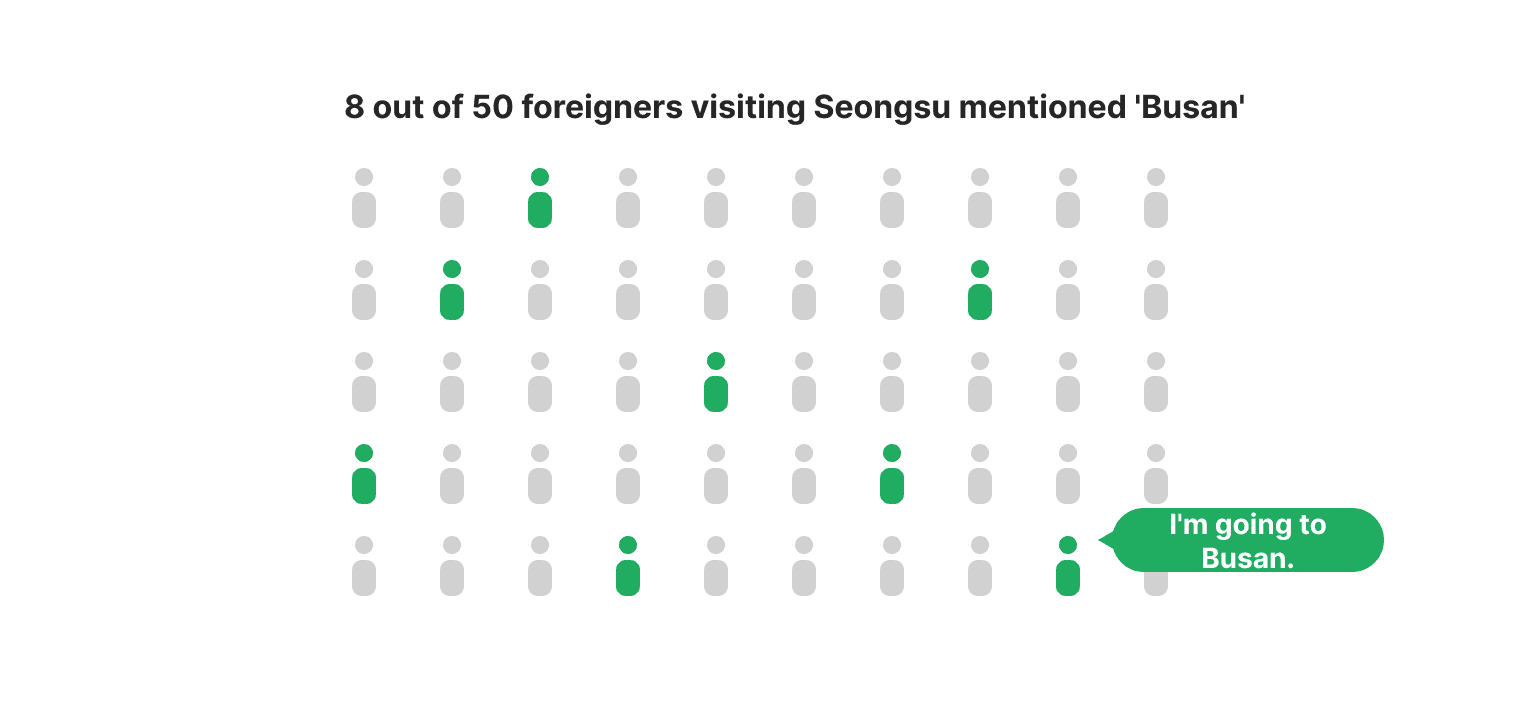
Let's return to the Seongsu survey (Seongsu Retail Insight). This survey did not ask about Busan. It only asked about satisfaction with Seongsu and the next destination in "Seoul." Nevertheless, 8 of the respondents voluntarily mentioned "Busan" as their next destination. Although the number is small, the signal is clear. The voluntary appearance of Busan in a Seoul survey that did not even provide Busan as an option means that the spillover from Seoul to Busan is already happening in travelers' minds.
Those tastes met in Seongsu—discovering through short-form content, opening wallets to K-fashion, and 96% of whom said they would return—are the very face of the demand that Busan's commercial districts will welcome. If so, how is this demand changing Busan's commercial districts and real estate?
When demand changes, commercial districts change. This is like the most basic law of commercial real estate. Busan's major commercial districts are currently transforming from a domestic-oriented structure into "foreigner-friendly complex consumption hubs."
Commercial Districts Are Being Realigned
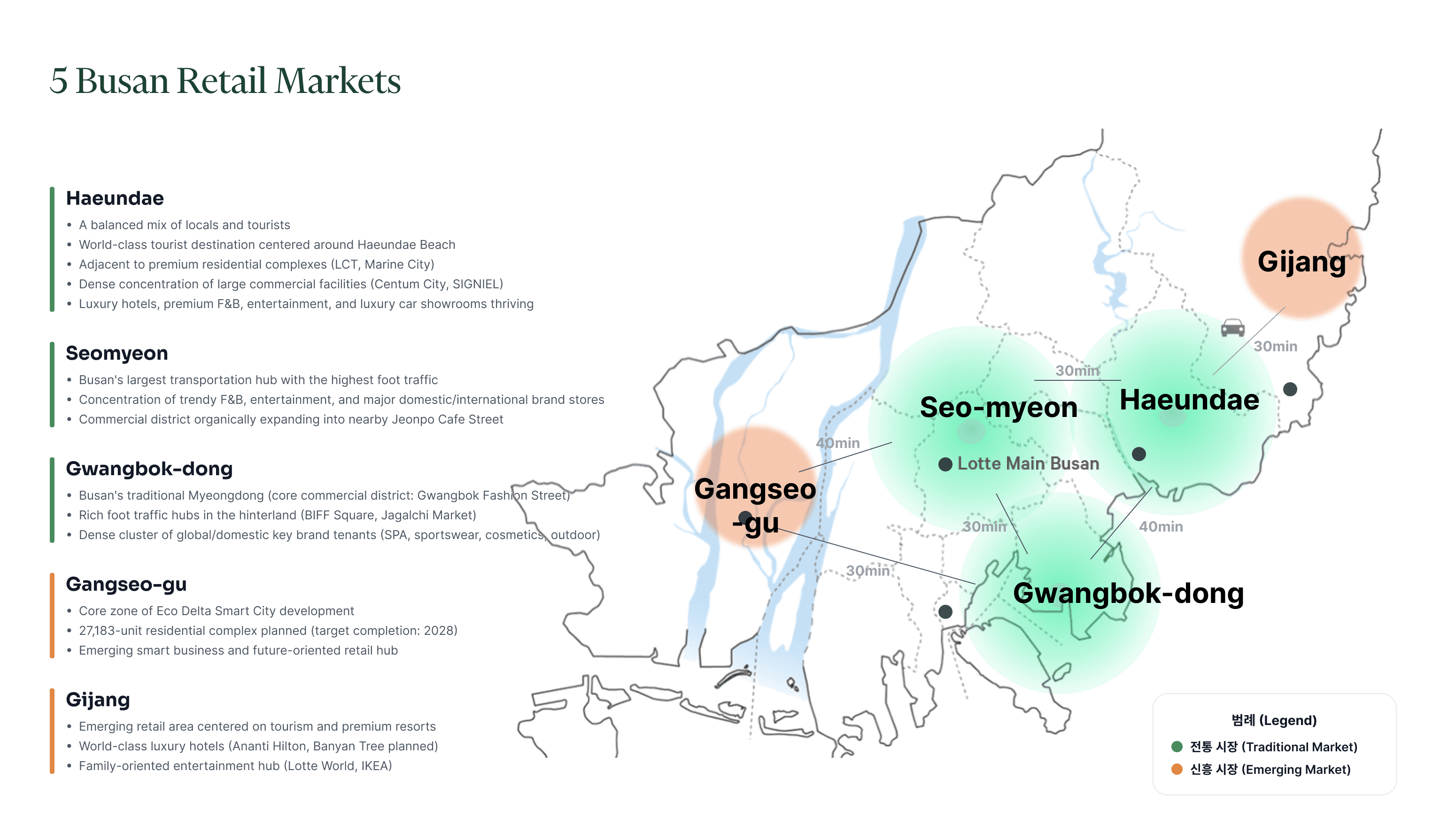
Busan's retail zones are largely divided into Haeundae, Seomyeon, Gwangbok-dong, Gangseo-gu, and Gijang.
Haeundae — From Tourist Destination to Shopping Destination
While Haeundae is a long-standing synonym for tourism, its stays are getting longer and shopping-oriented visits are increasing, changing the very character of the commercial district. Lifestyle brand Blue Elephant taking over the site of the former "Fuzzy Navel Haeundae" is a symbolic shift showing what kind of brands Haeundae needs.
According to field insights from CBRE Korea Retail, pharmacy businesses targeting tourists have visibly increased along Gunam-ro. If Gwangbok-ro, which we will see later, is the center of fashion and apparel, Gunam-ro's character is shaped by sundries like pharmacies and stores like Blue Elephant. The entry barrier is not low. Main street locations demand premium key money in the hundreds of millions of won, and since summer is the peak season, one must scout for spots in the fall of the previous year to prepare for the following year's business.
Nampo/Gwangbok — The Return of the Old Downtown's Gwangbok-ro
According to CBRE Korea Retail field insights, the recovery of Gwangbok-ro is distinct. Even at 1 to 2 PM on weekdays, the streets are crowded, and intuitively, over 70% of visitors are foreigners. New stores have quickly opened, and inquiries for leases from global and local brands are on the rise. Although both are tourist commercial districts, Gwangbok-ro is focused on fashion and apparel, while Gunam-ro is centered on general merchandise, showing how different demands attract different business types.
Seomyeon — The No. 1 Local Fashion Hub Visited by Foreigners
Seomyeon, Busan's largest downtown commercial district, used to be a fashion and F&B hub for domestic MZ generations, but now foreigners looking for "Busan's unique sentiment" are flowing in. Since opening its first Seomyeon store in 2023, Musinsa Standard has expanded to three stores including Lotte Mall Dongbusan and Centum City, establishing itself as a "must-visit K-fashion destination" for foreigners.
Shinsegae Centum City — A Shift in Department Store Consumption
Centum City is the most dramatic case. Foreign sales grew at high rates for three consecutive years: 668% in 2023 (against the pandemic baseline), followed by 105% in 2024, and 135% in 2025. The content has also changed. The share of foreign luxury brands fell from 49% in 2023 to 38% in 2025, while youth fashion centered on K-fashion rose to 15%. This is a structural shift from luxury shopping to K-brands and experiential consumption.
Brands Move First
Brands are the quickest to sense changes in commercial districts. Supply follows demand, and stores open where consumers are. That is exactly what is happening in Busan right now.
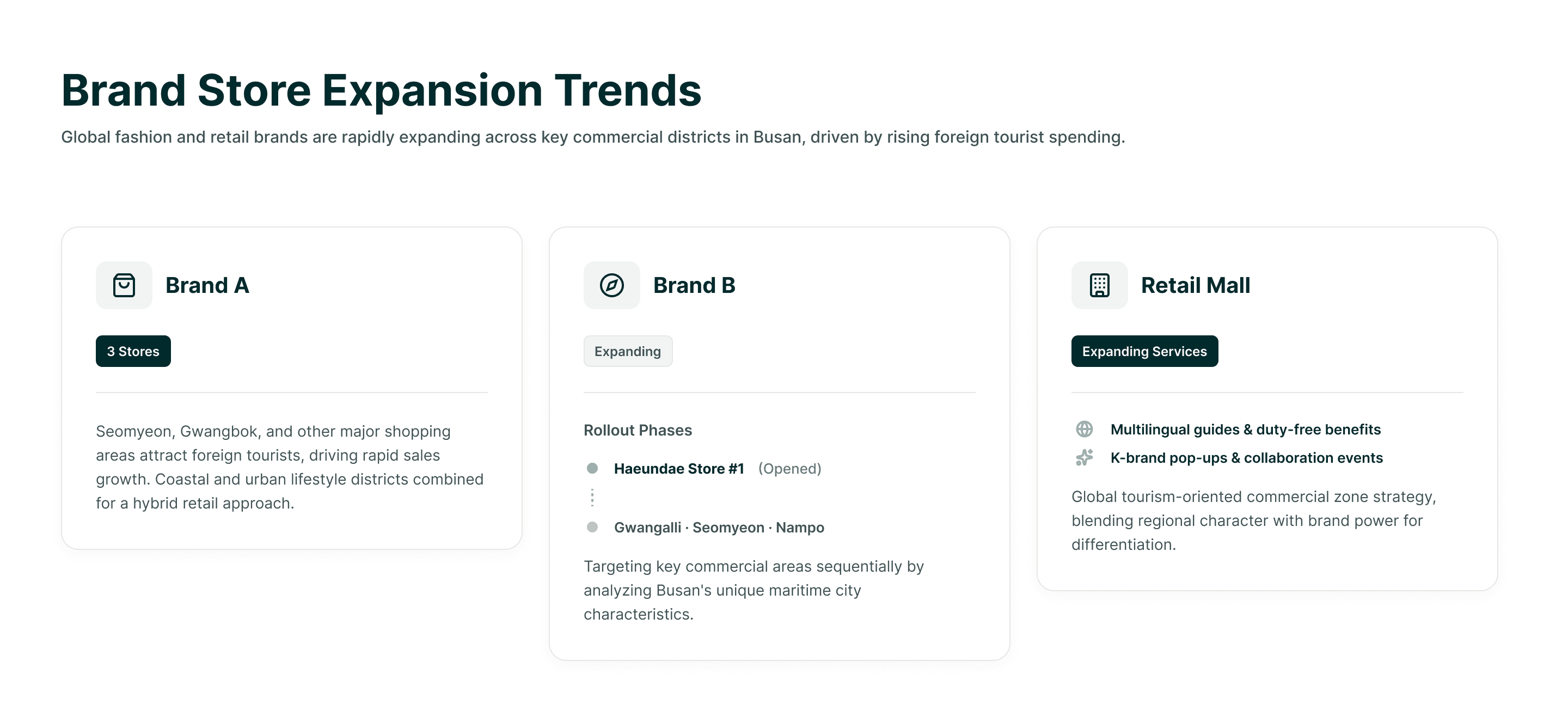
The meaning of this trend is clear. Entering Busan is no longer a passive concept of "regional expansion." It must be interpreted as strategic positioning to pre-empt a new demand segment consisting of foreign customers.
Rather than simply increasing the number of stores, brands are building foreigner-friendly service systems. Just as Musinsa introduced a foreigner-exclusive luggage storage service and unmanned currency exchange machines at its Hannam branch in Seoul, Busan stores are also strengthening multilingual services, payment convenience, and foreigner-exclusive promotions. The consumer experience itself is being redesigned to be tailored for foreigners.
The Dual Structure — Opportunities and Challenges
Interestingly, this boom is not evenly reflected across all of Busan's commercial real estate. Rather, a dual structure is distinct. According to the Korea Real Estate Board, in the first quarter of 2026, Busan's integrated commercial rental price index was virtually flat at -0.01% (compared to Seoul's +0.48%), and the office vacancy rate was 14.7%, which was 2.8 times higher than Seoul's (5.2%). The rent per square meter on the first floor in Busan was 26,300 won, half of Seoul's (52,500 won), and the office investment yield was 0.80%, only a third of Seoul's (2.35%).

HBAF located in Nampo-dong & Onitsuka Tiger Gwangbok Flagship Store located in Gwangbok-ro
However, the Korea Real Estate Board left a decisive clue: "While major commercial districts with tourist inflows maintain an upward trend, conventional and regional commercial districts continue to stagnate." There is a temperature difference even within Busan. Commercial districts where foreigners gather hold strong, while others sink. Therefore, these numbers should not be read solely in a negative light. This is a time when the scarcity of locations capable of capturing foreign demand is highlighted. Now, the core variable in investment decisions is shifting from "rental yield" to "what kind of demand this space can capture."
Why Now is the Golden Time
With the goal of attracting 5 million foreign tourists and 1.5 trillion won in tourism spending by 2028, Busan City is pushing forward with Centre Pompidou Busan, the Mt. Hwangryeong landmark development, BEXCO's 3rd Exhibition Hall, and the Suyeongman Yacht Marina redevelopment. Once this trend becomes a reality, the pace of commercial district realignment will be much faster than it is now.
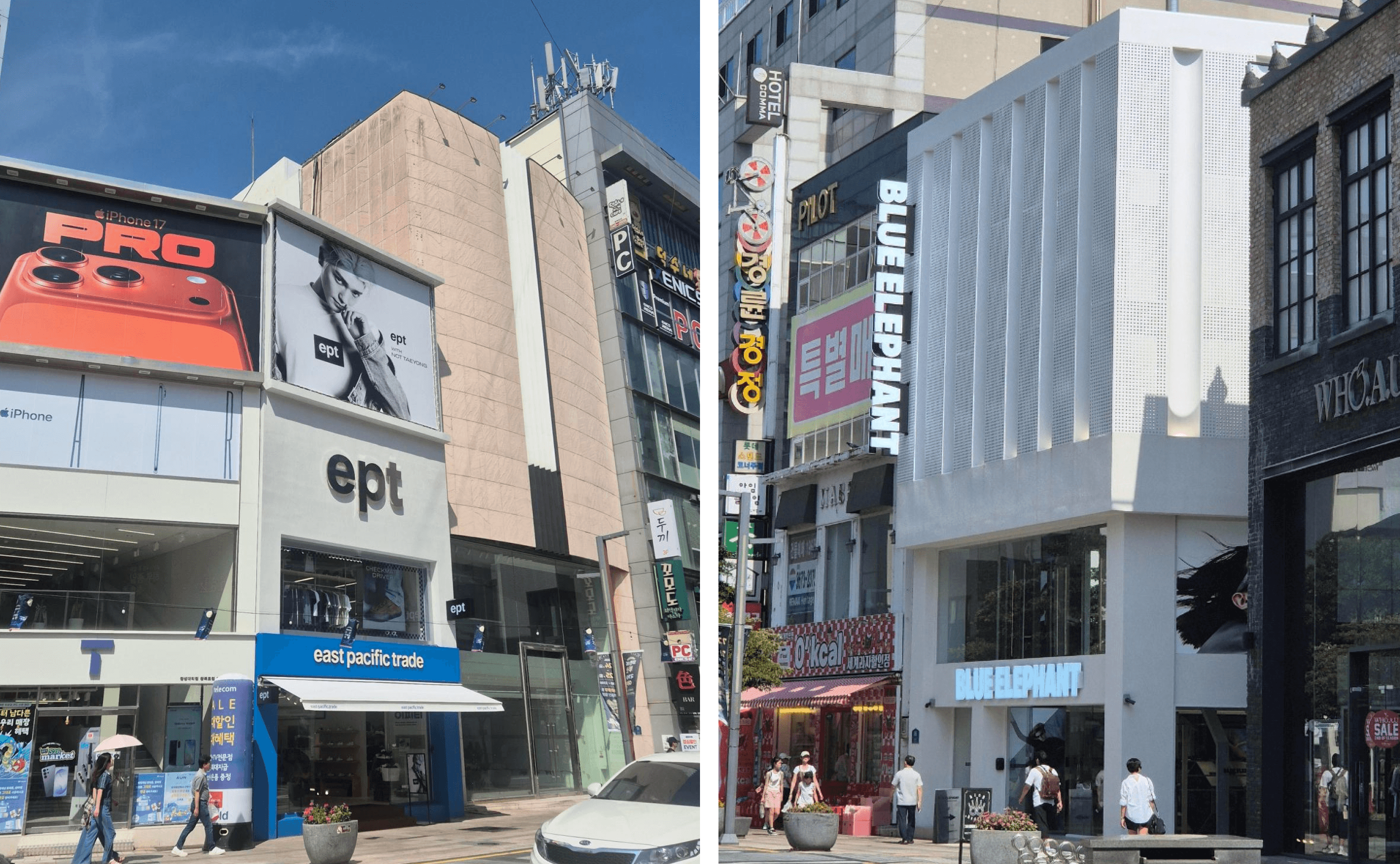
Photos of ept and Blue Elephant stores that opened in Gwangbok-ro in 2026
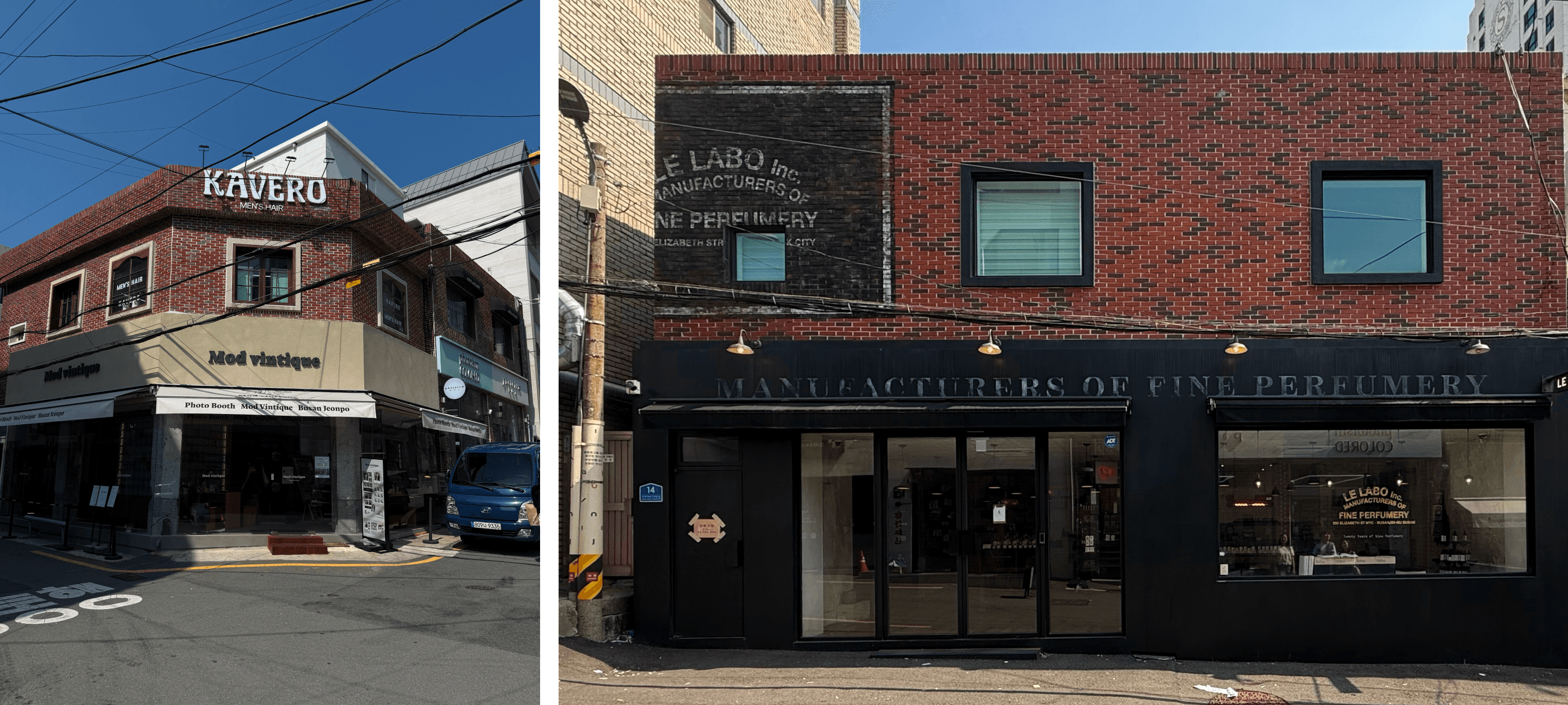
A vintage shop located in Nampo-dong and the Le Labo Jeonpo Flagship Boutique, the brand's first store outside the Seoul area, which opened in 2023
The fact that 3.64 million foreign tourists visited Busan means there were 3.64 million individual choices. These are people who chose "Busan, not Seoul," and chose it as a "destination, not a passing course." And the sum of those choices led to 1 trillion won in consumption.
Is this trend a temporary fad? It is hard to see it that way. The global expansion of K-content has not stopped, and global media attention toward Busan continues. The shift in consumer desire toward local experiences is also a structural change linked to a generational shift, rather than a short-term trend. Public investment in tourism infrastructure is also accelerating.
The key is timing. While Myeongdong, Hongdae, and Seongsu in Seoul are close to saturation with foreigner infrastructure, Seomyeon, Gwangalli, and Nampo-dong in Busan are still in transition. The window of time where foreign demand, eager brands, and still reasonable real estate prices align simultaneously is not long. The brands and assets that pre-empt this trend today will draw the landscape of Busan's commercial districts in 3 to 5 years.
Just a few years ago, shopping for foreign tourists visiting Busan was something they finished in Seoul. Today, things are different. Tri-lingual signs are posted in Haeundae's alleys, and travelers from Taiwan and Singapore line up in front of Musinsa Standard in Seomyeon. In 2025, 3.64 million foreigners visited Busan, a record high, and the amount they spent exceeded 1 trillion won for the first time. The influx of tourists is redrawing the landscape of local commercial districts.
To the 3.6 Million Era — Recovery and Growth Hand in Hand
Busan is currently rewriting the history of inbound tourism. In 2025, the number of foreign tourists visiting Busan was tallied at 3.64 million, setting an all-time record. This is a 24.4% increase compared to 2024 (2.93 million), and significantly outpaces the nationwide growth rate of foreign visitors (15.7%) during the same period. This means that even amidst the overall trend of increasing tourists visiting Korea from abroad, Busan is growing at an even faster pace.
The reason this number draws even more attention is the speed of recovery. The void left by the COVID-19 pandemic was filled in just 2 to 3 years. The number surged nearly 61% in just one year, from 1.82 million in 2023 to 2.93 million in 2024, and continuing that momentum, it broke the 3.5 million mark for the first time in history in 2025. In the tourism industry, "recovery" and "growth" are often distinguished, but as far as Busan is concerned, it is safe to say that these two stages occurred virtually simultaneously.
Nationalities have also diversified. In 2024, the top three countries—Taiwan (500k), Japan (450k), and China (420k)—accounted for 46%, followed by the United States, the Philippines, Hong Kong, and Vietnam. The fading dependence on specific countries is a sign that structural demand expansion, rather than a one-off event, is underway.
Why Busan Now? — Three Drivers of Demand Change
① The "Must-Visit City" Created by K-Content
The first is the K-content effect. Dramas, movies, and K-pop have carried the aesthetics of everyday Korean life (alleyway cafes, select shops, MZ fashion) to the world, and Busan stimulates the image of "a Korea different from Seoul" with its scenery where the sea and city coexist, the Gwangan Bridge night view, and the cultural image of BIFF. It was also named on the New York Times' "5 Beautiful Beach Cities" and TripAdvisor's Best Beaches.
In an on-site survey of 50 foreigners in Seongsu conducted by CBRE Korea Retail, short-form content like TikTok and Xiaohongshu was overwhelmingly the way they learned about their destinations. This is an era where feeds, not searches, determine destinations. The same algorithm places Busan on the next screen.
② From "Alternative to Seoul" to "Independent Destination"
In the past, Busan was a "half-day course during a Seoul trip." Today, Busan has become both the starting and ending point of journeys. Spending is also spreading from Haeundae and Gwangalli to local commercial districts in Seomyeon, Nampo, and Bujeon-dong.
Card spending data directly analyzed by CBRE Korea Retail supports this. Every June, foreign (overseas resident) card spending in Busan jumped from approximately 74 billion won in 2024 to 95.7 billion won in 2025, and 172.9 billion won in 2026. That is a 1.8-fold increase between 2025 and 2026 alone, and a 2.3-fold increase in just two years. This contrasts with the 9% growth in overall card spending in Busan during the same period. The proportion of spending by foreigners more than doubled from 4.1% to 8.8%. Foreigners accounted for more than half of Busan's consumption growth over the last two years.
③ Consumption Desire for K-Beauty and K-Fashion
The third driver is the desire for "experiential consumption." The spending structure of foreign tourists itself has changed. As seen in the case of Lotte Department Store's Gwangbok branch, fashion accounts for the largest share at about 65% among purchase categories, followed by beauty, accessories, IT, and food. The trend is to choose K-fashion brands and K-beauty procedures instead of luxury handbags.
The same direction can be read in the Seongsu survey. Foreigners' spending was concentrated on apparel, jewelry, and accessories. It is K-fashion and lifestyle items, not luxury goods. This perfectly overlaps with the shift "from luxury to local" observed in Busan department stores.
Optima Pharmacy, scheduled to open in Gwangbok-ro, and Nampo ON Pharmacy targeting tourists. Pharmacies, which have spread rapidly in Seoul retail, are also expanding aggressively in Busan.
Entering 2025, the top categories of foreign tourism spending in Busan shifted from transport products like trains and airport pickups to "beauty and medical care," with a pattern of dermatology clinic usage surging starting from the first quarter. Now, the key keyword for Busan tourism is not just scenery, but "experiences that transform me."
Card data makes this even clearer. Comparing June 2026 to June 2024, foreign card spending on retail increased about 2.7 times and food increased 2.5 times, while medical care, including pharmacies, exploded more than nine-fold from 1.9 billion won to 18.2 billion won. In contrast, lodging grew only 1.5 times. Wallets have shifted from "sleeping" to "buying, getting procedures, and experiencing."
They Were Already Heading to Busan
Let's return to the Seongsu survey (Seongsu Retail Insight). This survey did not ask about Busan. It only asked about satisfaction with Seongsu and the next destination in "Seoul." Nevertheless, 8 of the respondents voluntarily mentioned "Busan" as their next destination. Although the number is small, the signal is clear. The voluntary appearance of Busan in a Seoul survey that did not even provide Busan as an option means that the spillover from Seoul to Busan is already happening in travelers' minds.
Those tastes met in Seongsu—discovering through short-form content, opening wallets to K-fashion, and 96% of whom said they would return—are the very face of the demand that Busan's commercial districts will welcome. If so, how is this demand changing Busan's commercial districts and real estate?
When demand changes, commercial districts change. This is like the most basic law of commercial real estate. Busan's major commercial districts are currently transforming from a domestic-oriented structure into "foreigner-friendly complex consumption hubs."
Commercial Districts Are Being Realigned
Busan's retail zones are largely divided into Haeundae, Seomyeon, Gwangbok-dong, Gangseo-gu, and Gijang.
Haeundae — From Tourist Destination to Shopping Destination
While Haeundae is a long-standing synonym for tourism, its stays are getting longer and shopping-oriented visits are increasing, changing the very character of the commercial district. Lifestyle brand Blue Elephant taking over the site of the former "Fuzzy Navel Haeundae" is a symbolic shift showing what kind of brands Haeundae needs.
According to field insights from CBRE Korea Retail, pharmacy businesses targeting tourists have visibly increased along Gunam-ro. If Gwangbok-ro, which we will see later, is the center of fashion and apparel, Gunam-ro's character is shaped by sundries like pharmacies and stores like Blue Elephant. The entry barrier is not low. Main street locations demand premium key money in the hundreds of millions of won, and since summer is the peak season, one must scout for spots in the fall of the previous year to prepare for the following year's business.
Nampo/Gwangbok — The Return of the Old Downtown's Gwangbok-ro
According to CBRE Korea Retail field insights, the recovery of Gwangbok-ro is distinct. Even at 1 to 2 PM on weekdays, the streets are crowded, and intuitively, over 70% of visitors are foreigners. New stores have quickly opened, and inquiries for leases from global and local brands are on the rise. Although both are tourist commercial districts, Gwangbok-ro is focused on fashion and apparel, while Gunam-ro is centered on general merchandise, showing how different demands attract different business types.
Seomyeon — The No. 1 Local Fashion Hub Visited by Foreigners
Seomyeon, Busan's largest downtown commercial district, used to be a fashion and F&B hub for domestic MZ generations, but now foreigners looking for "Busan's unique sentiment" are flowing in. Since opening its first Seomyeon store in 2023, Musinsa Standard has expanded to three stores including Lotte Mall Dongbusan and Centum City, establishing itself as a "must-visit K-fashion destination" for foreigners.
Shinsegae Centum City — A Shift in Department Store Consumption
Centum City is the most dramatic case. Foreign sales grew at high rates for three consecutive years: 668% in 2023 (against the pandemic baseline), followed by 105% in 2024, and 135% in 2025. The content has also changed. The share of foreign luxury brands fell from 49% in 2023 to 38% in 2025, while youth fashion centered on K-fashion rose to 15%. This is a structural shift from luxury shopping to K-brands and experiential consumption.
Brands Move First
Brands are the quickest to sense changes in commercial districts. Supply follows demand, and stores open where consumers are. That is exactly what is happening in Busan right now.
The meaning of this trend is clear. Entering Busan is no longer a passive concept of "regional expansion." It must be interpreted as strategic positioning to pre-empt a new demand segment consisting of foreign customers.
Rather than simply increasing the number of stores, brands are building foreigner-friendly service systems. Just as Musinsa introduced a foreigner-exclusive luggage storage service and unmanned currency exchange machines at its Hannam branch in Seoul, Busan stores are also strengthening multilingual services, payment convenience, and foreigner-exclusive promotions. The consumer experience itself is being redesigned to be tailored for foreigners.
The Dual Structure — Opportunities and Challenges
Interestingly, this boom is not evenly reflected across all of Busan's commercial real estate. Rather, a dual structure is distinct. According to the Korea Real Estate Board, in the first quarter of 2026, Busan's integrated commercial rental price index was virtually flat at -0.01% (compared to Seoul's +0.48%), and the office vacancy rate was 14.7%, which was 2.8 times higher than Seoul's (5.2%). The rent per square meter on the first floor in Busan was 26,300 won, half of Seoul's (52,500 won), and the office investment yield was 0.80%, only a third of Seoul's (2.35%).
HBAF located in Nampo-dong & Onitsuka Tiger Gwangbok Flagship Store located in Gwangbok-ro
However, the Korea Real Estate Board left a decisive clue: "While major commercial districts with tourist inflows maintain an upward trend, conventional and regional commercial districts continue to stagnate." There is a temperature difference even within Busan. Commercial districts where foreigners gather hold strong, while others sink. Therefore, these numbers should not be read solely in a negative light. This is a time when the scarcity of locations capable of capturing foreign demand is highlighted. Now, the core variable in investment decisions is shifting from "rental yield" to "what kind of demand this space can capture."
Why Now is the Golden Time
With the goal of attracting 5 million foreign tourists and 1.5 trillion won in tourism spending by 2028, Busan City is pushing forward with Centre Pompidou Busan, the Mt. Hwangryeong landmark development, BEXCO's 3rd Exhibition Hall, and the Suyeongman Yacht Marina redevelopment. Once this trend becomes a reality, the pace of commercial district realignment will be much faster than it is now.
Photos of ept and Blue Elephant stores that opened in Gwangbok-ro in 2026
A vintage shop located in Nampo-dong and the Le Labo Jeonpo Flagship Boutique, the brand's first store outside the Seoul area, which opened in 2023
The fact that 3.64 million foreign tourists visited Busan means there were 3.64 million individual choices. These are people who chose "Busan, not Seoul," and chose it as a "destination, not a passing course." And the sum of those choices led to 1 trillion won in consumption.
Is this trend a temporary fad? It is hard to see it that way. The global expansion of K-content has not stopped, and global media attention toward Busan continues. The shift in consumer desire toward local experiences is also a structural change linked to a generational shift, rather than a short-term trend. Public investment in tourism infrastructure is also accelerating.
The key is timing. While Myeongdong, Hongdae, and Seongsu in Seoul are close to saturation with foreigner infrastructure, Seomyeon, Gwangalli, and Nampo-dong in Busan are still in transition. The window of time where foreign demand, eager brands, and still reasonable real estate prices align simultaneously is not long. The brands and assets that pre-empt this trend today will draw the landscape of Busan's commercial districts in 3 to 5 years.
© Copyright 2026. All rights reserved.
This publication has been prepared in good faith, based on CBRE Korea's current anecdotal and evidence based views of the commercial real estate market. Although CBRE Korea believes its views reflect market conditions on the date of this presentation, they are subject to significant uncertainties and contingencies, many of which are beyond CBRE Korea’s control. In addition, many of CBRE Korea’s views are opinion and/or projections based on CBRE Korea’s subjective analyses of current market circumstances. Other firms may have different opinions, projections and analyses, and actual market conditions in the future may cause CBRE Korea’s current views to later be incorrect. CBRE Korea has no obligation to update its views herein if its opinions, projections, analyses or market circumstances later change.
Nothing in this publication should be construed as an indicator of the future performance of CBRE’s securities or of the performance of any other company’s securities. You should not purchase or sell securities-of CBRE or any other company-based on the views herein. CBRE Korea disclaims all liability for securities purchased or sold based on information herein, and by viewing this publication, you waive all claims against CBRE Korea as well as against CBRE Korea’s affiliates, officers, directors, employees, agents, advisers and representatives arising out of the accuracy, completeness, adequacy or your use of the information herein. No part of this publication may be reproduced, quoted, distributed, or disclosed to any third party without the prior written consent of CBRE Korea.
More in
More in
More in
market
market
market

market
Oct 6, 2026
The laws that move the high street, which even small-scale building investors should know
The era of landlords who only collected rent is over
market
Aug 24, 2026
Retail Ownership: The Era of Brands Becoming Landlords
From Leasing to Buying: The Ultimate Playbook for Space Strategy
market
Aug 18, 2026
K-Brand US Market Entry Strategy
NY vs. LA Commercial District Comparison and Retail Success Formula
market
May 26, 2026
2026 Retail Market Insights from the Head of CBRE Korea Retail
From Seoul to the globe, the variable determining the success or failure of retail spaces is shifting from 'where' to 'how'.

market
Apr 13, 2026
It starts with data and is completed in the field
The Essence of the 2026 Retail Market, According to CBRE's Head of Research
market
Apr 13, 2026
The End of Strata Retail?
Supply is down on paper. Vacancies are up on the ground. The hidden oversupply and structural flaw behind Korea's pre-sale retail crisis.
market
Apr 13, 2026
Two Years Locked in Permits
The real cost of overseas retail expansion without a project management framework — why permit risk has to be resolved before the lease is signed.
market
Apr 13, 2026
From Supporting Role to Lead: Office Retail
From basement canteen to asset value driver — fifteen years of structural change in Seoul's office building retail, from Centre One to Olive Young N Seongsu.
market
Apr 13, 2026
Why Gut Instinct Kills Your Flagship Store
Thirty-one retail real estate practitioners rank what actually determines flagship store performance.

market
Apr 13, 2026
Know Anyone Good to Set Me Up With?
How leasing decisions are actually made in Seoul's most competitive retail districts — and why the broker in the middle determines the outcome.
market
Apr 13, 2026
New Era, New Areas
Korean brands are going global. The ones that make it understand one thing first: overseas leasing is a credit game, not a rent game.
market
Apr 13, 2026
It's Not That They're Not Spending
Why foreign visitor spending data is replacing card transactions as the next frontier in retail intelligence.
market
Apr 13, 2026
You are so Beauti-cal
Dermatology clinics are now the most sought-after anchor tenants on Gangnam street
market
Apr 13, 2026
Reading a Brand's DNA Before They Do
The retail MD practitioner's job is translation — turning a brand's qualitative language into measurable spatial conditions. What that looks like in practice.
Fresh Retail Insights, Every Week
Retail Dynamics & Edge Insights | by CBRE Korea Retail
New retail insights, updated every week.
Fresh Retail Insights, Every Week
Retail Dynamics & Edge Insights
| by CBRE Korea Retail
New retail insights, updated every week.
Fresh Retail Insights, Every Week
Retail Dynamics & Edge Insights | by CBRE Korea Retail
New retail insights, updated every week.