Back
Copy
Share
Like

market
The laws that move the high street, which even small-scale building investors should know
The laws that move the high street, which even small-scale building investors should know
The laws that move the high street, which even small-scale building investors should know
Now, profits belong not to those who look at location, but to those who calculate the value of tenants.
Now, profits belong not to those who look at location, but to those who calculate the value of tenants.
Now, profits belong not to those who look at location, but to those who calculate the value of tenants.
Article Highlights
The value of a building is determined by who occupies the first floor, not by its square footage.
What comes before sensitivity is the physical vessel; without a wide frontage and a whole-building lease, there is no brand. (Yeonmujang-gil vs. Seoul Forest)
A landlord's job is not just 'receiving' rent, but 'designing' the tenant mix even before the purchase.
The analysis that the buying sentiment in the small building market has dampened amid the real estate stagnation is only half correct. More accurately, the 'era of buying just any small building and receiving decent rent' is over. Recently, due to a shift in interest rate hikes, soaring transaction prices, and commercial district polarization, the market has entered a phase of thorough selective investment. Now, the success or failure of investment in small and medium-sized buildings depends not on loan leverage, but on what level of sensibility of tenants you can fill the first floor with to elevate the value of the building.
And the criteria for that 'jewel' is determined not by the eye level of small building investors, but by the logic of big capital driving the high streets. This is because what happens on the first floors of Myeongdong and Seongsu ultimately pulls up or drags down the value of the small and medium-sized buildings you are looking at. This is why investors targeting smaller buildings must first read how capital and brands are moving on the most expensive streets.
Polarization of Rents on Seoul's High Streets
The first-floor rent per pyeong in Seoul's core commercial districts, such as Myeongdong, Seongsu, Hannam, Dosan, and Hongdae, where foreign tourists and 2030 traffic are concentrated, has already exceeded 1 million won. The effective rent for short-term leases, such as pop-up stores, far exceeds this.
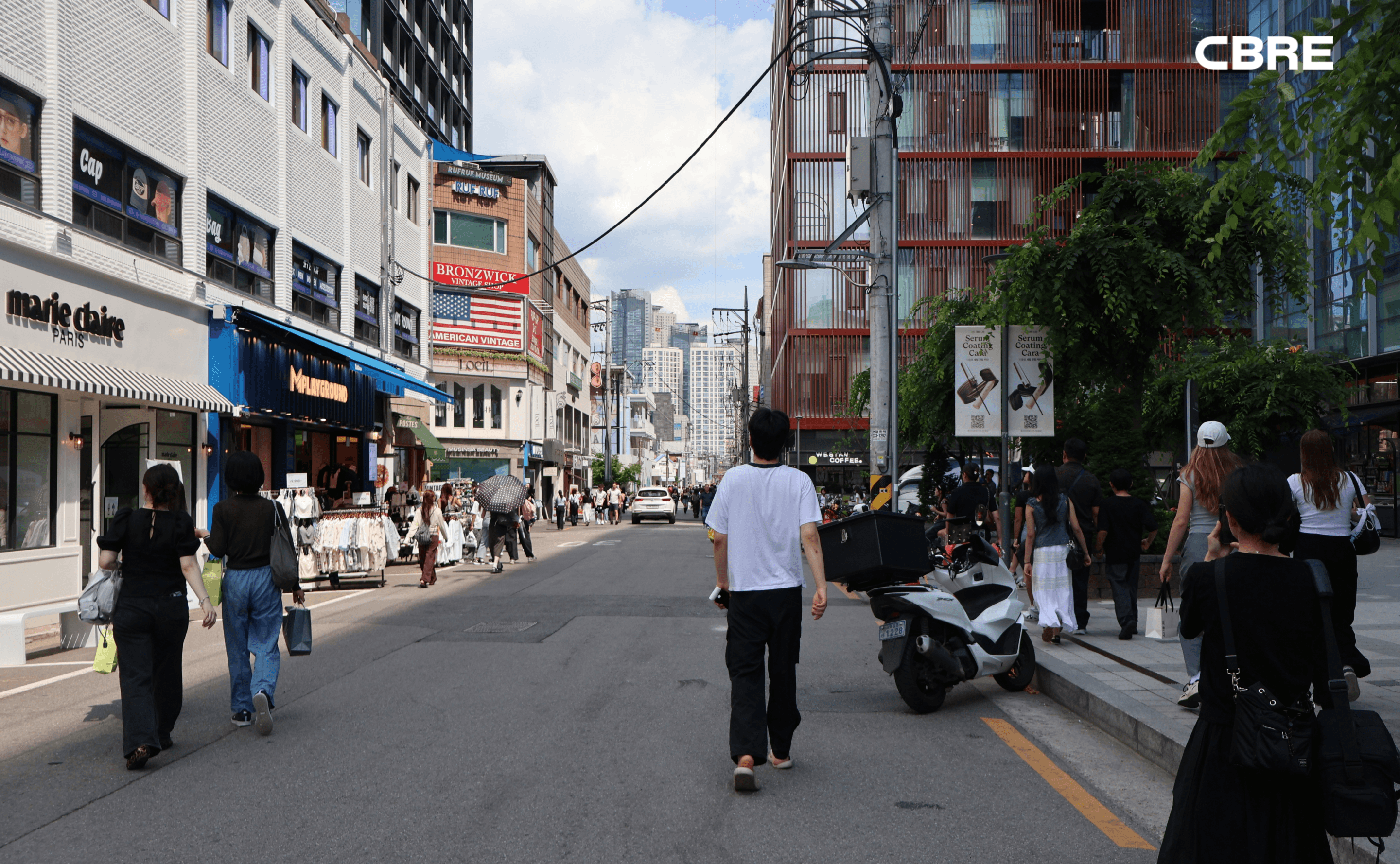
The problem is that the tenants who can afford this level of murderous rent are extremely limited. It is impossible for general F&B or individual shops to even enter. Only fashion with global capital strength, high-sensibility K-beauty, medical, or large retailers who can open flagship showrooms can accept this price.
The basis for them to endure high rents is sales. As discussed in the CBRE Korea Seongsu Retail Insight Note, the monthly sales per pyeong of Global Sportswear Brand A's Seongsu store was 8.76 million won, significantly ahead of the Gangnam store (5.09 million won), and Domestic Fashion Brand B was 6.34 million won, about 4 times that of the Gangnam store (1.67 million won). The annual sales of the Yeonmujang-gil area are estimated at about 800 billion won based on financial company consumption data, and key money in core areas has jumped 15 to 20 times compared to 2021, and rent per pyeong for long-term leases has jumped 2 to 3 times compared to 2023. It is a structure where only brands whose sales keep up with the rising rent survive. Ultimately, the value of a building is directly linked to whether or not it is chosen by these brands with high 'Rent Affordability'.
The hierarchy of this affordability does not remain only in core commercial districts. When top-tier brands fill the core streets, the next tier moves down to the secondary streets, and the tier below that to small and medium-sized buildings. The identity of the rental demand that small building investors must capture is ultimately somewhere in this chain.
The Formula of Commercial District Maturity Paved by F&B and Raised by Fashion
There is a kind of law in the mechanism of a commercial district's explosion. Seongsu-dong, which was a dilapidated factory zone in the 90s, is a prime example. The genesis of a commercial district is always opened by sensory cafes and unique food and beverage (F&B) outlets with low capital barriers. F&B housed in raw industrial spaces like red bricks and steel structures attracts the footsteps of those in their 20s and 30s, forming early traffic. However, the real protagonist that explosively pushes up the land value of a commercial area is 'fashion and beauty' which enters in the stage after F&B.

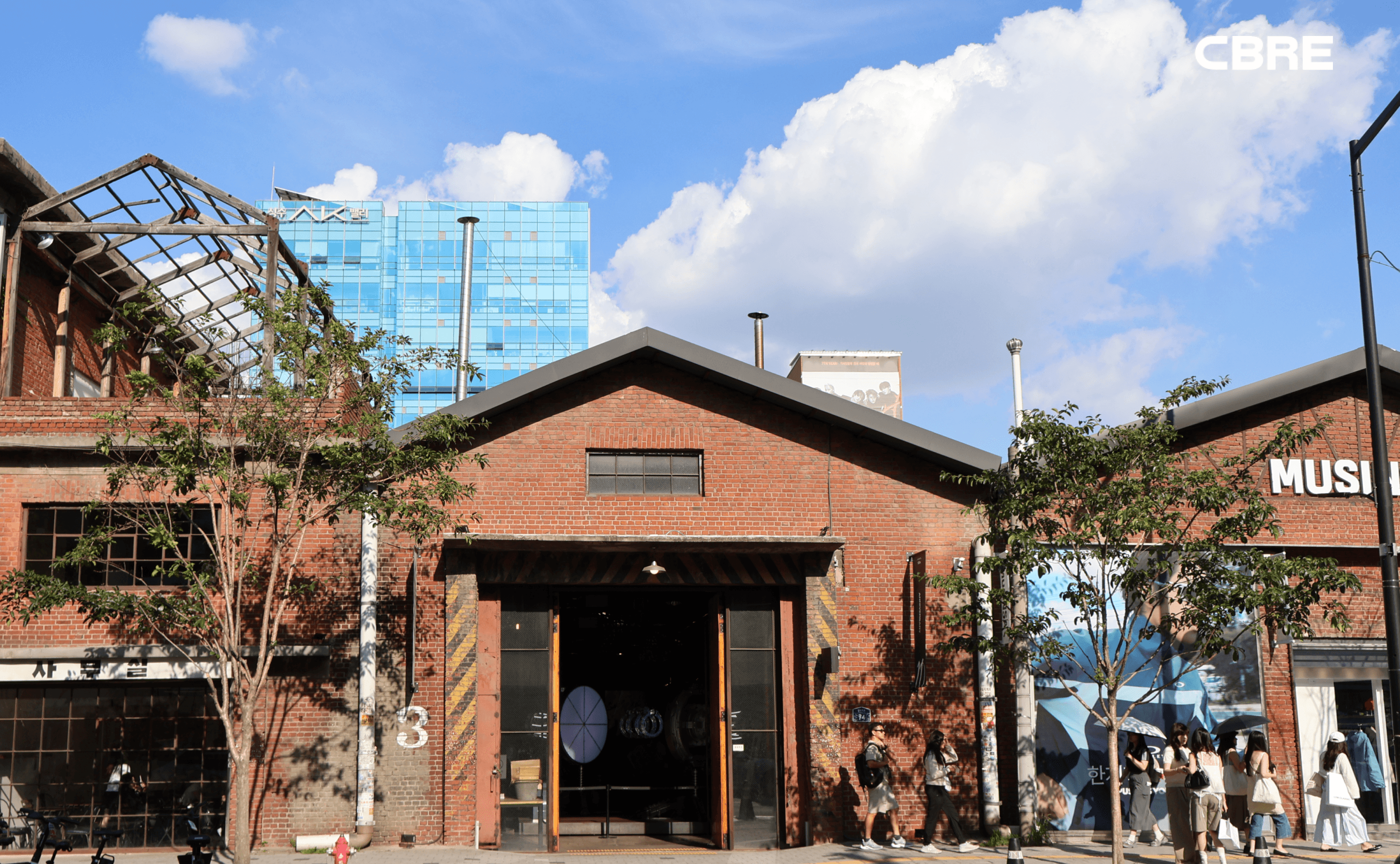
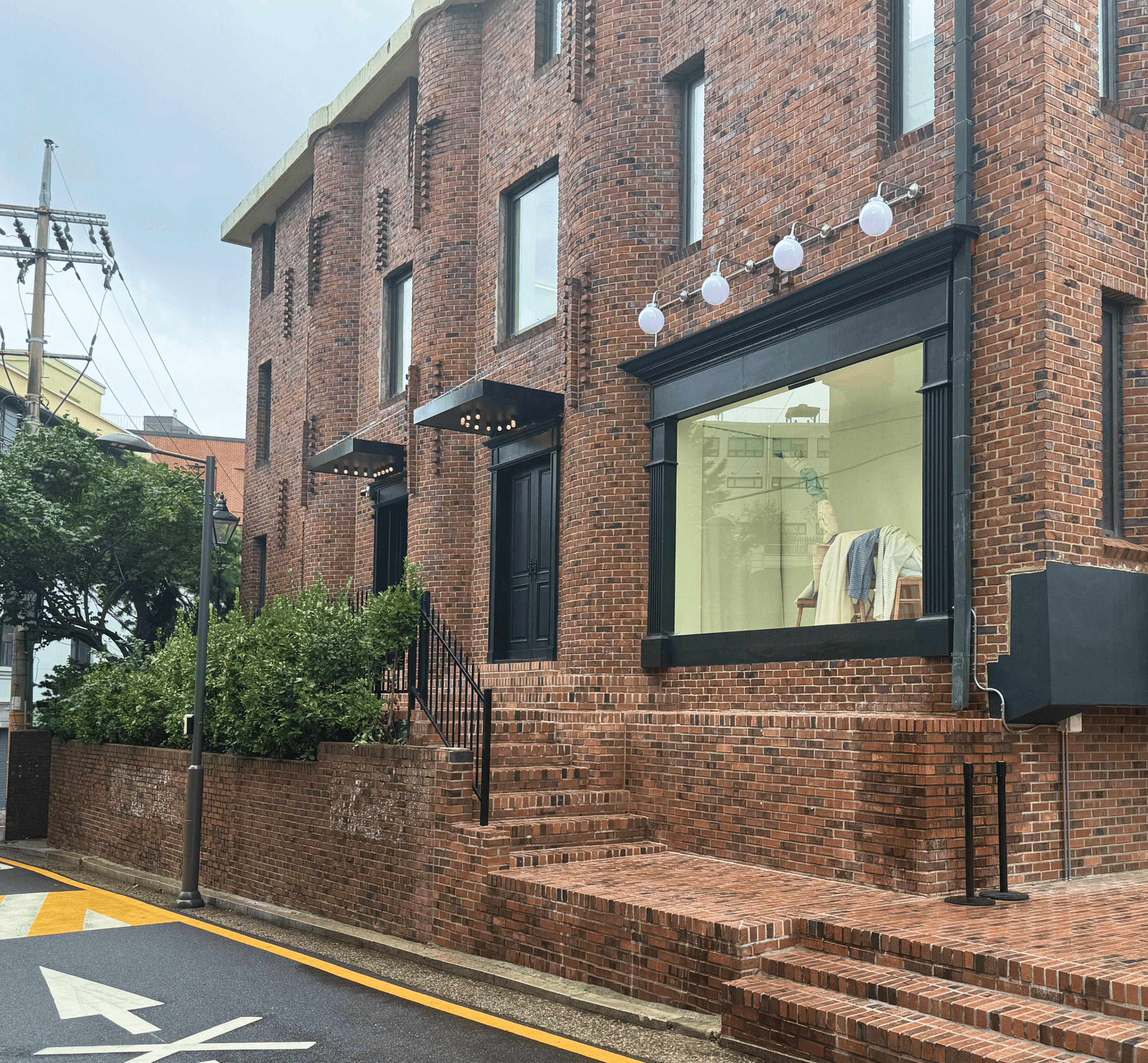
Daelim Changgo is a place that demonstrates this formula within a single building. It was an old rice mill building built with red bricks 50 years ago, and was an early space that contributed to Seongsu-dong rising as a hot place. It has now transformed into Musinsa's offline select shop, 'Musinsa Store Seongsu @ Daelim Changgo'. Fashion retail has now taken over the space that generated traffic in the early days of Seongsu.
As individual select shops and high-sensibility indie boutiques layer onto F&B traffic flows, and the moment the commercial district crosses the tipping point, large enterprise brands and global luxury brands plant their flags. From this point on, rents and land values rise vertically. Not all alleys complete this formula, but commercial districts where high-value-added industries like fashion and beauty fail to take the baton vanish along with the F&B trend cycle (2 to 3 years).
For small building investors, this formula is not a story of core commercial districts, but a map to read the timing of entry. You must preemptively secure assets in alleys where F&B has just started to generate traffic, but you must discern whether it is a street where fashion and beauty can enter next. However, the premise for that is not sensibility, but the physical conditions of the next chapter.
The Physical Premise on which Seongsu Yeonmujang-gil Overwhelmed Seoul Forest Atelier Street
There is a point that many investors overlook. It is the 'physical location specifications' that exist behind the sensibility or trends of a commercial district. Even within Seongsu-dong, the fates of Seoul Forest Atelier Street, the back of Ttukseom Station, and Yeonmujang-gil were completely divided. The Seoul Forest area was adjacent to a residential area, so the plot sizes were finely fragmented. Furthermore, Seongdong-gu implemented the nation's first gentrification prevention policy in the Seoul Forest-gil and Sangwon-gil areas starting from 2015, putting the brakes on the expansion of large capital. This regulation was concentrated in the Seoul Forest area until 'Sustainable Development Zones' were expanded to the entire Seongsu-dong area in August 2023. The area behind Ttukseom Station, despite being a semi-industrial area, had narrow alleys and poor plot connectivity, leaving no space for large tenants to enter.

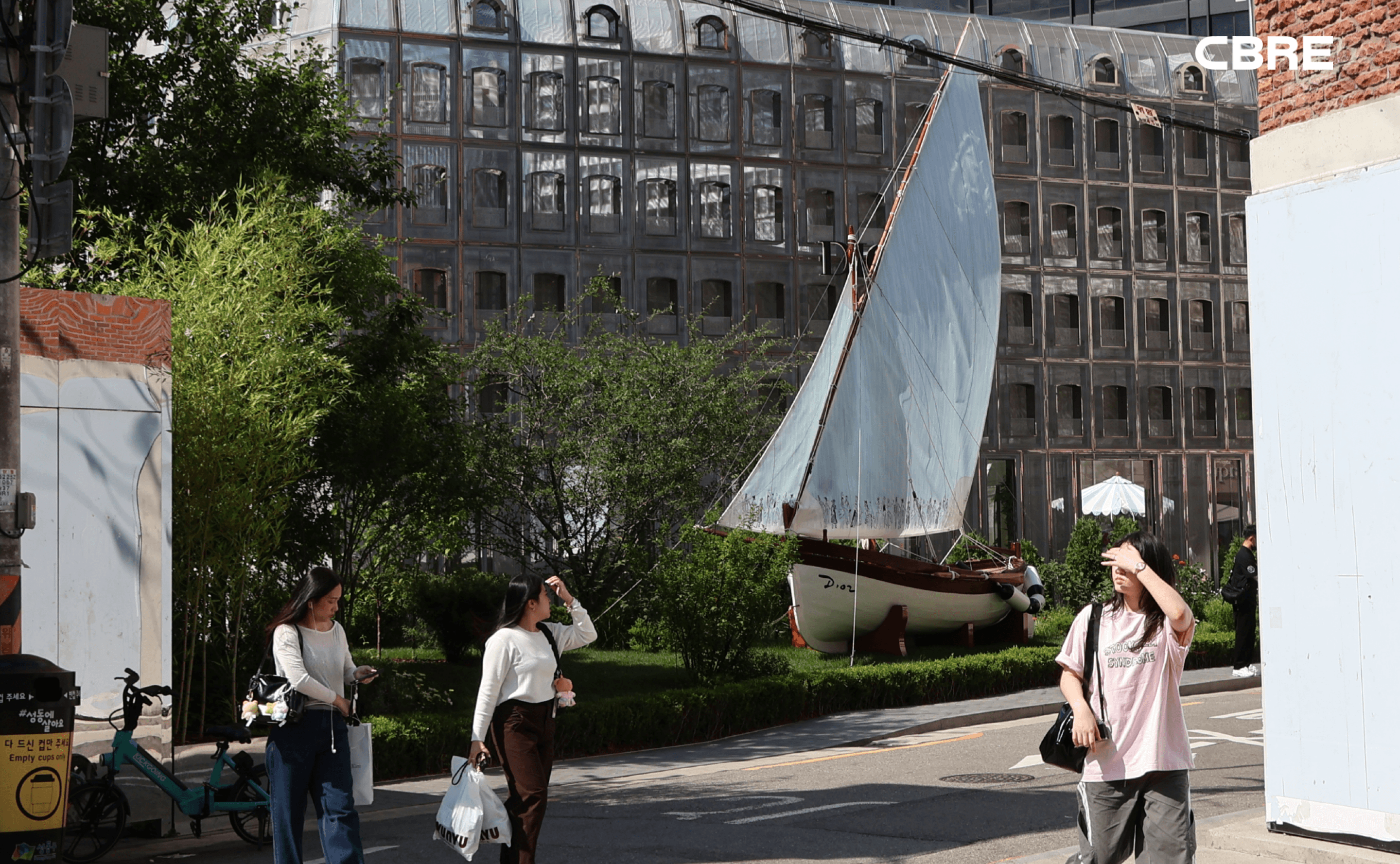
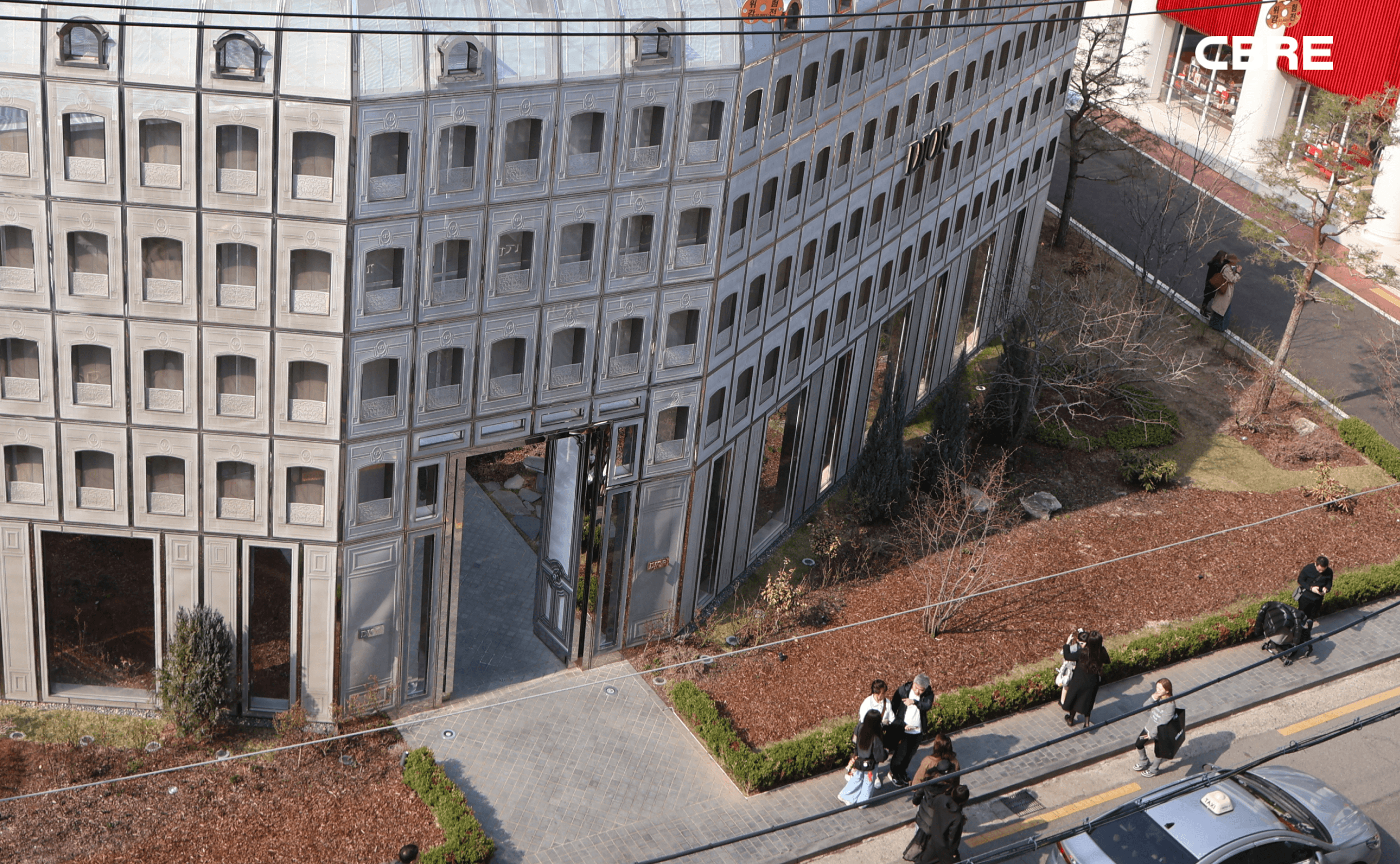
On the other hand, Yeonmujang-gil was different. It possessed a wide, straight road network stretching pleasantly for more than 1km on flat ground, and spacious semi-industrial area plots. It met the physical conditions, such as road width to accommodate abundant pedestrian traffic and the ability to construct large buildings. The site of Dior Seongsu, which opened in May 2022, was also originally a taxi company garage, and after passing through a public parking lot, the current building was built. It was an occupancy made possible because there was a wide plot that could be used as a whole.
Land prices followed. Yeonmujang-gil land, which was around 40 million won per pyeong in 2016, did not reach 100 million won per pyeong even until 2020-2021. Then, in May 2023, Amorepacific bought a building with 1 basement floor and 3 ground floors (land area 419㎡) for 31.7 billion won, or 250 million won per land pyeong, sextupling in seven years. In 2025, Simmons purchased a building on Dongyeonmujang-gil for 38 billion won. Subsequently, in February 2026, Make M, which runs the women's fashion brand Maybe Baby, purchased a building on Yeonmujang-gil (316-77 Seongsu-dong 2-ga) for about 450 million won per land pyeong, breaking the record high. The interesting point is that they are not using it directly as their own flagship, but are conducting rental marketing. This shows that it has evolved beyond the stage where brands directly plant flags, into a financial value-add territory where successful retail capital aggressively acquires assets aiming for land value appreciation and rental income on high streets.
The lesson for small building investors here is clear. Even within the same Seongsu, what divided their fates was not sensibility, but physical specs like plots, roads, and facades. Even when choosing a small building, the first question should not be "Is it a street with sensibility?" but "Is it hardware that can accommodate that sensibility?"
The Era of Experience Consumption, the Three Major Conditions of Buildings Sought by Brands
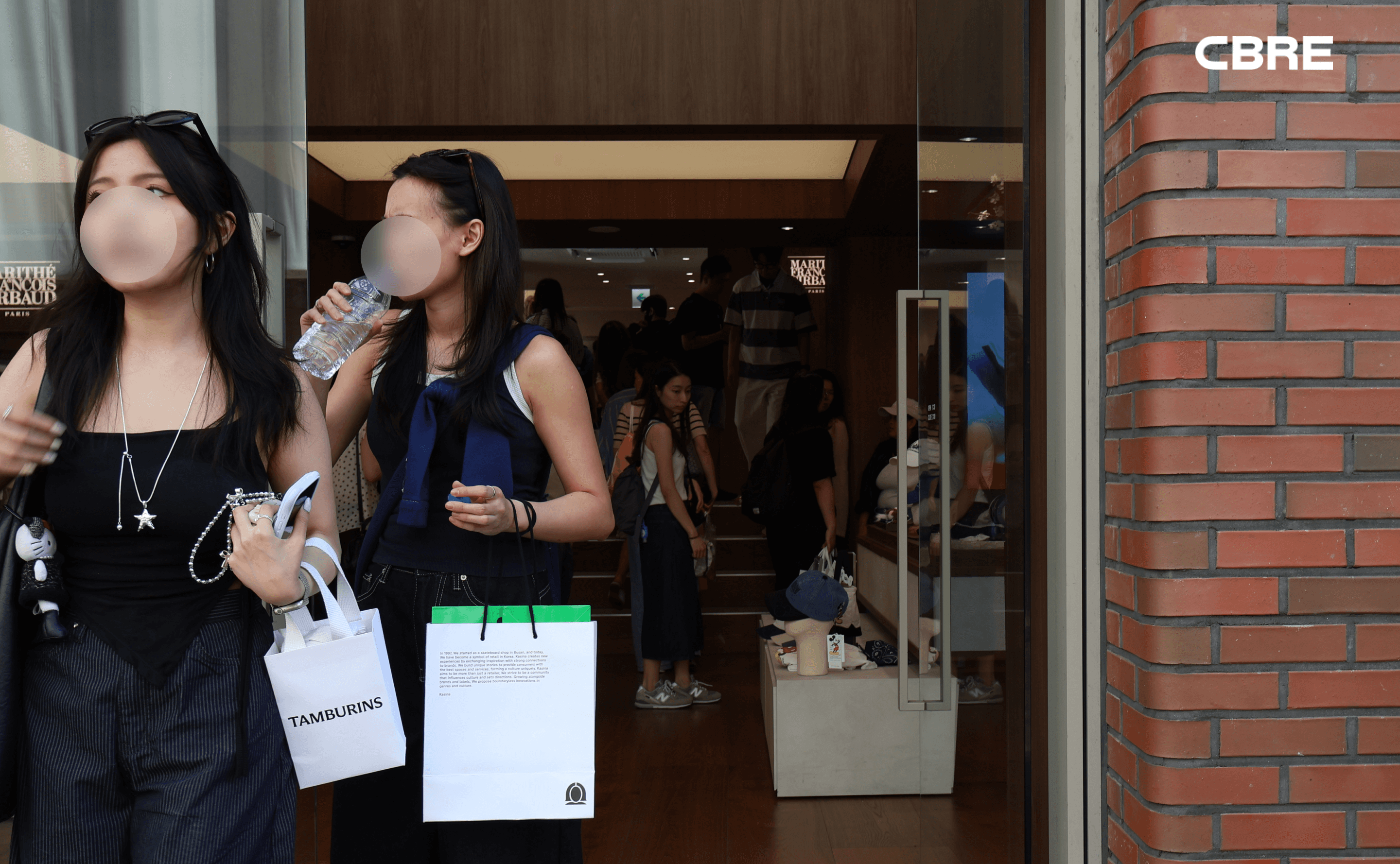
As spaces transition from simple points of sale to 'stages that sell a brand's universe', the standards of physical hardware required by tenants have completely changed. Like Gentle Monster and Tamburins, run by II COMBINED, models that pour a significant portion of store area into huge installation art and sensory space production instead of product display have settled as the offline standard. To realize such experiential flagships, brands demand three conditions.
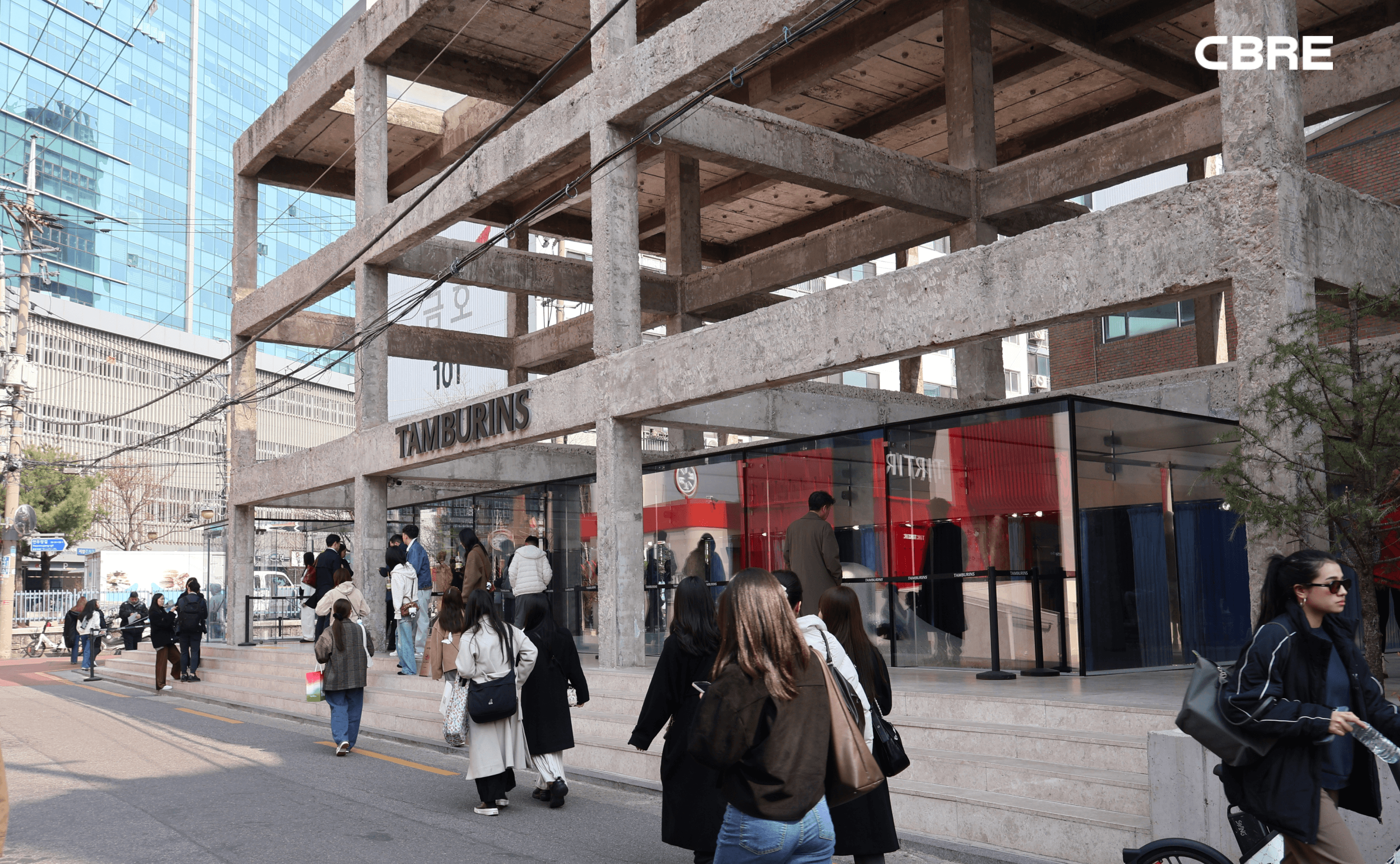
First, the front of the building facing the street (facade) must secure at least 20m. Second, it must be a location that can instantly hook the attention of the street. Third, the ceiling height must be high and the entire building must be available for single-tenant use.
It is no coincidence that the strongholds of Dior, Kith, Adidas, and Musinsa are, without exception, single-tenant leased buildings that secure a street-facing side of 20m or more. II COMBINED showed the peak of demand for visibility. Ahead of opening their new headquarters in Seongsu, they leased the entire site right in front of the office building and demolished the existing building. This is an unprecedented case where they secured visibility by removing the building that blocked the facade of the new headquarters and turned the spot into an open space with large branding sculptures installed.
In addition, the decisive change that has stood out recently is 'megaization (large-scaling)'. Instead of a multi-store strategy of opening finely dispersed stores, there is a clear trend of concentrating capital and experience by opening ultra-large flagships spanning hundreds to thousands of pyeongs in core locations with proven traffic-drawing power. Olive Young introducing 'Olive Young N Seongsu', an ultra-large store spanning ground floors 1 to 5, approximately 1,400 pyeongs, is a prime example.
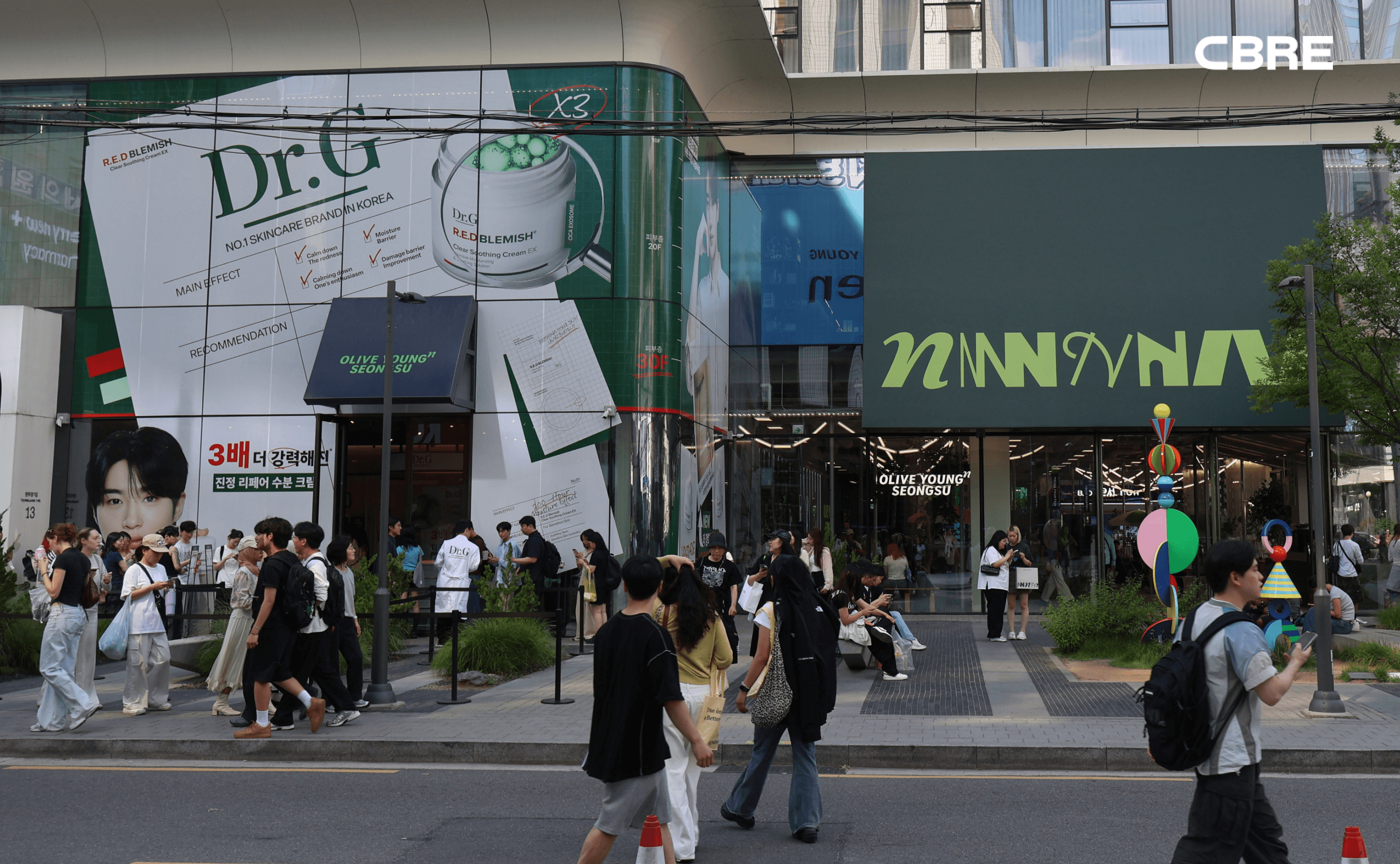
At first glance, the way they handle this huge area and rent might seem irrational. However, the reason global retail headquarters pinpoint Seongsu as a top-priority flagship location is not simply because of offline domestic sales. It is because Seoul yields the strongest global ROI as a 'studio for K-culture traffic' that goes viral in real-time on TikTok and Instagram worldwide. Ultimately, for them, an ultra-large flagship is a giant outdoor billboard executed as global branding SG&A expenses, not store rent. This is why the rent structure of high streets has been reorganized into a system linked to global marketing budgets, transcending the burden rate relative to store sales.
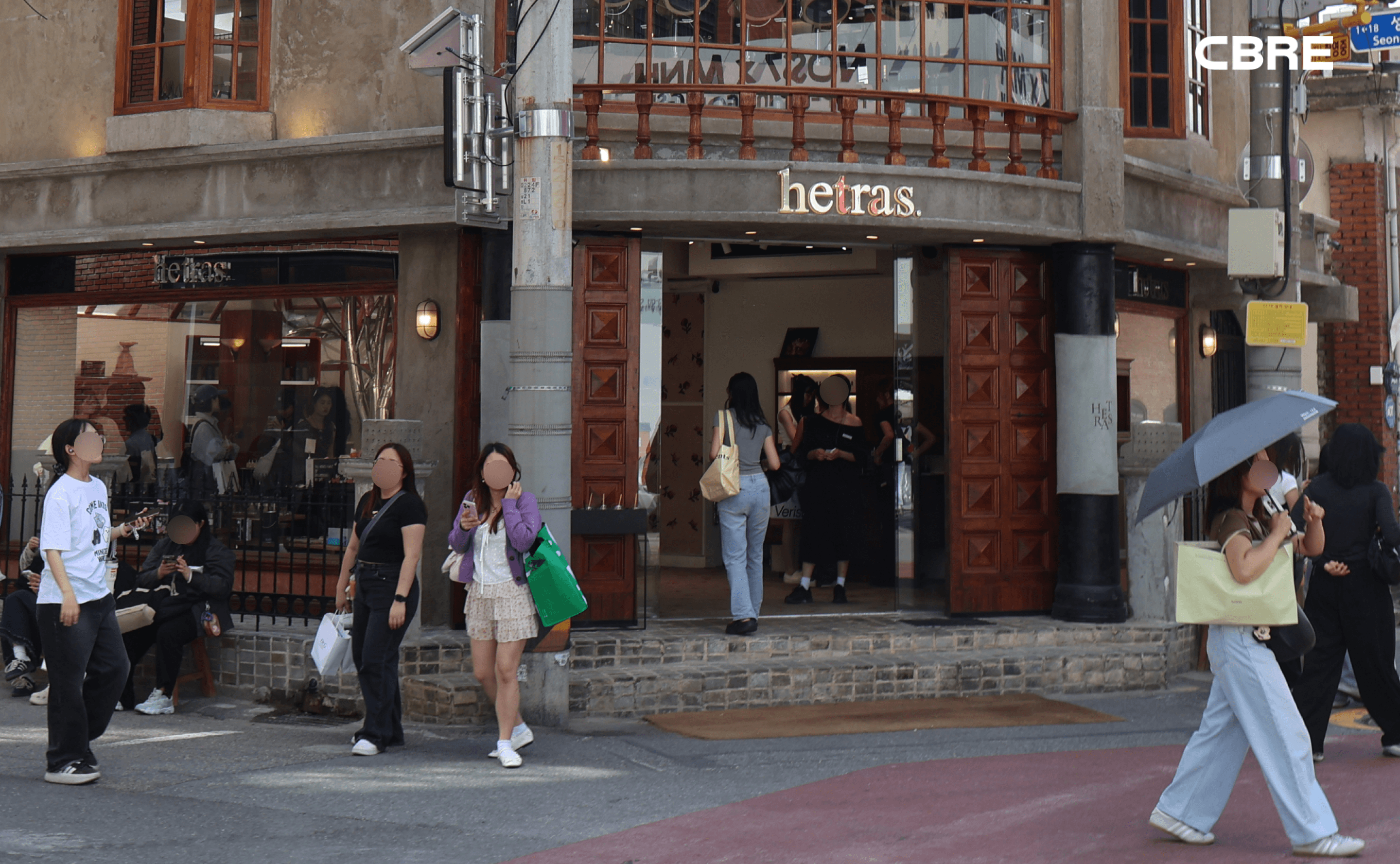
However, this standard is not a luxury exclusive to large flagships. The fact that a brand looks for a '20m front facade available for single-tenant lease' means that even a small building can be a candidate for a top-tier brand if it meets that condition. What determines the value is not the square footage, but the suitability of the hardware.
Reverse Value-Add: Selecting Buildings after Looking at Tenants First
A building on a main street that everyone knows, already packed with decent anchor tenants, looks perfect on the surface. However, such assets rarely come onto the market, and because they are already traded at peak prices, both the cap rate and return on equity are bound to fall short of expectations.
True smart value-add comes from reading the flow of traffic in the early stages of commercial district development and preempting aging assets that possess physical specs (wide front, corner, single-leaseable structure) preferred by subsequent fashion and beauty tenants. It is a structure where a 'pre-leasing strategy' is established from the building acquisition stage, planning what level of brand can re-lease the first floor and the entire building before entering.
II COMBINED's new Seongsu headquarters is an extreme example of this. They purchased the site in 2018 for 26.6 billion won, and in 2020 borrowed 100 billion won from the Korea Development Bank to proceed with a 40.7 billion won construction project. The plan was to house their own brands, such as Gentle Monster, Tamburins, and Nudake, on the lower floors. The purchase point was when Yeonmujang-gil land prices were still under 100 million won per pyeong. In essence, they bought the land after deciding on secure tenants, which were their own brands. This building opened as the complex cultural space 'HAUS NOWHERE' in September 2025.
While there are cases of preemptive purchase on the premise of housing their own brand's flagship like this, recently, there has been a clear trend where general investors or corporations also go through professional consulting with the CBRE Korea Retail Team from the early stages of acquisition review. This is a strategic approach to eliminate vacancy risk and maximize value-add execution capability by pre-verifying specific potential rental demand in the market, reasonable rent receivable, and the financial validity of the transaction price prior to purchasing a building.
In the end, the polarization of the small and medium-sized/small building market is bound to intensify further. Building owners should not be passive recipients waiting for deposits and monthly rent, but must have the sensibility of a retail planner who curates tenants by penetrating the context of the street and the spatial demands of brands. What determines the value of a building is not the number of the land area, but the sensibility and depth of the brand that the space can embrace. Only investors who understand the logic of the most expensive streets can reproduce that sensibility in even the smallest buildings.
The analysis that the buying sentiment in the small building market has dampened amid the real estate stagnation is only half correct. More accurately, the 'era of buying just any small building and receiving decent rent' is over. Recently, due to a shift in interest rate hikes, soaring transaction prices, and commercial district polarization, the market has entered a phase of thorough selective investment. Now, the success or failure of investment in small and medium-sized buildings depends not on loan leverage, but on what level of sensibility of tenants you can fill the first floor with to elevate the value of the building.
And the criteria for that 'jewel' is determined not by the eye level of small building investors, but by the logic of big capital driving the high streets. This is because what happens on the first floors of Myeongdong and Seongsu ultimately pulls up or drags down the value of the small and medium-sized buildings you are looking at. This is why investors targeting smaller buildings must first read how capital and brands are moving on the most expensive streets.
Polarization of Rents on Seoul's High Streets
The first-floor rent per pyeong in Seoul's core commercial districts, such as Myeongdong, Seongsu, Hannam, Dosan, and Hongdae, where foreign tourists and 2030 traffic are concentrated, has already exceeded 1 million won. The effective rent for short-term leases, such as pop-up stores, far exceeds this.
The problem is that the tenants who can afford this level of murderous rent are extremely limited. It is impossible for general F&B or individual shops to even enter. Only fashion with global capital strength, high-sensibility K-beauty, medical, or large retailers who can open flagship showrooms can accept this price.
The basis for them to endure high rents is sales. As discussed in the CBRE Korea Seongsu Retail Insight Note, the monthly sales per pyeong of Global Sportswear Brand A's Seongsu store was 8.76 million won, significantly ahead of the Gangnam store (5.09 million won), and Domestic Fashion Brand B was 6.34 million won, about 4 times that of the Gangnam store (1.67 million won). The annual sales of the Yeonmujang-gil area are estimated at about 800 billion won based on financial company consumption data, and key money in core areas has jumped 15 to 20 times compared to 2021, and rent per pyeong for long-term leases has jumped 2 to 3 times compared to 2023. It is a structure where only brands whose sales keep up with the rising rent survive. Ultimately, the value of a building is directly linked to whether or not it is chosen by these brands with high 'Rent Affordability'.
The hierarchy of this affordability does not remain only in core commercial districts. When top-tier brands fill the core streets, the next tier moves down to the secondary streets, and the tier below that to small and medium-sized buildings. The identity of the rental demand that small building investors must capture is ultimately somewhere in this chain.
The Formula of Commercial District Maturity Paved by F&B and Raised by Fashion
There is a kind of law in the mechanism of a commercial district's explosion. Seongsu-dong, which was a dilapidated factory zone in the 90s, is a prime example. The genesis of a commercial district is always opened by sensory cafes and unique food and beverage (F&B) outlets with low capital barriers. F&B housed in raw industrial spaces like red bricks and steel structures attracts the footsteps of those in their 20s and 30s, forming early traffic. However, the real protagonist that explosively pushes up the land value of a commercial area is 'fashion and beauty' which enters in the stage after F&B.
Daelim Changgo is a place that demonstrates this formula within a single building. It was an old rice mill building built with red bricks 50 years ago, and was an early space that contributed to Seongsu-dong rising as a hot place. It has now transformed into Musinsa's offline select shop, 'Musinsa Store Seongsu @ Daelim Changgo'. Fashion retail has now taken over the space that generated traffic in the early days of Seongsu.
As individual select shops and high-sensibility indie boutiques layer onto F&B traffic flows, and the moment the commercial district crosses the tipping point, large enterprise brands and global luxury brands plant their flags. From this point on, rents and land values rise vertically. Not all alleys complete this formula, but commercial districts where high-value-added industries like fashion and beauty fail to take the baton vanish along with the F&B trend cycle (2 to 3 years).
For small building investors, this formula is not a story of core commercial districts, but a map to read the timing of entry. You must preemptively secure assets in alleys where F&B has just started to generate traffic, but you must discern whether it is a street where fashion and beauty can enter next. However, the premise for that is not sensibility, but the physical conditions of the next chapter.
The Physical Premise on which Seongsu Yeonmujang-gil Overwhelmed Seoul Forest Atelier Street
There is a point that many investors overlook. It is the 'physical location specifications' that exist behind the sensibility or trends of a commercial district. Even within Seongsu-dong, the fates of Seoul Forest Atelier Street, the back of Ttukseom Station, and Yeonmujang-gil were completely divided. The Seoul Forest area was adjacent to a residential area, so the plot sizes were finely fragmented. Furthermore, Seongdong-gu implemented the nation's first gentrification prevention policy in the Seoul Forest-gil and Sangwon-gil areas starting from 2015, putting the brakes on the expansion of large capital. This regulation was concentrated in the Seoul Forest area until 'Sustainable Development Zones' were expanded to the entire Seongsu-dong area in August 2023. The area behind Ttukseom Station, despite being a semi-industrial area, had narrow alleys and poor plot connectivity, leaving no space for large tenants to enter.
On the other hand, Yeonmujang-gil was different. It possessed a wide, straight road network stretching pleasantly for more than 1km on flat ground, and spacious semi-industrial area plots. It met the physical conditions, such as road width to accommodate abundant pedestrian traffic and the ability to construct large buildings. The site of Dior Seongsu, which opened in May 2022, was also originally a taxi company garage, and after passing through a public parking lot, the current building was built. It was an occupancy made possible because there was a wide plot that could be used as a whole.
Land prices followed. Yeonmujang-gil land, which was around 40 million won per pyeong in 2016, did not reach 100 million won per pyeong even until 2020-2021. Then, in May 2023, Amorepacific bought a building with 1 basement floor and 3 ground floors (land area 419㎡) for 31.7 billion won, or 250 million won per land pyeong, sextupling in seven years. In 2025, Simmons purchased a building on Dongyeonmujang-gil for 38 billion won. Subsequently, in February 2026, Make M, which runs the women's fashion brand Maybe Baby, purchased a building on Yeonmujang-gil (316-77 Seongsu-dong 2-ga) for about 450 million won per land pyeong, breaking the record high. The interesting point is that they are not using it directly as their own flagship, but are conducting rental marketing. This shows that it has evolved beyond the stage where brands directly plant flags, into a financial value-add territory where successful retail capital aggressively acquires assets aiming for land value appreciation and rental income on high streets.
The lesson for small building investors here is clear. Even within the same Seongsu, what divided their fates was not sensibility, but physical specs like plots, roads, and facades. Even when choosing a small building, the first question should not be "Is it a street with sensibility?" but "Is it hardware that can accommodate that sensibility?"
The Era of Experience Consumption, the Three Major Conditions of Buildings Sought by Brands
As spaces transition from simple points of sale to 'stages that sell a brand's universe', the standards of physical hardware required by tenants have completely changed. Like Gentle Monster and Tamburins, run by II COMBINED, models that pour a significant portion of store area into huge installation art and sensory space production instead of product display have settled as the offline standard. To realize such experiential flagships, brands demand three conditions.
First, the front of the building facing the street (facade) must secure at least 20m. Second, it must be a location that can instantly hook the attention of the street. Third, the ceiling height must be high and the entire building must be available for single-tenant use.
It is no coincidence that the strongholds of Dior, Kith, Adidas, and Musinsa are, without exception, single-tenant leased buildings that secure a street-facing side of 20m or more. II COMBINED showed the peak of demand for visibility. Ahead of opening their new headquarters in Seongsu, they leased the entire site right in front of the office building and demolished the existing building. This is an unprecedented case where they secured visibility by removing the building that blocked the facade of the new headquarters and turned the spot into an open space with large branding sculptures installed.
In addition, the decisive change that has stood out recently is 'megaization (large-scaling)'. Instead of a multi-store strategy of opening finely dispersed stores, there is a clear trend of concentrating capital and experience by opening ultra-large flagships spanning hundreds to thousands of pyeongs in core locations with proven traffic-drawing power. Olive Young introducing 'Olive Young N Seongsu', an ultra-large store spanning ground floors 1 to 5, approximately 1,400 pyeongs, is a prime example.
At first glance, the way they handle this huge area and rent might seem irrational. However, the reason global retail headquarters pinpoint Seongsu as a top-priority flagship location is not simply because of offline domestic sales. It is because Seoul yields the strongest global ROI as a 'studio for K-culture traffic' that goes viral in real-time on TikTok and Instagram worldwide. Ultimately, for them, an ultra-large flagship is a giant outdoor billboard executed as global branding SG&A expenses, not store rent. This is why the rent structure of high streets has been reorganized into a system linked to global marketing budgets, transcending the burden rate relative to store sales.
However, this standard is not a luxury exclusive to large flagships. The fact that a brand looks for a '20m front facade available for single-tenant lease' means that even a small building can be a candidate for a top-tier brand if it meets that condition. What determines the value is not the square footage, but the suitability of the hardware.
Reverse Value-Add: Selecting Buildings after Looking at Tenants First
A building on a main street that everyone knows, already packed with decent anchor tenants, looks perfect on the surface. However, such assets rarely come onto the market, and because they are already traded at peak prices, both the cap rate and return on equity are bound to fall short of expectations.
True smart value-add comes from reading the flow of traffic in the early stages of commercial district development and preempting aging assets that possess physical specs (wide front, corner, single-leaseable structure) preferred by subsequent fashion and beauty tenants. It is a structure where a 'pre-leasing strategy' is established from the building acquisition stage, planning what level of brand can re-lease the first floor and the entire building before entering.
II COMBINED's new Seongsu headquarters is an extreme example of this. They purchased the site in 2018 for 26.6 billion won, and in 2020 borrowed 100 billion won from the Korea Development Bank to proceed with a 40.7 billion won construction project. The plan was to house their own brands, such as Gentle Monster, Tamburins, and Nudake, on the lower floors. The purchase point was when Yeonmujang-gil land prices were still under 100 million won per pyeong. In essence, they bought the land after deciding on secure tenants, which were their own brands. This building opened as the complex cultural space 'HAUS NOWHERE' in September 2025.
While there are cases of preemptive purchase on the premise of housing their own brand's flagship like this, recently, there has been a clear trend where general investors or corporations also go through professional consulting with the CBRE Korea Retail Team from the early stages of acquisition review. This is a strategic approach to eliminate vacancy risk and maximize value-add execution capability by pre-verifying specific potential rental demand in the market, reasonable rent receivable, and the financial validity of the transaction price prior to purchasing a building.
In the end, the polarization of the small and medium-sized/small building market is bound to intensify further. Building owners should not be passive recipients waiting for deposits and monthly rent, but must have the sensibility of a retail planner who curates tenants by penetrating the context of the street and the spatial demands of brands. What determines the value of a building is not the number of the land area, but the sensibility and depth of the brand that the space can embrace. Only investors who understand the logic of the most expensive streets can reproduce that sensibility in even the smallest buildings.
© Copyright 2026. All rights reserved.
This publication has been prepared in good faith, based on CBRE Korea's current anecdotal and evidence based views of the commercial real estate market. Although CBRE Korea believes its views reflect market conditions on the date of this presentation, they are subject to significant uncertainties and contingencies, many of which are beyond CBRE Korea’s control. In addition, many of CBRE Korea’s views are opinion and/or projections based on CBRE Korea’s subjective analyses of current market circumstances. Other firms may have different opinions, projections and analyses, and actual market conditions in the future may cause CBRE Korea’s current views to later be incorrect. CBRE Korea has no obligation to update its views herein if its opinions, projections, analyses or market circumstances later change.
Nothing in this publication should be construed as an indicator of the future performance of CBRE’s securities or of the performance of any other company’s securities. You should not purchase or sell securities-of CBRE or any other company-based on the views herein. CBRE Korea disclaims all liability for securities purchased or sold based on information herein, and by viewing this publication, you waive all claims against CBRE Korea as well as against CBRE Korea’s affiliates, officers, directors, employees, agents, advisers and representatives arising out of the accuracy, completeness, adequacy or your use of the information herein. No part of this publication may be reproduced, quoted, distributed, or disclosed to any third party without the prior written consent of CBRE Korea.
More in
More in
More in
market
market
market
market
Aug 24, 2026
Retail Ownership: The Era of Brands Becoming Landlords
From Leasing to Buying: The Ultimate Playbook for Space Strategy
market
Aug 18, 2026
K-Brand US Market Entry Strategy
NY vs. LA Commercial District Comparison and Retail Success Formula

market
Aug 3, 2026
The Busan Commercial District Transformed by Foreigners
The shifting consumer landscape shaped by a wave of 3.64 million people
market
May 26, 2026
2026 Retail Market Insights from the Head of CBRE Korea Retail
From Seoul to the globe, the variable determining the success or failure of retail spaces is shifting from 'where' to 'how'.

market
Apr 13, 2026
It starts with data and is completed in the field
The Essence of the 2026 Retail Market, According to CBRE's Head of Research
market
Apr 13, 2026
The End of Strata Retail?
Supply is down on paper. Vacancies are up on the ground. The hidden oversupply and structural flaw behind Korea's pre-sale retail crisis.
market
Apr 13, 2026
Two Years Locked in Permits
The real cost of overseas retail expansion without a project management framework — why permit risk has to be resolved before the lease is signed.
market
Apr 13, 2026
From Supporting Role to Lead: Office Retail
From basement canteen to asset value driver — fifteen years of structural change in Seoul's office building retail, from Centre One to Olive Young N Seongsu.

market
Apr 13, 2026
Why Gut Instinct Kills Your Flagship Store
Thirty-one retail real estate practitioners rank what actually determines flagship store performance.

market
Apr 13, 2026
Know Anyone Good to Set Me Up With?
How leasing decisions are actually made in Seoul's most competitive retail districts — and why the broker in the middle determines the outcome.
market
Apr 13, 2026
New Era, New Areas
Korean brands are going global. The ones that make it understand one thing first: overseas leasing is a credit game, not a rent game.

market
Apr 13, 2026
It's Not That They're Not Spending
Why foreign visitor spending data is replacing card transactions as the next frontier in retail intelligence.
market
Apr 13, 2026
You are so Beauti-cal
Dermatology clinics are now the most sought-after anchor tenants on Gangnam street
market
Apr 13, 2026
Reading a Brand's DNA Before They Do
The retail MD practitioner's job is translation — turning a brand's qualitative language into measurable spatial conditions. What that looks like in practice.
Fresh Retail Insights, Every Week
Retail Dynamics & Edge Insights | by CBRE Korea Retail
New retail insights, updated every week.
Fresh Retail Insights, Every Week
Retail Dynamics & Edge Insights
| by CBRE Korea Retail
New retail insights, updated every week.
Fresh Retail Insights, Every Week
Retail Dynamics & Edge Insights | by CBRE Korea Retail
New retail insights, updated every week.