Back
Share
Like
market
Article Highlights
Reorganization of Acquisition Grammar: Evolving from the acquisition of landmarks by mega-capital to the establishment of alley-scale clustering bases by emerging brands
Financial Strategy and Spatial Sovereignty: Capitalization of rental sunk costs, defense against eviction risks, complete autonomy in spatial planning, and direct recovery of land value appreciation
Shift in Asset Value-Up Standards: A need for an approach centered on structural margin and spatial potential capable of projecting brand identity, rather than standardized new construction specifications
Three months ago, I pointed out on these pages that the grammar of retail has shifted from 'Where are you?' to 'How are you?'. The era where securing a good location guaranteed performance is over. Now, even in the same location, how a space is designed and operated determines the success or failure of a brand and asset.
However, if you push the question of 'how' to its limit, you eventually reach one fundamental question: "Whose space is it (Whose)?"
As brands define space not as a mere sales channel but as a medium to convey a unique narrative, the limitations of rented spaces become clear. Instead of being dragged along by soaring rents, landlord intervention, and the uncertainty of lease expirations, brands are choosing to assetize their expenses. They have begun to consider the option of becoming a 'landlord' to secure autonomy in space deployment and build a financial safety net.
Cheongdam of the Past and Seongsu/Dosan of Today: Changes in the Grammar of Acquisition
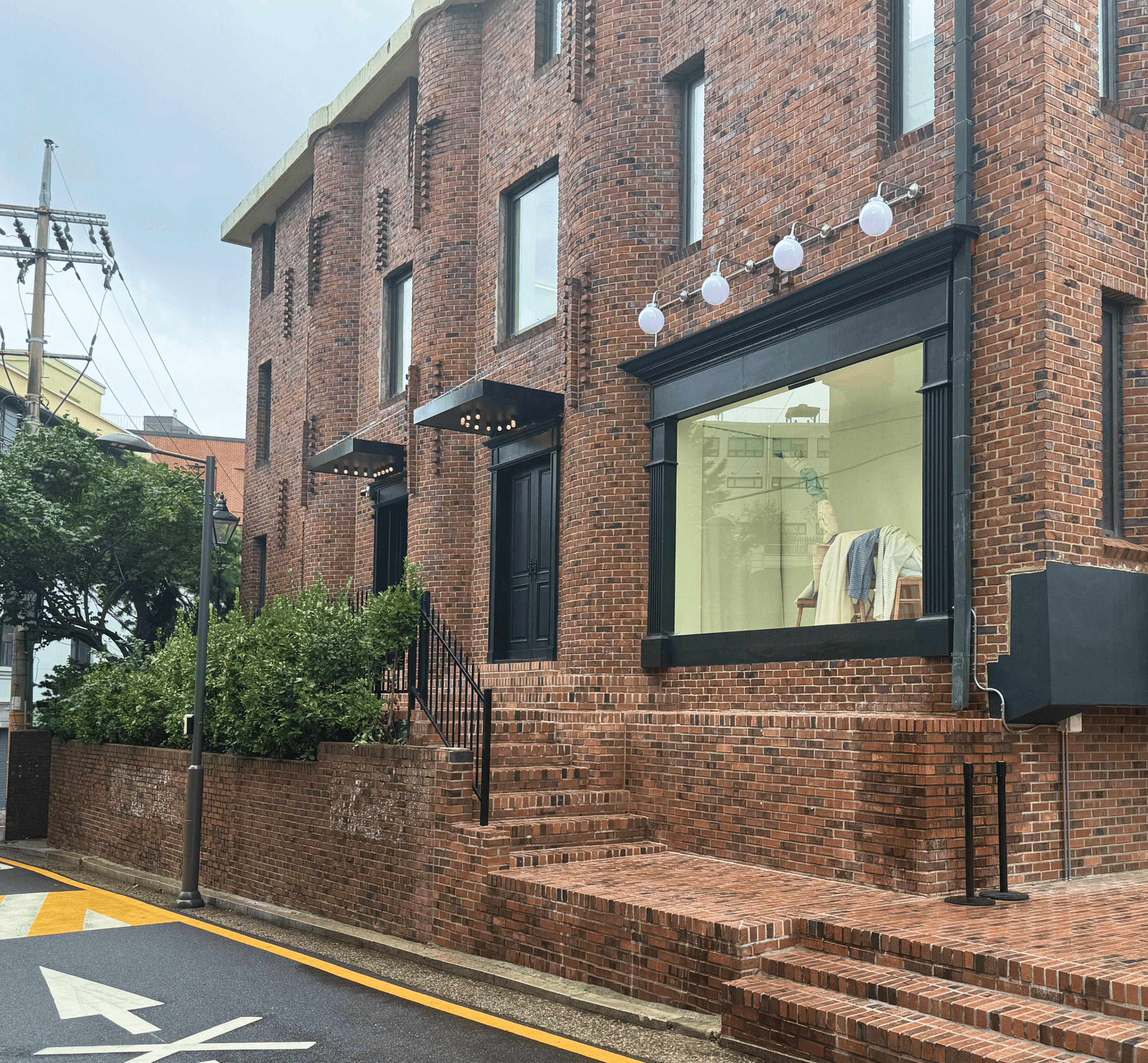
Brands owning spaces directly is not a completely new phenomenon. In the past, global luxury houses, conglomerates, and major capitalists bought up core locations in Cheongdam-dong Luxury Street or the Hannam-dong area with massive capital to establish landmarks and strongholds, building office buildings and antenna shops on assets they had held for a long time.
However, ownership in those days was either a symbolic investment by global houses with vast capital or limited to the utilization of fixed assets by conglomerates—a grammar exclusive to a few giant capital players. The wave of acquisitions witnessed today in the Seongsu, Dosan, and Yaksu/Sindang areas differs in its nature and subjects.
While past acquisitions were a matter of 'securing office-type antenna shops' by giant capital, the practical changes that warrant attention in today's market are the following three.
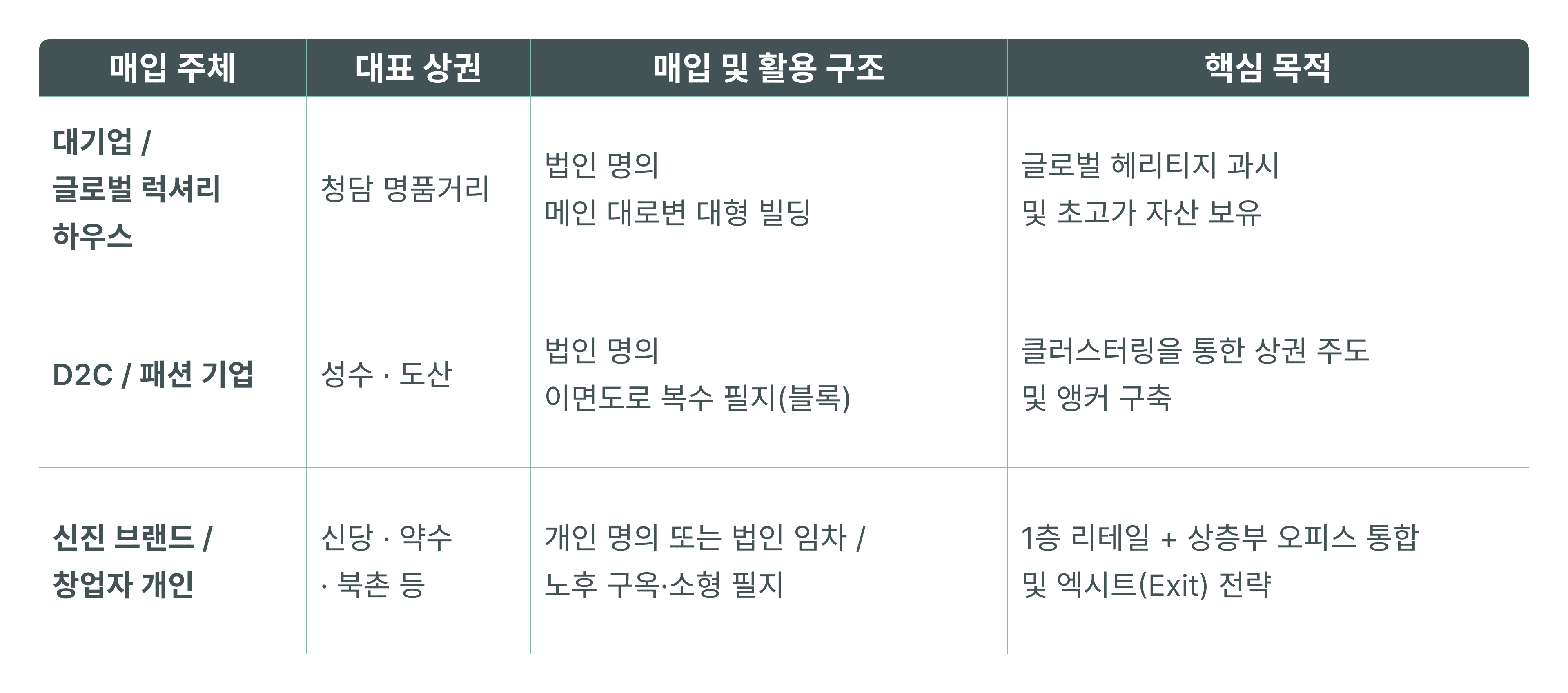
First, the subjects wishing to acquire have expanded beyond conglomerates. Small and medium-sized brands that have received VC investment or grown rapidly through online/D2C channels have begun to review acquisitions, eyeing funds ranging from tens of billions to hundreds of billions of won. However, wishing and actual realization are separate issues. In reality, those who succeed in large-scale acquisitions are a minority with supported financial stamina, and assets in core commercial areas are information-asymmetry markets where intentions to buy are exchanged among a few insiders before being listed as public properties.
Second, they adopt a 'clustering' method, buying old houses or factories in back alleys rather than on main roads to lead the atmosphere of the alley unit. The intention is for the brand not to passively integrate into the commercial district, but to create a destination themselves and seize control of the alley. In a structure where consumers look into the background of a brand's creation and its spatial narrative, the strategy of occupying the context of the alley increases brand immersion.
Third, it is an alternative to stably secure long-term strongholds in commercial districts centered on short-term trends. As core commercial districts with concentrated waiting demand are dominated by short-term pop-ups or lease agreements centered on frequent turnover, lease cycles have become somewhat short for brands to spend time building deep relationships with genuine customers.
Added to this, brand fatigue due to the concentration of floating population is also a factor accelerating acquisitions. Founders who wish to fully accumulate their brand's unique philosophy and depth, rather than focusing on fast consumption and simple exposure, require independent strongholds in quiet back-alley old houses or small parcels to calmly refine the texture of their brand.
Ultimately, strategic decisions to carry on brand continuity unaffected by external environmental volatility while simultaneously building long-term asset value are leading to the choice of direct acquisition.
The Day the Tenant Became the Landlord: Clustering and Building the Main Base
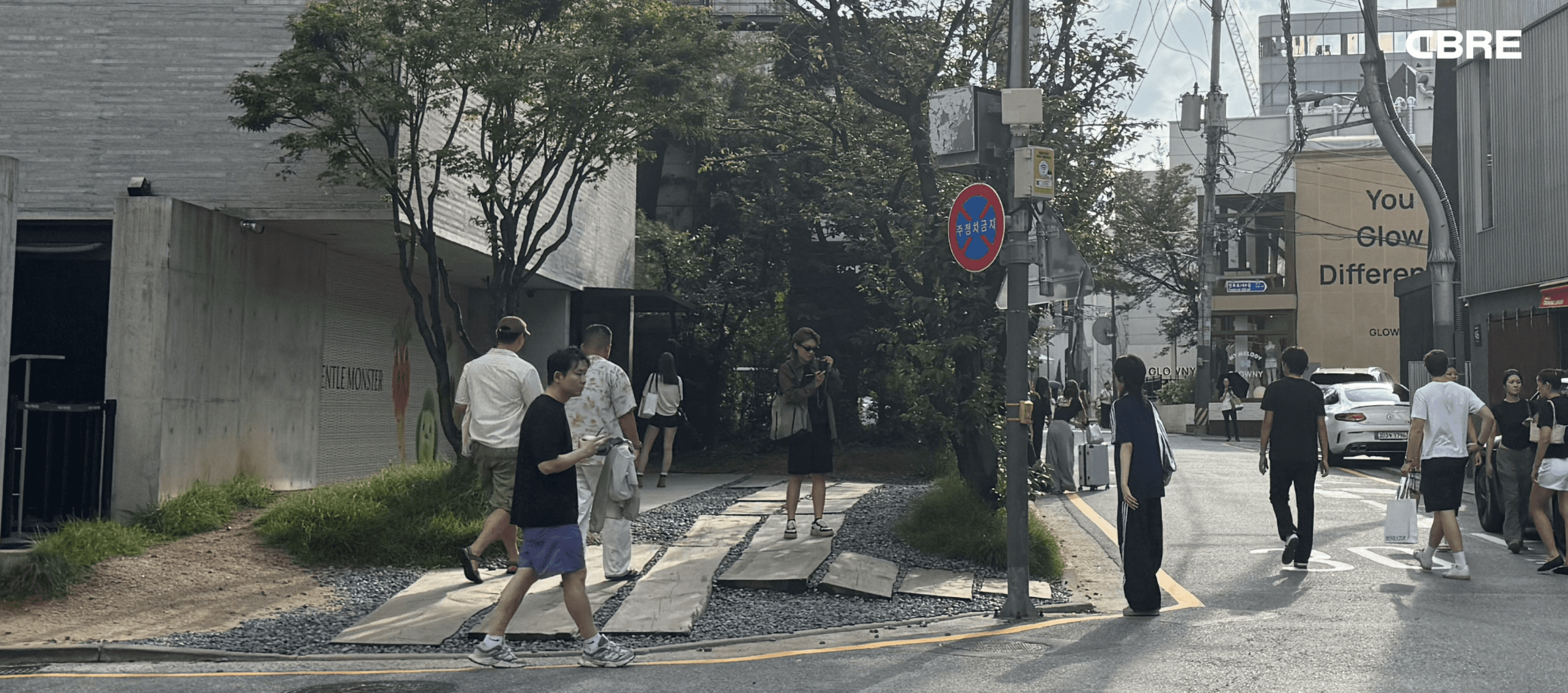
IICOMBINED's strategy of permanently securing a brand's core offline stronghold, eliminating high rental risks and eviction variables due to lease expiration
In the Dosan Park commercial area, IICOMBINED, which develops Gentle Monster, clearly demonstrates this method. Starting with buying the Sinsa-dong building where the flagship store 'HAUS DOSAN' was located for 68.6 billion won (350 million won per pyeong of land) in October 2024, they successively acquired the nearby 'Stüssy Seoul Chapter' building (34 billion won) and an adjacent single-family home (28.5 billion won). This is a method of securing multiple parcels in a specific alley to directly lead the tenant composition and commercial district atmosphere.

Musinsa Run, the first running-specialized select shop presented on Seoul Forest Road.
In the Yeonmujang-gil area of Seongsu-dong, asset acquisitions by major fashion companies have also continued.
Simmons: Secured an offline stronghold by acquiring assets near Yeonmujang-gil for 35.5 billion won.
Amorepacific: Bought a core site on Yeonmujang-gil for 31.7 billion won (approx. 250 million won per pyeong of land) to convert it into a brand flagship.
Musinsa: Leading the development axis by concentrating acquisitions of 5 or more land plots and buildings in the Seongsu-dong area alone (Empty site for 10.5 billion won, former logistics center site for 46 billion won, etc.).
The moment a brand that was once a tenant transitions into a landlord, that brand becomes both a tenant of its own store and an anchor that determines the atmosphere of the commercial district. It is a structure where they directly hold the initiative in increasing asset value beyond space operations.
Expert's Insight
"Acquisition is about securing control to fully encapsulate a brand's unique concept and narrative in a space without lease agreements or external interference. Added to this is a practical financial strategy that converts monthly rent expenses into assets and keeps capital gains in mind for future sales."
Why Brands Consider Acquisitions Even in a High-Interest Rate Environment
Looking at the real estate market as a whole, it is not an environment friendly to buying small and medium-sized buildings due to high interest rates and financial cost burdens. Land in Dosan Park is formed at 350 to 400 million won per pyeong, Yeonmujang-gil in Seongsu-dong at around 250 million won per pyeong, and the back alleys of Seongsu 2-ga at around 168 million won per pyeong.
In the overall commercial building market, brands do not make up the absolute majority of buyers. However, unlike in the past when 'real estate' was excluded in the process of growing a brand, it has now emerged as a valid pillar of brand strategy. The realistic calculations of brands can be summarized into three main points.
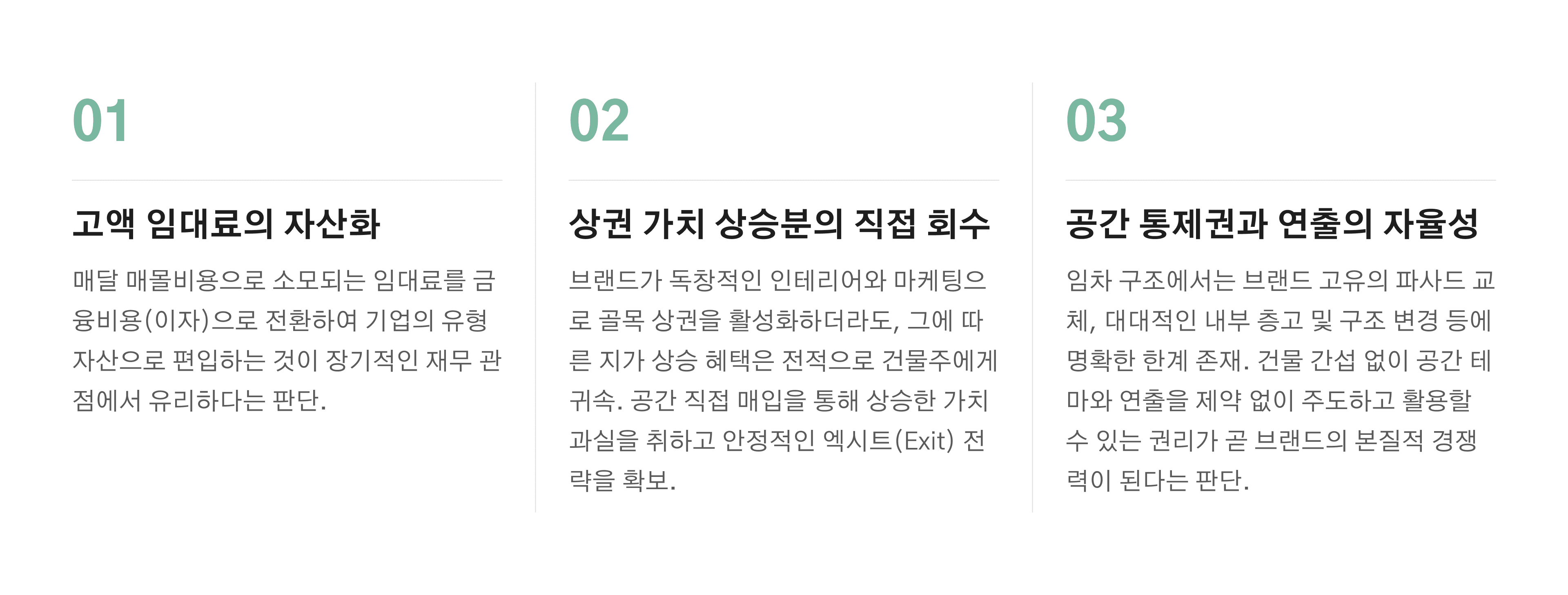
First, the 'assetization' of high monthly rents. Rents on the first floor of core commercial districts in Seoul exceed 1 million won per pyeong. Considering the costs wasted as rent every month, they judge that it is more advantageous in the long run to bear financial costs and incorporate it as an asset with those funds.
Second, direct recovery of commercial district value appreciation. Even if a brand revitalizes an alley by investing massive interior costs and marketing, the increase in land value belongs to the landlord. Instead of rent increases or eviction risks at the time of lease expiration, they choose acquisition to directly reap the fruits of value appreciation and prepare an exit strategy through future sales.
Third, control over space and autonomy in presentation. Replacing the facade and changing the ceiling height and internal structure to fit the brand identity have clear limitations under a tenant structure. In a situation where the offline space itself has become a major means of conveying the brand message, the right to use the space without restrictions becomes practical competitiveness.
Along with this, diversification of acquisition methods is also appearing. In addition to corporate entities directly acquiring assets, a structure is utilized where a founder or CEO personally buys a building and then places their own brand in it. This is a method that simultaneously satisfies securing a stable long-term stronghold for the corporation and building an asset portfolio on a personal level.
However, acquisition is not the right answer for every brand. If it is a category with rapid trend changes, it is more effective to keep assets light and move to the next commercial district rather than tying up capital. Acquisition versus leasing is not a matter of superiority, but of strategic choice according to a brand's financial power and stage of growth.
What to Buy — The Ideal of '1st Floor Retail + Upper Floor Office' and Realities by Commercial District
The ideal acquisition model considered by brands is to secure an entire building, opening the 1st and lower floors as flagship stores and showrooms, and filling the upper floors with headquarters offices or design studios to integrate their main base.
However, physical and price limitations by commercial district are revealed in the process of executing this structure.
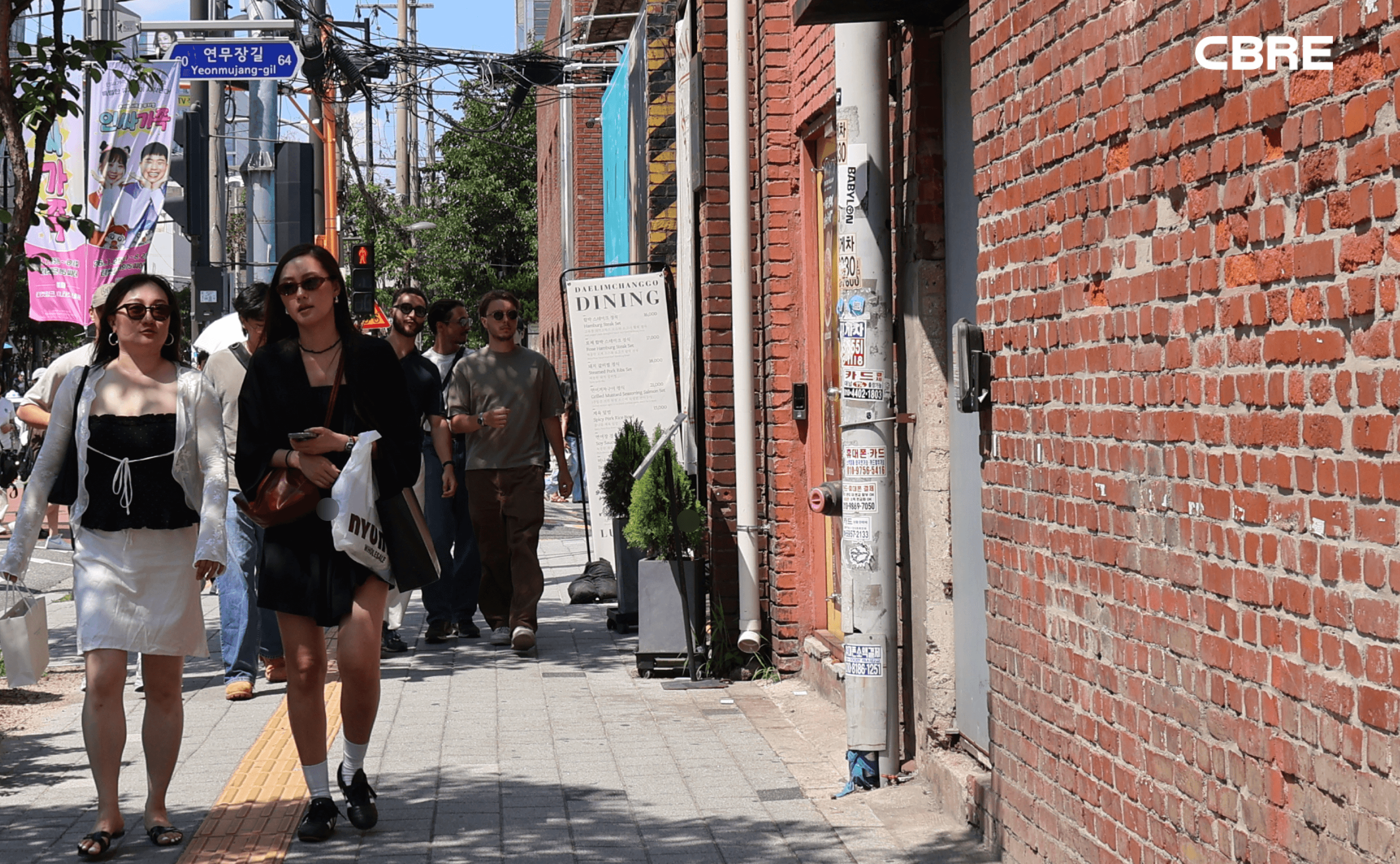
Seongsu, always crowded with people
Seongsu and Dosan have the physical conditions to operate entire buildings, but because the price per pyeong of land is high, the barrier to entry is high for all but a few companies with large capital. On the other hand, Bukchon or Seochon are relatively accessible in terms of unit price, but lack gross floor area due to the narrow parcels characteristic of Hanoks and old, worn-down houses. Since there is no space to place upper-floor offices other than the 1st-floor showroom, overall acquisitions stop at small asset investments or limited showroom use rather than practical office use.

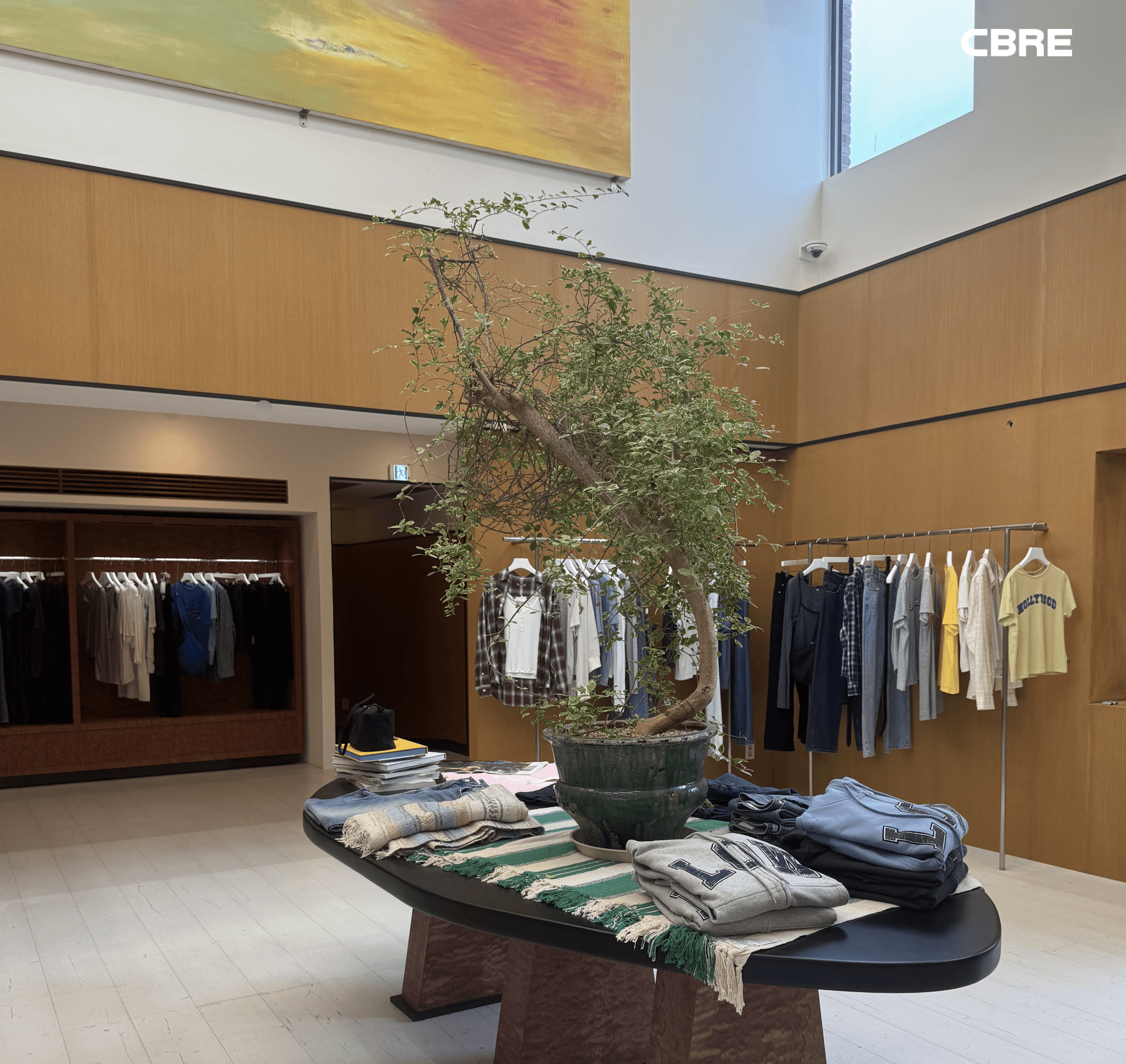
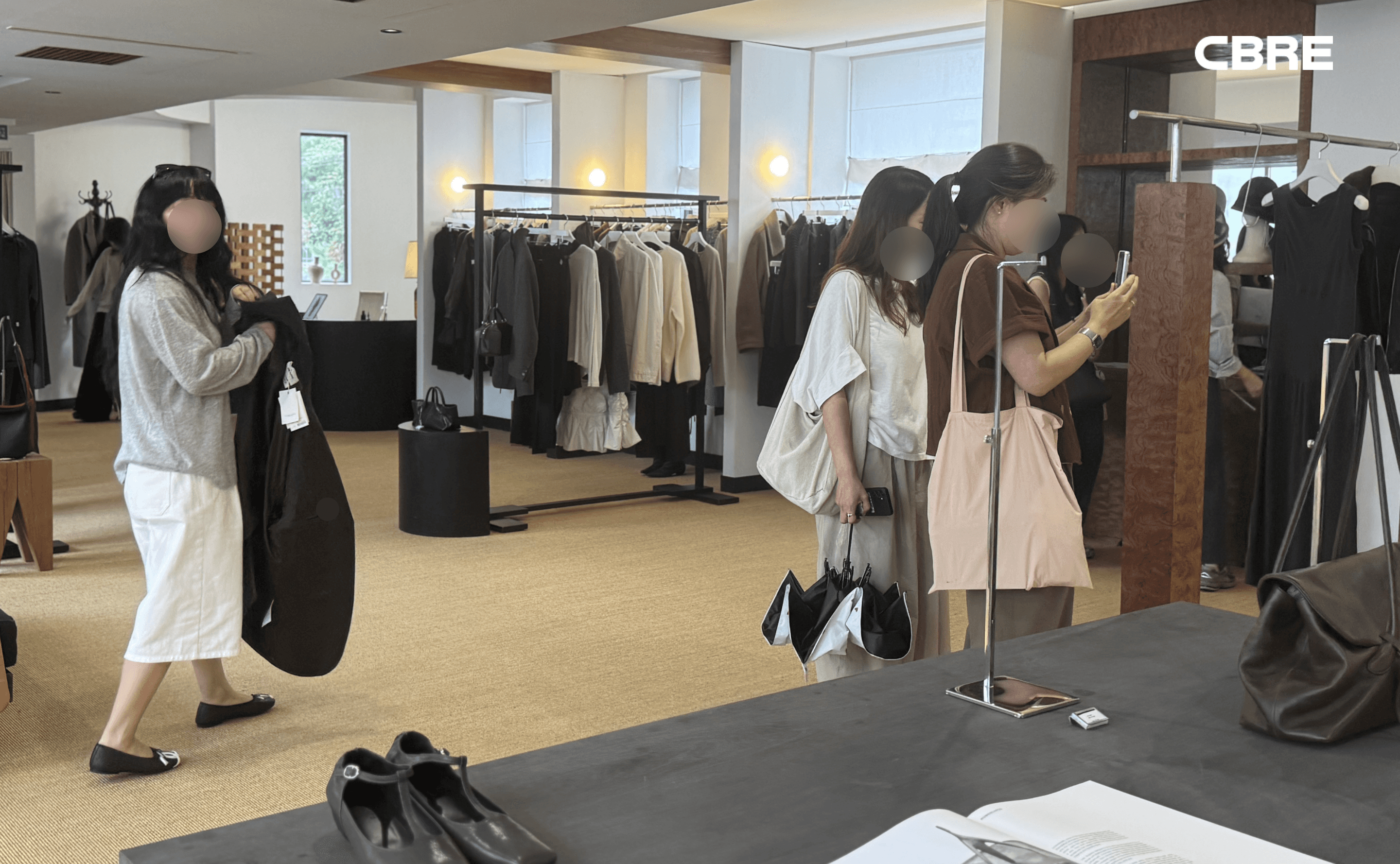
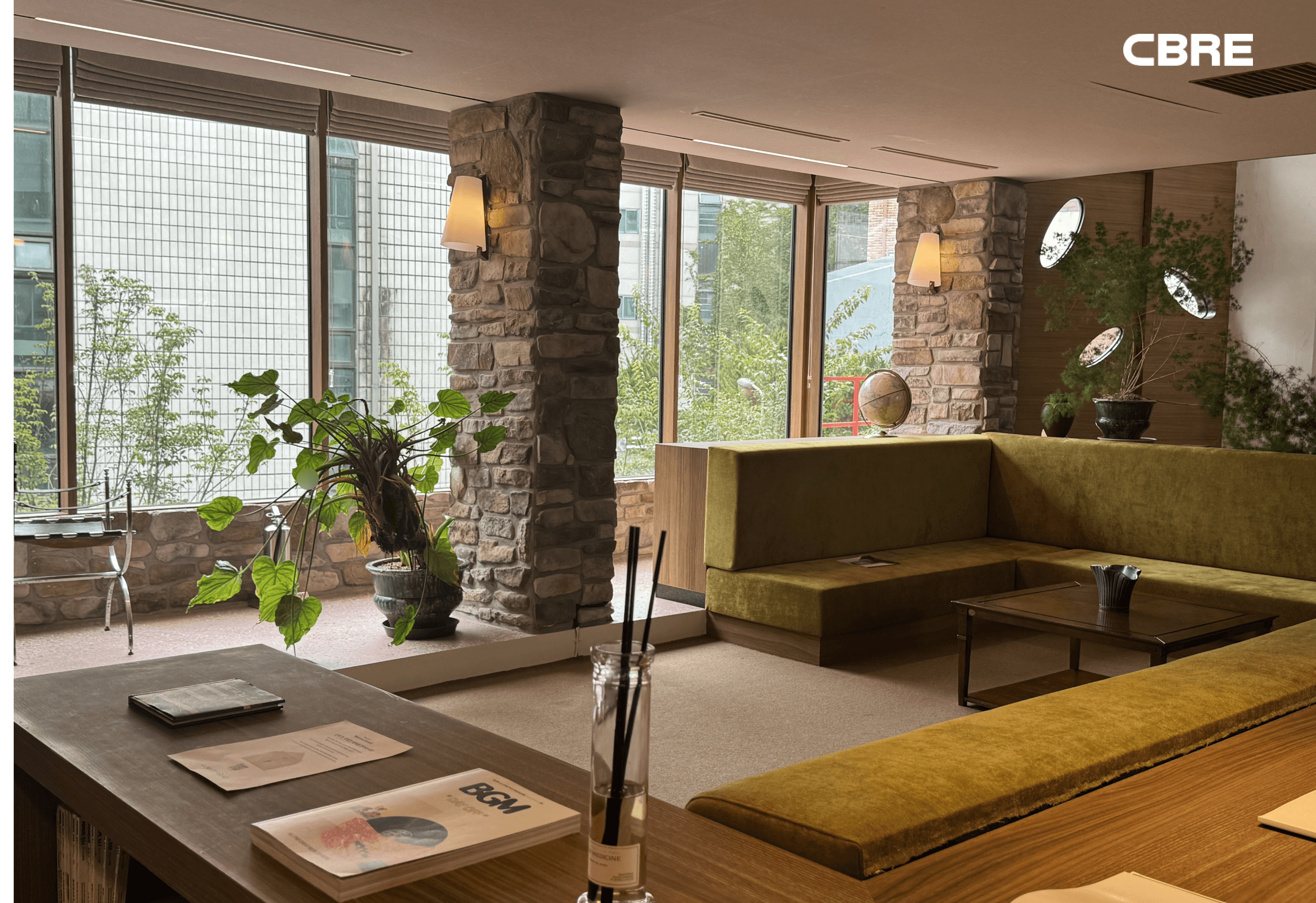
Low Classic flagship & office building located in Sindang. It is a complex stronghold configured to comprehensively experience Low Classic's identity by combining the brand's office, sample production workshop, and showroom into one.
This is why the Sindang and Yaksu areas have emerged as alternative strongholds for emerging fashion brands. Just as Low Classic bought an old residence building near Yaksu Station to integrate its 1st-floor retail and upper-floor design studio, Sindang and Yaksu provide effective building sizes to combine offices and shops at lower prices compared to Seongsu. Combined with the infrastructure of nearby sewing and pattern factories, they have adopted an office-complex model that completes everything from planning to production and retail in one building.
Re-reading Assets: Why Investors Must Also Look with 'Brand Eyes'
As brands emerge as 'subjects that directly buy assets' beyond tenants renting buildings, the calculations of people who develop and invest in buildings must also change.
The past development formula was simple. You would put up a neat new building, split it by floor, and receive the highest rent possible. However, in a market where brands want to buy buildings directly to use as office-cum-flagships, such standardized buildings are sometimes avoided. What brands actually need is not a tightly packed interior, but 'physical margins and spatial foundations' where they can freely paint their own colors.
The trend identified in Seongsu-dong is representative. The site where Dior garnered attention was originally an ordinary parking lot (vacant land), and the Seongsu-dong area also had many buildings worth tearing down and remodeling, such as auto repair shops, printing shops, and old red-brick factories. From a brand's perspective, rather than a completed, standardized building, such original spaces or vacant lands have become a much easier foundation to manage to unfold their concepts.
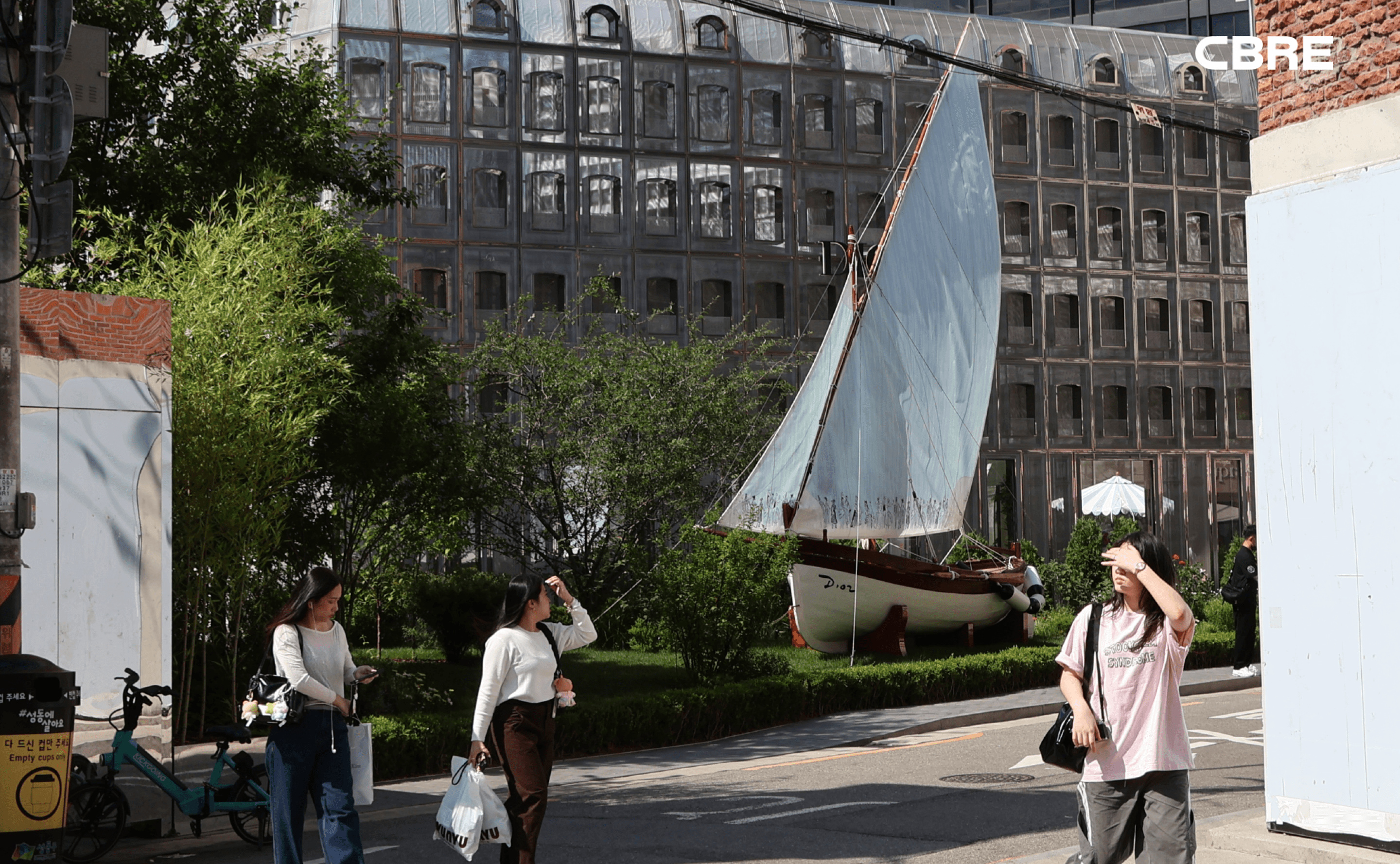
Dior, symbolic of Seongsu-dong
Of course, this does not mean that old houses or vacant lands unconditionally sell for more than new constructions. The key is that "now, investors or landlords must also look at assets with brands in mind as potential buyers and key end-users."
As pointed out earlier, what brands look at most importantly when reviewing direct acquisitions are ceiling height, freedom of facade presentation, and spatial flexibility to house both offices and shops together. Therefore, when pondering value-ups, rather than unconditionally upgrading finishing materials and thinking only about dividing and renting, it has become time to consider the question from the planning stage: "Which brand would see the foundation of this space and want to use or buy the whole thing?"
Expert's Insight
"It is clear that 'location' is the key criterion in retail real estate. Corporate and tenant demand preferring neatly constructed new buildings is still a major axis of the market. However, the eye levels of brands entering direct acquisitions recently are slightly different. We must also look at the fact that there is a clear demand group looking for buildings with spatial margins and potential where they can freely overlay the brand's colors, rather than the specifications of the completed building itself."
From Rented Channels to Owned Assets
The grammar of the Seoul retail market has evolved significantly.
Where (Location): Where is it located, preempting floating population and main commercial districts
Where & Who (Location and Target): Preempting main roads with high floating population and showing it to whom
What & How (Content and Experience): With what products (MD) and space will we make them experience the brand's worldview
Whose (Sovereignty of Space and Asset): Who will seize the ownership and initiative of that space, going beyond soaring rents and external volatility

There is a familiar paradox in the commercial real estate market. When a restaurant with long lines boosts a commercial area, rents soar, and eventually, the replica store that takes over the spot of the evicted original shop closes down before long, leading to the commercial area itself losing vitality. It is a stark example showing that even if the physical conditions of a space are the same, the fate of the asset changes completely depending on who breathes life into it.
This is also the essential reason why brands have recently pulled out the card of 'ownership'. On a rented stage, one can be kicked out at any time or have the texture of the brand damaged, but a brand that directly owns the stage can accumulate its worldview in the space with a long breath without worrying about being kicked out, and fully recover the asset value.
Of course, not all brands need to buy buildings. While a brand that chooses to lease keeps its assets light and moves quickly to the next commercial area in line with trend changes instead of bearing lease variation risks, a brand that chooses ownership takes on the weight of capital input in exchange for practical benefits such as independent branding and asset defense. It is a choice according to each other's stamina and strategy.
This also throws an important message to landlords and investors. Along with the method of attracting stable tenants with standardized new buildings, this is an era where one must first ponder: "Who should fill this space, and how, for the value of the asset to continue?"
In a flow where the calculations of those who occupy space and those who own it intersect, and retail goes beyond a simple sales channel to determine the value of assets, the subject that penetrates the life force of the brand and the potential of the space in a balanced way will seize the opportunity of the next commercial district.
© Copyright 2026. All rights reserved.
This publication has been prepared in good faith, based on CBRE Korea's current anecdotal and evidence based views of the commercial real estate market. Although CBRE Korea believes its views reflect market conditions on the date of this presentation, they are subject to significant uncertainties and contingencies, many of which are beyond CBRE Korea’s control. In addition, many of CBRE Korea’s views are opinion and/or projections based on CBRE Korea’s subjective analyses of current market circumstances. Other firms may have different opinions, projections and analyses, and actual market conditions in the future may cause CBRE Korea’s current views to later be incorrect. CBRE Korea has no obligation to update its views herein if its opinions, projections, analyses or market circumstances later change.
Nothing in this publication should be construed as an indicator of the future performance of CBRE’s securities or of the performance of any other company’s securities. You should not purchase or sell securities-of CBRE or any other company-based on the views herein. CBRE Korea disclaims all liability for securities purchased or sold based on information herein, and by viewing this publication, you waive all claims against CBRE Korea as well as against CBRE Korea’s affiliates, officers, directors, employees, agents, advisers and representatives arising out of the accuracy, completeness, adequacy or your use of the information herein. No part of this publication may be reproduced, quoted, distributed, or disclosed to any third party without the prior written consent of CBRE Korea.

market
Oct 6, 2026
The laws that move the high street, which even small-scale building investors should know
The era of landlords who only collected rent is over
market
Aug 18, 2026
K-Brand US Market Entry Strategy
NY vs. LA Commercial District Comparison and Retail Success Formula

market
Aug 3, 2026
The Busan Commercial District Transformed by Foreigners
The shifting consumer landscape shaped by a wave of 3.64 million people
market
May 26, 2026
2026 Retail Market Insights from the Head of CBRE Korea Retail
From Seoul to the globe, the variable determining the success or failure of retail spaces is shifting from 'where' to 'how'.

market
Apr 13, 2026
It starts with data and is completed in the field
The Essence of the 2026 Retail Market, According to CBRE's Head of Research
market
Apr 13, 2026
The End of Strata Retail?
Supply is down on paper. Vacancies are up on the ground. The hidden oversupply and structural flaw behind Korea's pre-sale retail crisis.
market
Apr 13, 2026
Two Years Locked in Permits
The real cost of overseas retail expansion without a project management framework — why permit risk has to be resolved before the lease is signed.
market
Apr 13, 2026
From Supporting Role to Lead: Office Retail
From basement canteen to asset value driver — fifteen years of structural change in Seoul's office building retail, from Centre One to Olive Young N Seongsu.

market
Apr 13, 2026
Why Gut Instinct Kills Your Flagship Store
Thirty-one retail real estate practitioners rank what actually determines flagship store performance.

market
Apr 13, 2026
Know Anyone Good to Set Me Up With?
How leasing decisions are actually made in Seoul's most competitive retail districts — and why the broker in the middle determines the outcome.
market
Apr 13, 2026
New Era, New Areas
Korean brands are going global. The ones that make it understand one thing first: overseas leasing is a credit game, not a rent game.
market
Apr 13, 2026
It's Not That They're Not Spending
Why foreign visitor spending data is replacing card transactions as the next frontier in retail intelligence.
market
Apr 13, 2026
You are so Beauti-cal
Dermatology clinics are now the most sought-after anchor tenants on Gangnam street
market
Apr 13, 2026
Reading a Brand's DNA Before They Do
The retail MD practitioner's job is translation — turning a brand's qualitative language into measurable spatial conditions. What that looks like in practice.